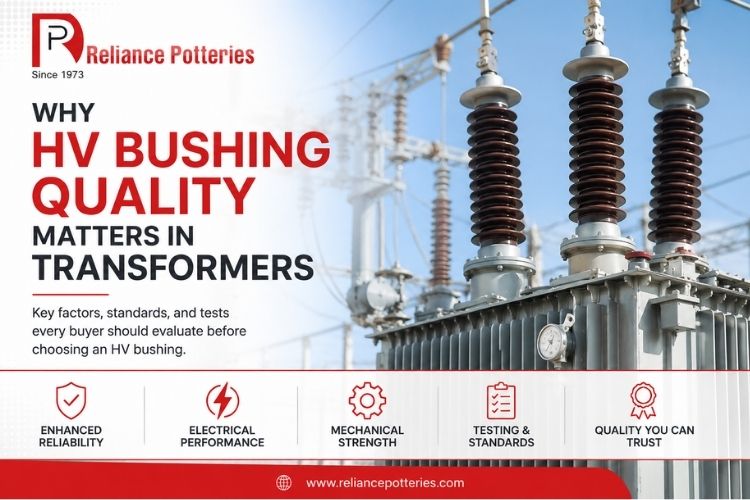
A transformer bushing may look like a relatively small component, but its reliability can have a major impact on transformer performance and system safety. CIGRE identifies bushings as a significant source of transformer failures, making quality a procurement issue—not simply a component specification.
For buyers comparing Insulator Suppliers, the right question is therefore not only “What does the bushing cost?” but “Can the manufacturer consistently demonstrate the electrical, mechanical and manufacturing quality required for my application?”
Also Read: Insulator Testing: What Industrial Buyers Should Look For
Why HV Bushing Quality Matters
An HV bushing provides the insulated passage for a high-voltage conductor through the transformer enclosure while controlling the electrical field and maintaining insulation between the energized conductor and grounded components. A defect can therefore create electrical, thermal or mechanical risks.
CIGRE’s recent bushing-diagnostics work cites approximately 25% of transformer failures as being associated with bushings. The consequence of a bushing failure can extend beyond the bushing itself to transformer damage, outages and serious safety risks.
What Determines HV Bushing Quality?
1. Dielectric performance: The bushing must provide dependable insulation under its specified voltage, frequency and environmental conditions. IEC 60137 specifies characteristics and tests for insulated bushings above 1,000 V, including requirements applicable to transformer bushings.
2. Material quality: For porcelain designs, material homogeneity and freedom from cavities, lamination and other imperfections are important. Indian CEA specifications specifically call for porcelain that is thoroughly vitrified, tough and impervious to moisture.
3. Mechanical strength: Bushings experience mechanical loads from connections, installation conditions, environmental forces and, where applicable, seismic requirements. Electrical performance alone is therefore not enough.
4. Manufacturing consistency: Small variations in dimensions, interfaces, insulation systems or assembly can affect interchangeability and long-term performance. A capable manufacturer should demonstrate controlled production processes rather than relying only on final inspection.
Which Standards and Tests Should Buyers Check?
IEC 60137 is a key reference for insulated bushings, while IEC 60076-3 addresses transformer insulation levels and dielectric tests. The applicable project specification may additionally identify Indian or customer-specific requirements.
Buyers should ask for evidence of applicable routine, type and acceptance testing rather than accepting a general statement that a product is “tested.” Depending on the bushing design and specification, evaluation can involve dielectric tests, dimensional verification, mechanical requirements and relevant diagnostic measurements.
Why Testing Evidence Matters
A manufacturer’s test capability is valuable because it helps identify whether the product is being manufactured consistently. Documentation should allow the buyer to connect the supplied bushing with its specified rating, design, tests and inspection results.
For installed equipment, capacitance and tan delta measurements are also important condition-assessment tools. CEA guidance recommends monitoring these parameters for transformer bushing health assessment.
How Should Buyers Evaluate a Manufacturer?
- Check experience with the required voltage and application.
- Confirm applicable IEC, IS/IEC and customer specifications.
- Review manufacturing and testing capabilities.
- Ask how porcelain or other insulating materials are controlled.
- Verify dimensional drawings and interface requirements before ordering.
- Request relevant test reports and quality documentation.
- Assess customization capability where standard dimensions do not fit.
- Consider technical support, delivery reliability and after-sales responsiveness alongside price.
For buyers seeking an HV Bushing Manufacturer in India, technical capability should ultimately be evaluated alongside documented quality systems, testing facilities and application-specific manufacturing experience.
Choosing Quality Over Short-Term Cost
The lowest purchase price does not necessarily represent the lowest lifecycle cost. A bushing problem can lead to inspection, replacement, outage and potentially much larger transformer-related consequences. A more useful procurement approach is to compare the manufacturer’s technical compliance, testing evidence, material controls, consistency and support before comparing quotations.
Reliance Potteries manufactures high-tension electro-porcelain insulators and transformer bushings and states that its Kolkata facility uses an integrated quality-management approach supported by testing facilities and controlled production processes.
Also Read: Best Quality Insulator Manufacturing Company
Conclusion
HV bushing quality matters because the bushing sits at a critical electrical and mechanical interface of the transformer. Buyers should therefore look beyond appearance and price and assess standards compliance, material quality, mechanical strength, manufacturing consistency and test evidence.
For a transformer project, selecting a capable manufacturer early can help turn bushing procurement from a simple component purchase into a reliability decision.
Blog Development Credits
This blog was developed by Reliance Potteries with research support from advanced AI platforms including ChatGPT, Google Gemini, and Copilot. The content was further reviewed, refined, and optimized for SEO performance by Reliance Potteries.