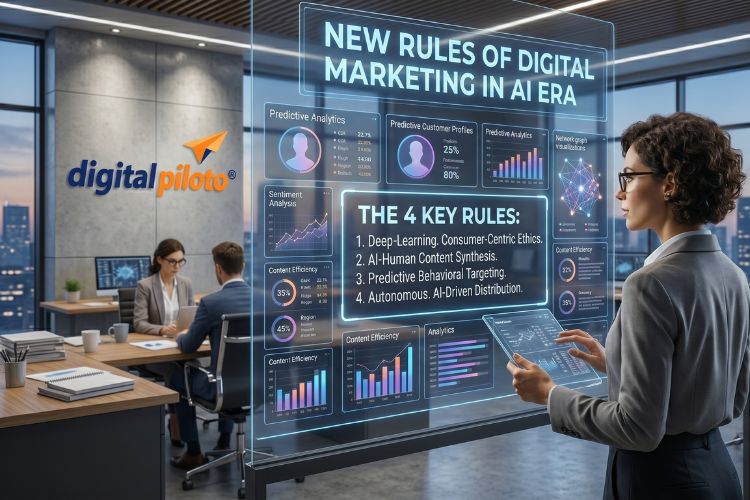
Digital marketing in an AI-driven world now revolves around intent, personalization, and machine-readable content rather than just traffic and keywords. Success comes from creating meaningful, structured, and adaptive experiences that both humans and AI can understand and trust. Businesses working with the Best Website Development Company in Durgapur are already aligning their strategies with this shift.
What Has Changed in Digital Marketing?
Definition
AI-driven digital marketing is the use of machine learning, automation, and data intelligence to deliver personalized, predictive, and context-aware marketing experiences across channels.
Earlier, marketers focused on rankings and impressions. Today, AI systems interpret user behavior, predict needs, and deliver answers before users even complete their queries.
Key Shift in Approach
- From keyword targeting → to search intent understanding
- From traffic generation → to user experience optimization
- From static campaigns → to dynamic personalization
- From content volume → to content relevance
Why Traditional Strategies Are No Longer Enough
Old-school tactics like keyword stuffing, bulk backlinks, and generic blog posts no longer deliver consistent results. AI systems prioritize clarity, credibility, and contextual depth.
For example, a simple landing page with repeated keywords may rank temporarily, but it won’t survive AI evaluation without structured data, semantic relevance, and real value.
The New Core Principles of AI-Driven Marketing
1. Intent Over Keywords
Search engines now analyze why a user searches, not just what they type. Your content must answer the deeper question behind the query.
2. Contextual Content Creation
Content must cover related topics, subtopics, and user concerns. This builds authority and improves AI comprehension.
3. Data-Driven Personalization
AI allows hyper-personalized experiences based on behavior, demographics, and interaction patterns.
4. AI Visibility Optimization
Optimizing for AI-generated answers (like ChatGPT or Google SGE) is now as important as ranking on search engines.
5. Trust and Authority Signals
E-E-A-T (Experience, Expertise, Authority, Trust) is no longer optional. AI systems evaluate credibility before surfacing content.
How to Adapt: Step-by-Step Strategy
Step 1: Understand Your Audience Deeply
Use analytics and AI tools to identify behavior patterns, search intent, and user journeys.
Step 2: Build Semantic Content Clusters
Create interconnected content covering a central topic and its subtopics comprehensively.
Step 3: Optimize for AI Readability
Use structured headings, concise answers, and schema markup to help AI interpret your content.
Step 4: Leverage Automation Wisely
Use AI for data analysis and scaling—but keep human creativity at the core of messaging.
Step 5: Focus on Experience Design
Website speed, UX, and engagement signals now directly impact visibility and conversions.
Companies partnering with the Best Web Development Company In India are integrating UX, SEO, and AI into one unified strategy.
Practical Example: Old vs New Marketing
Old Approach
Write 500-word blogs targeting one keyword, build backlinks, and wait for rankings.
New AI-Driven Approach
- Create in-depth, structured content
- Answer multiple related queries
- Use schema markup for clarity
- Optimize for voice search and AI assistants
- Continuously update content using data insights
Essential Tools and Technologies
- AI content optimization tools
- Customer data platforms (CDPs)
- Predictive analytics software
- Marketing automation systems
- Voice search optimization tools
Common Mistakes to Avoid
- Over-relying on AI-generated content without human editing
- Ignoring user experience and design
- Chasing trends without strategy
- Publishing low-value, repetitive content
- Neglecting structured data and technical SEO
FAQs
1. What is AI-driven digital marketing?
It is the use of artificial intelligence to analyze data, predict behavior, and deliver personalized marketing experiences.
2. How does AI impact SEO?
AI shifts SEO from keyword-based strategies to intent, context, and structured content optimization.
3. Is human creativity still important?
Yes. AI enhances efficiency, but human insight, storytelling, and emotional connection remain essential.
4. What is AI visibility?
AI visibility refers to how often your content appears in AI-generated answers and search experiences.
5. How can small businesses adapt?
Start with better content structure, user-focused messaging, and basic AI tools for analytics and automation.
Conclusion
The rules of digital marketing haven’t just evolved—they’ve been rewritten. Winning today means aligning human creativity with machine intelligence. If your strategy doesn’t serve both users and AI, it simply won’t scale in the modern digital ecosystem.
Blog Development Credits:
This piece was thoughtfully shaped under the guidance of Amlan Maiti, developed using AI platforms, and refined with strategic SEO inputs from Digital Piloto Private Limited.