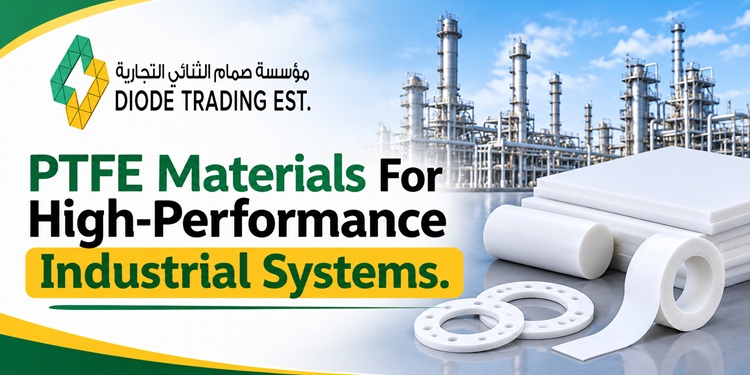
Modern industrial systems require materials that can withstand demanding operating conditions, including high temperatures, aggressive chemicals, continuous friction and mechanical pressure. PTFE (Polytetrafluoroethylene), commonly known as Teflon, is widely used in industrial applications because of its excellent chemical resistance, low friction, thermal stability and electrical insulation properties. Businesses looking for reliable PTFE Sheets Rods Tubes Supplier Saudi Arabia can explore different material grades and product forms to meet specific engineering requirements.
From oil and gas facilities to chemical processing plants, PTFE materials help improve equipment reliability and support efficient industrial operations. Selecting the appropriate PTFE grade, shape and specification is essential for achieving consistent performance and long-term value.
What Makes PTFE Materials Suitable for Industrial Applications?
PTFE is a high-performance fluoropolymer manufactured from tetrafluoroethylene. Its molecular structure provides excellent resistance to many chemicals, moisture and environmental conditions. It also offers a naturally low-friction surface, making it suitable for components exposed to sliding movement and repeated mechanical contact.
One of its important advantages is its broad operating temperature capability. Many industrial PTFE grades are suitable for temperatures ranging approximately from -200°C to +260°C, although the actual operating limit depends on the grade, pressure, mechanical load and application design.
Other important properties include:
- Chemical resistance: Resists many industrial acids, alkalis, solvents and corrosive substances.
- Low friction: Supports smooth movement in bearings, seals and sliding components.
- Thermal stability: Maintains useful properties across a wide temperature range.
- Electrical insulation: Offers excellent dielectric properties for electrical applications.
- Moisture resistance: Absorbs very little water, supporting performance in humid environments.
- Non-stick characteristics: Helps prevent unwanted material accumulation on component surfaces.
Different Forms of PTFE Materials Used in Industry
PTFE is available in several shapes and product forms to accommodate different manufacturing and engineering requirements. Choosing the correct form depends on component dimensions, operating conditions and fabrication needs.
1. PTFE Sheets
PTFE sheets are commonly used for industrial gaskets, insulation components, chemical-resistant linings and sealing applications. They can be cut, shaped or machined according to project specifications. Their chemical resistance makes them particularly useful in equipment exposed to aggressive process fluids.
2. PTFE Rods
PTFE rods are suitable for manufacturing precision-engineered components such as valve seats, bushes, bearings, seals and wear-resistant parts. They can be machined into different shapes and dimensions to meet specific equipment requirements.
3. PTFE Tubes
PTFE tubes are used in fluid handling, chemical transfer, laboratory equipment and specialised industrial systems. Their resistance to many chemicals and smooth internal surfaces make them useful where material compatibility and reliable fluid movement are important.
Virgin PTFE vs Filled PTFE Materials
Virgin and filled PTFE materials serve different engineering purposes. Virgin PTFE provides excellent chemical resistance and electrical insulation, whereas filled PTFE incorporates additional materials to improve mechanical strength, dimensional stability and wear performance.
- Virgin PTFE: Suitable for chemical-resistant gaskets, insulation components and general sealing applications.
- Glass-filled PTFE: Offers improved compressive strength and wear resistance for mechanical components.
- Carbon-filled PTFE: Provides improved wear characteristics and electrical conductivity compared with virgin PTFE.
- Bronze-filled PTFE: Offers enhanced load-bearing and wear properties for selected bearings and bushes.
- Graphite-filled PTFE: Can improve friction and wear performance in suitable sliding applications.
The correct filler depends on operating pressure, sliding speed, temperature, chemical exposure and mating surface conditions. Filled materials should not automatically replace virgin PTFE because some fillers can affect chemical compatibility and electrical insulation.
Industrial Applications of PTFE Materials
Oil and Gas Industry
The oil and gas industry uses PTFE components in valves, pumps, seals, gaskets and specialised equipment. Their resistance to many hydrocarbons and industrial chemicals makes them useful in demanding operating environments.
For companies seeking PTFE for Oil and Gas Saudi Arabia, material selection should consider fluid compatibility, pressure ratings, temperature exposure and applicable industry requirements. The correct PTFE grade can support dependable sealing and reduce premature component wear.
Chemical and Petrochemical Processing
Chemical processing equipment frequently handles aggressive substances that may damage conventional materials. PTFE sheets, tubes, gaskets and machined components provide useful solutions for chemical-resistant sealing, fluid transfer and equipment lining.
Automotive and Mechanical Engineering
PTFE is used in selected automotive and mechanical applications, including bushes, bearings, sliding elements and seals. Its low-friction characteristics help reduce resistance between moving surfaces and support smooth equipment operation.
Electrical and Electronics Industry
Because of its excellent electrical insulation properties, PTFE is used in specialised wire insulation, cable components, electrical connectors and insulating parts. Its thermal stability also makes it suitable for applications involving changing operating temperatures.
Important Factors When Selecting PTFE Materials
Choosing PTFE materials requires more than checking their dimensions and price. Engineers and procurement professionals should evaluate the complete operating environment before selecting a product.
- Operating temperature: Confirm the material’s continuous and intermittent temperature limits.
- Pressure conditions: Evaluate compression, deformation and creep under sustained loading.
- Chemical compatibility: Verify compatibility with the actual process fluid, concentration and operating temperature.
- Mechanical requirements: Consider wear resistance, strength, dimensional stability and load capacity.
- Product dimensions: Specify sheet thickness, rod diameter, tube inner and outer diameters, and required lengths.
- Quality documentation: Request appropriate material certificates, technical data sheets and test documentation.
Understanding PTFE Limitations in Industrial Systems
Although PTFE offers several performance advantages, it is not suitable for every industrial application. Virgin PTFE can experience creep or cold flow when subjected to continuous mechanical pressure. It also has relatively low stiffness and can wear under demanding sliding conditions.
Filled PTFE grades can address some of these limitations by improving wear resistance and mechanical performance. However, engineers must also consider the effect of fillers on chemical resistance, friction and electrical properties.
Additionally, PTFE is not compatible with every chemical under every condition. Highly reactive substances, certain molten alkali metals and fluorinating agents require specific compatibility assessment. Proper engineering evaluation is therefore essential before installation.
How Quality PTFE Materials Support Industrial Performance?
Reliable PTFE materials contribute to equipment performance by supporting effective sealing, reducing friction and resisting chemical degradation. Selecting suitable grades can also help minimise premature component replacement and unplanned maintenance.
Diode Trading EST provides industrial PTFE product solutions, including sheets, rods, tubes, gaskets and specialised components for demanding applications. Its product range supports different engineering and procurement requirements across industrial sectors.
For businesses sourcing engineering plastics, comparing product specifications, material grades and documentation before purchasing helps ensure that the selected solution meets project requirements.
Frequently Asked Questions (FAQs)
1. What are PTFE materials commonly used for?
PTFE materials are commonly used for industrial gaskets, seals, bearings, valve components, chemical-resistant linings, insulation parts and fluid-handling equipment. Their chemical resistance and low-friction properties make them useful across several industries.
2. What is the difference between virgin PTFE and filled PTFE?
Virgin PTFE contains no reinforcing filler and provides excellent chemical resistance and electrical insulation. Filled PTFE contains additives such as glass, carbon or bronze to improve selected mechanical and wear properties.
3. Can PTFE materials withstand high temperatures?
Many standard PTFE grades can operate at temperatures up to approximately 260°C under suitable conditions. However, the actual temperature limit depends on the material grade, mechanical load and application requirements.
4. Are PTFE sheets and rods suitable for chemical processing?
Yes. PTFE sheets and rods are commonly used to manufacture chemical-resistant gaskets, seals, linings and equipment components. Compatibility should always be checked against the actual chemicals and operating conditions.
5. Why is PTFE used in oil and gas applications?
PTFE is used in oil and gas systems because it resists many hydrocarbons and chemicals, offers low friction and supports reliable sealing in appropriately designed components.
6. How can I select the right PTFE grade for industrial applications?
Consider chemical exposure, operating temperature, pressure, mechanical loading, wear requirements and electrical properties. Consult technical data sheets and material suppliers to identify the appropriate grade.
Final Thoughts
PTFE materials play an important role in modern industrial systems by providing excellent chemical resistance, low friction, thermal stability and reliable insulation properties. From oil and gas operations to chemical processing and mechanical engineering, their versatility makes them valuable for manufacturing dependable industrial components.
However, selecting the correct PTFE grade is essential for achieving the desired performance. Understanding the differences between virgin and filled PTFE, evaluating operating conditions and checking material specifications can help businesses make informed purchasing decisions.
Diode Trading EST offers a range of PTFE sheets, rods, tubes and industrial components to support diverse engineering requirements. Explore its PTFE product range to identify suitable material solutions for your industrial applications and project needs.
Full Audio Version:- Click Here