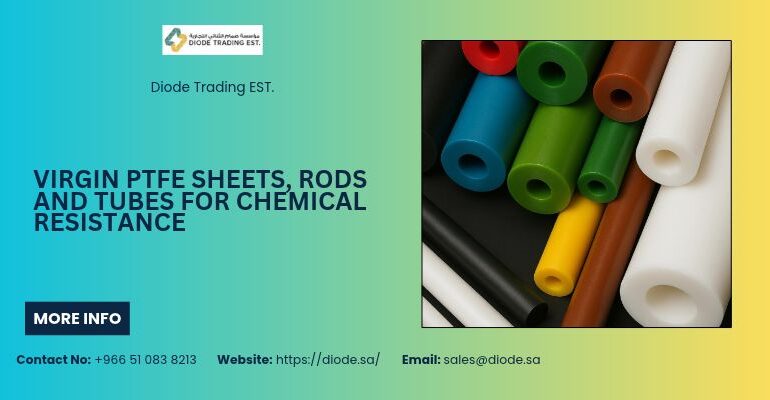
Industrial environments often expose equipment to aggressive chemicals, high temperatures, moisture and demanding operating conditions. Selecting suitable materials is essential for maintaining equipment reliability and reducing unexpected maintenance. Virgin PTFE (Polytetrafluoroethylene) is widely preferred for industrial applications because of its outstanding chemical resistance, low friction and thermal stability. Businesses looking for Virgin PTFE Sheets Rods Tubes Saudi Arabia can explore material solutions designed for chemical processing, petrochemical facilities, manufacturing and other demanding industries.
What Makes Virgin PTFE Suitable for Chemical Resistance?
Virgin PTFE is an unfilled fluoropolymer manufactured without reinforcing additives such as glass fibre, carbon or bronze. Its molecular structure provides excellent resistance to most industrial chemicals, making it suitable for applications where conventional plastics and metals may experience chemical degradation.
One of its biggest advantages is its ability to maintain material stability when exposed to many acids, alkalis, solvents and corrosive substances. It also offers excellent electrical insulation, a non-stick surface and low moisture absorption.
Virgin PTFE typically supports service temperatures ranging from approximately -200°C to +260°C, depending on the grade and operating conditions. However, chemical compatibility, mechanical loading and manufacturer specifications must always be considered before selecting the material.
Important Applications of Virgin PTFE Sheets, Rods and Tubes
Virgin PTFE is available in different forms to accommodate various industrial requirements. Each product format offers specific fabrication and application advantages.
1. Virgin PTFE Sheets for Gaskets and Industrial Linings
PTFE sheets are commonly used to manufacture chemical-resistant gaskets, insulation components, protective linings and sealing elements. Their chemical stability makes them suitable for equipment exposed to aggressive processing fluids.
Industrial manufacturers can cut and machine PTFE sheets into specific shapes and dimensions according to equipment requirements. They are particularly useful in chemical plants, pharmaceutical facilities and petrochemical installations.
2. Virgin PTFE Rods for Precision-Machined Components
PTFE rods provide a convenient starting material for manufacturing custom industrial components. They can be machined into valve seats, bushes, seals, spacers, bearing elements and other precision-engineered parts.
Their low-friction characteristics support smooth movement in mechanical assemblies. Their chemical resistance also makes them useful in equipment where conventional materials may deteriorate through repeated exposure to processing chemicals.
3. Virgin PTFE Tubes for Chemical Transfer Applications
PTFE tubes are suitable for applications requiring chemical-resistant internal surfaces and reliable fluid handling. They are used in selected chemical transfer systems, laboratory equipment, instrumentation and industrial processing assemblies.
Before installation, engineers should evaluate pressure ratings, wall thickness, temperature, chemical compatibility and connection requirements to ensure safe operation.
Why Chemical Industries Prefer Virgin PTFE
Material selection directly influences equipment performance, operational efficiency and maintenance requirements. Virgin PTFE offers several useful advantages for chemical-intensive environments.
- Excellent chemical resistance: It withstands exposure to a wide range of acids, alkalis, solvents and industrial chemicals.
- Low friction: Its naturally slippery surface supports smooth movement in sliding and mechanical components.
- Thermal stability: It performs across a broad temperature range when used within appropriate operating limits.
- Electrical insulation: Its dielectric properties make it suitable for electrical insulation applications.
- Non-stick characteristics: Its low surface energy helps reduce material adhesion and simplifies cleaning.
- Low moisture absorption: It maintains useful dimensional and electrical properties in many humid environments.
However, PTFE is not suitable for every operating condition. Molten alkali metals and elemental fluorine under certain conditions can attack fluoropolymers. Furthermore, PTFE can experience cold flow or creep under sustained mechanical loading. These limitations should be considered during engineering evaluation.
Virgin PTFE vs Filled PTFE: Which Is Better?
Although virgin PTFE offers excellent chemical resistance, filled PTFE grades may provide improved mechanical performance in applications involving higher loads, friction and wear.
- Virgin PTFE: Best suited to applications prioritising chemical purity, broad chemical resistance and electrical insulation.
- Glass-filled PTFE: Offers improved stiffness, compressive strength and wear performance for selected mechanical applications.
- Carbon-filled PTFE: Provides improved dimensional stability and wear characteristics in demanding components.
- Bronze-filled PTFE: Commonly selected for certain bearings, bushes and applications requiring improved wear resistance.
The correct selection depends on the chemical environment, mechanical load, temperature and expected service life. Filled grades should not automatically replace virgin PTFE where chemical compatibility or material purity is the primary requirement.
How to Select the Right PTFE Material for Industrial Applications
Choosing the correct PTFE product requires more than comparing dimensions and prices. Industrial buyers should evaluate the complete operating environment before placing an order.
- Identify chemical exposure: Determine the exact chemicals, concentrations, mixtures and potential contamination risks.
- Evaluate operating temperature: Check continuous and intermittent temperatures against the material manufacturer’s specifications.
- Assess mechanical loading: Consider pressure, compression, friction and sustained loads that may cause deformation.
- Select the correct product form: Choose sheets for gaskets and linings, rods for machined components and tubes for suitable fluid-handling applications.
- Verify material documentation: Request technical datasheets, grade identification and applicable material certificates.
- Check fabrication requirements: Confirm the dimensions, tolerances, machining requirements and installation conditions.
Virgin PTFE for Oil, Gas and Petrochemical Industries
Oil and gas facilities require engineering materials that can withstand demanding operating environments. PTFE components are used in selected sealing systems, valve assemblies, pump components, insulation applications and chemical processing equipment.
For companies sourcing PTFE for Oil and Gas Saudi Arabia selecting the correct grade is important for maintaining equipment reliability. Chemical compatibility, operating pressure, temperature fluctuations and mechanical stresses should all be evaluated before choosing a product.
Diode Trading EST offers PTFE product solutions, including sheets, rods, tubes and other industrial components, supporting different engineering and manufacturing requirements. Buyers can explore available product options and discuss their specific application requirements with the supplier.
Why Choose a Reliable PTFE Supplier?
Working with a dependable industrial materials supplier helps businesses identify suitable products for their technical requirements. Product consistency, correct grade identification, dimensional availability and supporting documentation are important considerations when purchasing engineering plastics.
Diode Trading EST focuses on industrial trading and contract services, supplying engineering materials and industrial solutions for different sectors. Its PTFE product portfolio supports applications involving chemical processing, oil and gas, mechanical engineering and industrial manufacturing.
Before finalising an order, buyers should communicate their required dimensions, operating conditions, application details and documentation expectations. This helps ensure that the selected material is appropriate for the intended use.
Frequently Asked Questions (FAQs)
1. What is virgin PTFE material?
Virgin PTFE is pure, unfilled polytetrafluoroethylene manufactured without reinforcing additives. It offers excellent chemical resistance, low friction, electrical insulation and thermal stability for industrial applications.
2. Are virgin PTFE sheets resistant to acids and chemicals?
Yes. Virgin PTFE resists most industrial acids, alkalis and solvents. However, compatibility should be verified against the exact chemical, concentration, temperature and operating conditions.
3. What are virgin PTFE rods commonly used for?
Virgin PTFE rods are commonly machined into valve seats, bushes, seals, spacers, insulating components and other precision-engineered industrial parts.
4. Can PTFE tubes be used in chemical processing?
Yes. PTFE tubes are used in selected chemical transfer and processing applications because of their chemical resistance. Pressure, temperature, wall thickness and connection requirements must be checked before installation.
5. What is the difference between virgin and filled PTFE?
Virgin PTFE contains no reinforcing fillers and prioritises chemical resistance and material purity. Filled PTFE incorporates materials such as glass, carbon or bronze to improve selected mechanical and wear properties.
6. How do I select the right PTFE grade for my industry?
Consider chemical exposure, temperature, pressure, mechanical loading, friction and application requirements. Reviewing technical datasheets and consulting a knowledgeable supplier can help identify an appropriate grade.
7. Where can I source Virgin PTFE Sheets Rods Tubes Saudi Arabia?
Diode Trading EST supplies PTFE sheets, rods, tubes and other industrial PTFE products in Saudi Arabia. Buyers can contact the company to discuss product specifications and application requirements.
Final Thoughts
Virgin PTFE sheets, rods and tubes offer valuable solutions for industries that require excellent chemical resistance, low friction and dependable material performance. From chemical processing and petrochemical facilities to oil and gas operations, selecting the correct PTFE form and grade can support equipment reliability and efficient industrial operations.
However, successful material selection requires careful consideration of chemical compatibility, temperature, pressure and mechanical loading. Businesses seeking reliable PTFE products in Saudi Arabia can explore the industrial range offered by Diode Trading EST and discuss their specific requirements before purchasing.
Looking for suitable PTFE materials for your industrial application? Visit Diode Trading EST to explore available PTFE sheets, rods, tubes and other engineering solutions.
Full Audio Version:- Click Here