Industrial piping rarely stays still. As temperatures rise, pressure changes, and equipment vibrates, pipes expand, contract, and shift. Without the right flexibility, these movements can put considerable stress on connected equipment. Choosing the right manufacturer, therefore, is about more than price. It is about finding a reliable engineering partner who understands your operating conditions.
A dependable metal expansion joints manufacturer should help you select a solution that fits your system, not simply offer a standard product and hope it works. Here is what to look for before making that important decision.
1. Look Beyond the Product Catalogue
Two expansion joints may look almost identical but perform very differently under actual operating conditions. Temperature, pressure, pipe movement, vibration, and the fluid passing through the system all influence the design.
Look for a manufacturer that asks detailed technical questions before recommending a product. A competent engineering team should review your application, identify potential challenges, and explain why a particular design is suitable.
For example, a joint installed in a high-temperature steam line faces different demands from one used in a chemical processing plant. The right solution starts with understanding that difference.
2. Check Engineering Expertise and Design Standards
Engineering capability is one of the strongest indicators of a manufacturer’s reliability. Metal expansion joints must accommodate specified movements while managing pressure loads and stresses within the piping system.
The Expansion Joint Manufacturers Association (EJMA) publishes technical standards covering the selection and application of metallic bellows expansion joints. Its guidance is a useful reference when evaluating a supplier’s technical approach. You can explore the official EJMA standards information for further details.
Before placing an order, ask the manufacturer about:
- Design calculations: Can the team explain how movement, pressure, and temperature affect the proposed design?
- Applicable standards: Which industry standards and project specifications will the product follow?
- Technical documentation: Will you receive drawings, material details, and relevant inspection records?
Clear technical answers are a good sign. Vague assurances are not a substitute for documented engineering.
3. Evaluate Material Quality and Manufacturing Processes
The material used in an expansion joint has a direct impact on its service life. Stainless steel is common in metal bellows construction, but the appropriate grade depends on the operating temperature, pressure, process medium, and corrosion risks.
Ask how the manufacturer selects materials and verifies their quality. Depending on the application, useful checks may include material test certificates, weld inspection records, dimensional verification, and pressure or leak testing where specified.
Pay attention to fabrication quality, too. Bellows are designed to flex repeatedly, so damage, poor welding, or incorrect dimensions can compromise performance. A well-organised manufacturing process should include inspection at appropriate stages rather than relying entirely on a final check.
4. Choose the Right Type for Your Application
Not every piping challenge calls for the same expansion joint. Axial movement, lateral displacement, angular movement, and vibration can require different design approaches.
Experienced manufacturers can help determine whether a single, universal, hinged, gimbal, or pressure-balanced design is appropriate for your installation. The final selection should consider the complete piping arrangement, including anchors, guides, and connected equipment.
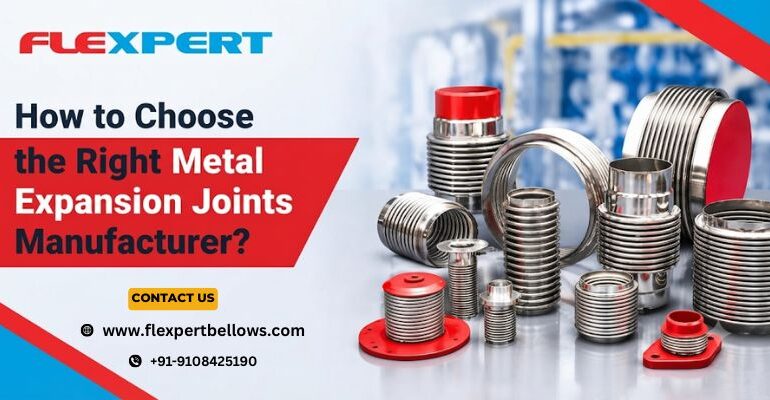
This is where metal bellows expansion joints can play an important role. Their flexible convoluted construction allows controlled movement while helping accommodate thermal expansion in properly engineered systems.
Remember, flexibility alone is not enough. The joint must be designed for the actual movement and operating conditions it will experience.
5. Compare Total Value, Not Just the Initial Price
It is tempting to choose the lowest quotation, especially when project budgets are tight. However, a cheaper component may become expensive if it requires frequent maintenance, causes unplanned shutdowns, or fails prematurely.
When comparing manufacturers, consider these practical factors:
- Product suitability: Does the quotation match your technical specifications?
- Quality assurance: Are inspections and required tests clearly documented?
- Delivery reliability: Can the supplier meet your project schedule?
- After-sales support: Is technical assistance available during installation and operation?
A transparent quotation makes it easier to compare equivalent products. If one supplier offers a significantly lower price, check whether the scope, materials, testing, and documentation are genuinely comparable.
6. Don’t Overlook Installation and After-Sales Support
Even a well-designed expansion joint can underperform if it is installed incorrectly. Misalignment, inadequate pipe guides, improper anchoring, or unwanted twisting can introduce stresses the joint was not designed to accommodate.
Choose a manufacturer that provides clear installation instructions and practical technical assistance. Before installation, confirm the required orientation, shipping restraints, specified presetting, and support arrangements for your particular design.
For additional guidance, read Essential Tips for Error-Free Joint Installation: A Comprehensive Guide. Good coordination between the manufacturer, piping designer, and installation team can prevent avoidable problems.
Frequently Asked Questions
1. What should I look for in a metal expansion joints manufacturer?
Look for engineering expertise, suitable material selection, documented quality checks, relevant design standards, dependable delivery, and responsive technical support.
2. Which material is best for metal expansion joints?
There is no universal best material. Stainless steel and other suitable alloys should be evaluated against the process medium, temperature, pressure, corrosion exposure, and required service life.
3. How do I choose the right expansion joint design?
Start by identifying the expected axial, lateral, and angular movements, along with operating pressure, temperature, and piping layout. A qualified engineer or manufacturer can use these details to recommend a suitable design.
4. Why is installation support important?
Correct alignment, anchoring, guiding, and handling help the joint perform as intended. Following the manufacturer’s application-specific instructions can reduce installation errors and avoid unnecessary stress.
Final Thoughts
Choosing the right metal expansion joints manufacturer is an investment in dependable plant operation. Look beyond the catalogue and compare engineering knowledge, material quality, manufacturing controls, documentation, and long-term support. With the right partner, you can select an expansion joint that meets your system’s needs and supports safer, more reliable operation over time.
Full Audio Version: Click Here