Industrial projects rarely run exactly as planned, especially when heat, pressure, vibration, and changing operating conditions put continuous stress on piping systems. For EPC contractors, even a small component can influence project timelines and long-term reliability. That is why choosing the right expansion joint supplier deserves careful attention from the earliest stages of engineering and procurement.
A dependable lateral expansion joint manufacturer in India can help EPC companies address pipe movement, simplify equipment integration, and reduce avoidable maintenance concerns. The real value lies not simply in supplying a component, but in understanding how it will perform within the complete piping arrangement.
Why Lateral Expansion Joints Matter in EPC Projects?
Engineering, Procurement, and Construction (EPC) projects bring together multiple disciplines, tight schedules, and demanding technical specifications. Piping networks must accommodate thermal growth, equipment movement, vibration, and installation tolerances without transferring excessive loads to connected machinery.
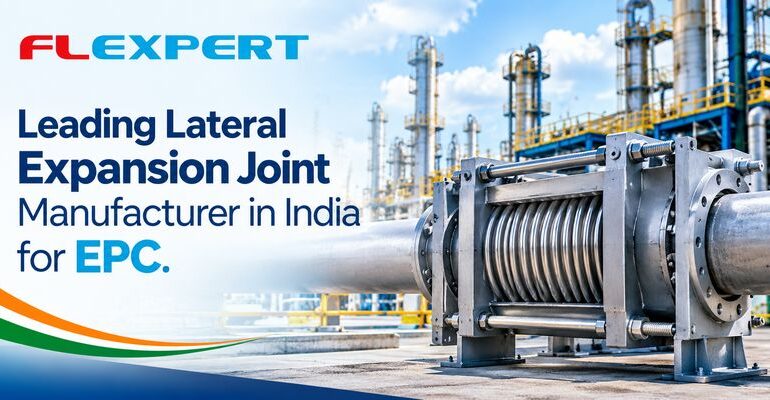
Lateral expansion joints are designed to accommodate sideways movement between connected piping sections. Depending on their configuration, they can help manage movement in systems where a conventional axial expansion joint may not meet the design requirements.
Consider a process plant carrying hot fluids through a long pipe network. As temperatures change, the pipe expands or contracts. If that movement is restricted, stress can develop at anchors, supports, flanges, and equipment connections. A properly selected expansion joint provides controlled flexibility, helping the system accommodate movement within its engineered limits.
What EPC Contractors Should Look for in a Manufacturer?
Not every expansion joint is suitable for every application. The right selection depends on operating conditions, installation geometry, movement requirements, and the surrounding pipework. For EPC teams, the manufacturer’s engineering support can be just as important as the product itself.
1. Application-Specific Engineering
A capable supplier should review the design conditions before recommending a configuration. Temperature, pressure, fluid characteristics, movement direction, and available installation space all influence the final specification.
Rather than relying on a standard product description, EPC engineers should confirm whether the proposed joint matches the project’s actual operating requirements.
2. Material Selection and Manufacturing Quality
Expansion joints may operate in demanding environments where corrosion, thermal cycling, and repeated movement affect service life. Bellows material, end connections, reinforcement, and construction details therefore need to match the intended application.
Useful checks during supplier evaluation include:
- Material suitability for the process fluid and operating temperature.
- Design pressure and specified lateral movement capacity.
- Dimensional compatibility with the piping layout.
- Inspection records, material traceability, and applicable quality documentation.
- Installation guidance and recommendations for maintenance.
These checks give procurement teams a more meaningful basis for comparison than price alone. A component that appears inexpensive initially may prove costly if it requires redesign, replacement, or additional installation work.
3. Documentation and Project Coordination
EPC projects depend on accurate documentation. Technical drawings, dimensional details, material specifications, and inspection requirements must be coordinated with the engineering team before manufacturing and dispatch.
Clear communication is particularly valuable when several contractors are working on the same site. Early confirmation of dimensions and connection details can help prevent last-minute changes that delay installation or commissioning.
How the Right Supplier Supports Long-Term Reliability?
Choosing an experienced lateral expansion bellow manufacturer can support better coordination between piping design, equipment requirements, and maintenance planning. However, the component must always be selected as part of a complete engineered system rather than treated as an isolated fitting.
For example, an expansion joint installed without proper consideration of anchors, guides, and movement direction may experience loads beyond its intended capacity. Even a well-manufactured bellows can perform poorly when surrounding pipework is incorrectly designed or installed.
Before finalising a supplier, EPC teams should consider these practical steps:
- Share complete operating data. Provide design pressure, temperature, movement requirements, and process conditions.
- Review the installation arrangement. Confirm anchor positions, pipe guides, connected equipment, and available space.
- Verify technical compliance. Check the relevant project specifications, applicable design standards, and required inspection documents.
- Plan installation and inspection. Follow the manufacturer’s instructions and establish suitable inspection procedures for service conditions.
For a broader perspective on evaluating piping components, the Pipe Joint Buying Guide: What Industries Should Never Overlook can help procurement and engineering teams identify important considerations before making a purchasing decision.
Industries That Benefit from Lateral Expansion Joints
Lateral expansion joints can be relevant across several industrial sectors, depending on the piping design and movement requirements. Common applications include:
- Power generation: Piping systems exposed to temperature changes and demanding operating cycles.
- Oil and gas: Process lines where pressure, fluid compatibility, and operating conditions require careful joint selection.
- Chemical processing: Systems where material compatibility and resistance to the process environment are important.
- Steel and cement plants: Industrial networks exposed to heat, vibration, and challenging operating conditions.
- Petrochemical facilities: Complex piping arrangements requiring coordinated movement management and equipment protection.
Actual suitability depends on the design, process conditions, and manufacturer’s recommendations. No single expansion joint configuration should be assumed appropriate for every industry or application.
Frequently Asked Questions
What is a lateral expansion joint?
A lateral expansion joint is a flexible piping component designed to accommodate sideways movement between connected pipe sections. Its suitability depends on the required movement, operating conditions, and joint configuration.
How should EPC contractors select a manufacturer in India?
Evaluate engineering capabilities, material selection, manufacturing quality, technical documentation, compliance with project specifications, and the ability to coordinate with the EPC engineering team.
What information is needed to specify a lateral expansion joint?
Important details include operating and design pressure, temperature, fluid characteristics, required lateral movement, connection dimensions, installation layout, and applicable project standards.
Can lateral expansion joints reduce piping maintenance?
A correctly engineered and installed joint can help accommodate specified movement and reduce excessive loads on connected piping components. Maintenance requirements still depend on operating conditions, installation quality, inspection practices, and overall system design.
Final Thoughts
For EPC contractors, selecting a lateral expansion joint manufacturer is ultimately about more than procurement. It is about finding a technical partner who understands project requirements, communicates clearly, and supplies components suited to the intended application. By prioritising engineering compatibility, documented quality, and proper installation, project teams can make more informed decisions and build piping systems designed for dependable service.
Listen Here: Click Now