BIC understands that most homeowners rarely think about what happens inside a drainage system—until something goes wrong. A leaking pipe joint can lead to unpleasant odors, water damage, expensive repairs, and ongoing maintenance headaches. That’s why engineers have spent decades improving pipe connection technology, creating solutions that deliver long-lasting performance and reliability.
One of the most significant advancements in modern plumbing is the use of Hubless Cast Iron Pipe Joints. Designed for strength, flexibility, and leak prevention, these joints have become a preferred choice in residential, commercial, and institutional buildings worldwide.
What Makes a Pipe Joint Leak-Resistant?
At first glance, a pipe joint may appear simple. However, the engineering behind it is surprisingly sophisticated. A leak-resistant connection must withstand internal water flow, building movement, temperature fluctuations, and years of continuous use without losing its seal.
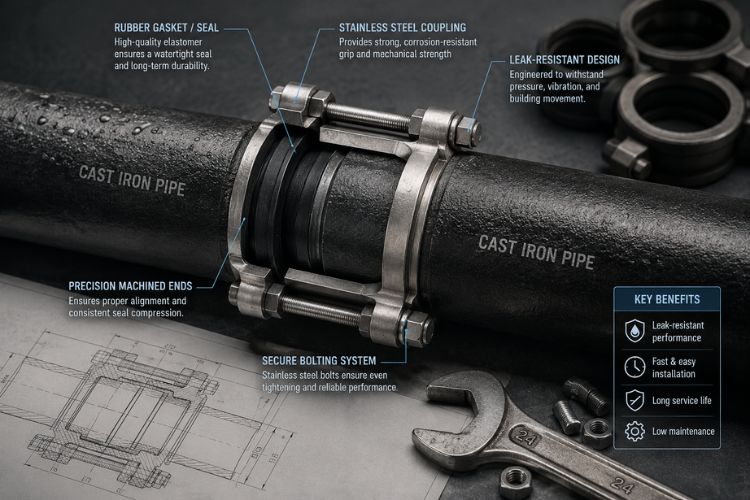
Hubless systems achieve this through a combination of precision-manufactured pipe ends, elastomeric gaskets, and stainless-steel couplings. Together, these components create a secure mechanical connection that distributes pressure evenly and minimizes the risk of leakage.
The Role of the Rubber Gasket
The gasket acts as the primary sealing element. Made from durable elastomeric materials, it compresses between adjoining pipe sections to create a watertight barrier. Unlike older connection methods that depended heavily on rigid materials, modern gaskets can absorb slight movement while maintaining a secure seal.
This flexibility is particularly important in multi-story buildings, where structural shifts and vibration are common over time.
Engineering Features That Prevent Leaks
The reliability of hubless systems comes from several carefully engineered design elements:
- Uniform Compression: Stainless-steel couplings apply consistent pressure around the entire circumference of the joint.
- Corrosion Resistance: Metal components are designed to resist rust and environmental degradation.
- Vibration Absorption: Flexible sealing materials help accommodate movement without compromising performance.
- Precision Manufacturing: Consistent dimensions ensure accurate fitting and secure installation.
According to research published by the National Institute of Standards and Technology (NIST), properly engineered piping systems significantly reduce maintenance issues and lifecycle costs when compared with poorly connected systems.
Why Cast Iron Remains a Trusted Material
Many homeowners are surprised to learn that cast iron remains one of the most trusted materials for drainage infrastructure. While newer materials have entered the market, cast iron continues to offer advantages that are difficult to match.
- Excellent durability and longevity
- Superior sound-dampening properties
- High fire resistance
- Strong structural integrity
- Low maintenance requirements
These benefits explain why cast iron systems continue to be specified for apartment complexes, hospitals, hotels, and premium residential developments.
How Installation Quality Influences Joint Performance
Even the most advanced pipe joint design depends on proper installation. Experienced professionals understand that tightening couplings correctly and ensuring proper alignment are critical to achieving maximum leak resistance.
In many modern infrastructure projects, drainage networks are installed alongside products such as a Cast Iron Manhole Cover in India to create durable, long-lasting underground utility systems. When quality materials are combined with skilled installation practices, system reliability improves dramatically.
Common Factors That Affect Performance
- Improper coupling torque during installation
- Misalignment between pipe sections
- Use of low-quality replacement components
- Lack of periodic inspection in high-use environments
Addressing these issues early can prevent expensive repairs later.
The Importance of System Integration
Modern drainage engineering is no longer about individual components. Instead, engineers evaluate how every part works together as a complete system.
For example, projects that incorporate durable drainage infrastructure often pair hubless piping networks with solutions such as a Ductile Iron Manhole Cover India to improve accessibility, load-bearing performance, and long-term operational efficiency.
When integrated correctly, these systems deliver years of dependable service while reducing maintenance demands for homeowners and property managers.
Also Read: Future Trends Shaping the Cast Iron Pipe Suppliers Near Me Industry
Frequently Asked Questions
Q. What are Hubless Cast Iron Pipe Joints?
A. They are specialized pipe connections that use rubber gaskets and stainless-steel couplings instead of traditional hub-and-spigot designs, providing reliable and leak-resistant performance.
Q. Why are hubless joints less likely to leak?
A. They create uniform sealing pressure around the entire joint, reducing weak points that can lead to leakage over time.
Q. How long do cast iron drainage systems typically last?
A. With proper installation and maintenance, cast iron drainage systems can often provide reliable service for several decades.
Q. Are hubless cast iron systems suitable for residential buildings?
A. Yes. Their durability, noise reduction capabilities, and leak-resistant design make them an excellent choice for residential applications.
Final Thoughts
The engineering behind leak-resistant pipe connections is a perfect example of how thoughtful design improves everyday life. By combining precision manufacturing, durable materials, and advanced sealing technology, Hubless Cast Iron Pipe Joints help create drainage systems that remain dependable for years. For homeowners seeking long-term reliability, fewer maintenance concerns, and improved performance, these engineered connections continue to set the benchmark for modern drainage infrastructure.
Blog Development Credit
To ensure accuracy and relevance, this article draws upon knowledge and research support from ChatGPT and Google Gemini. The content strategy, quality review, optimization process, and publishing management were carried out by Bengal Iron Corporation.