Modern piping systems rarely sit still. Temperature changes, equipment movement, vibration, and pressure variations can all put stress on connected components. That is where lateral expansion joints become important. Choosing the right Lateral Expansion Joint Manufacturer in India can help engineers build piping systems that handle movement without compromising reliability or service life.
Why Lateral Movement Matters in Piping?
Imagine a long pipeline carrying a hot fluid through an industrial plant. As the temperature rises, the pipe expands. When it cools, the material contracts again. Add equipment vibration or small amounts of sideways movement, and the piping system has to accommodate several forces at once.
A lateral expansion joint is designed to absorb movement occurring perpendicular to the pipe axis. Rather than forcing rigid pipes, flanges, and connected equipment to absorb every bit of movement, the joint provides controlled flexibility at a planned location.
This becomes especially useful in systems where thermal movement and installation constraints make a completely rigid arrangement impractical. In real engineering work, the goal is not simply to make a joint flexible. It is to make that flexibility predictable.
How Modern Expansion Joints Support System Reliability?
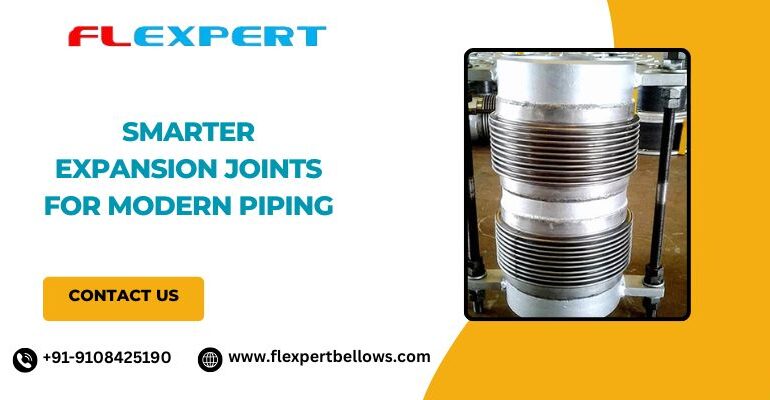
A well-selected expansion joint can act as a pressure-bearing flexible connection while accommodating specified movement. The bellows element is typically the working component, flexing through carefully engineered convolutions as the piping system moves.
Key advantages engineers consider
- Thermal movement: Helps accommodate expansion and contraction caused by changing operating temperatures.
- Lateral displacement: Allows controlled sideways movement where piping geometry requires flexibility.
- Vibration management: Can help isolate certain vibration effects when correctly integrated into the system.
- Equipment protection: Reduces unwanted loads transferred to connected machinery and piping components.
However, an expansion joint should never be treated as a universal solution for every piping problem. Movement requirements, pressure, temperature, material compatibility, cycle life, and installation conditions all influence the appropriate design.
What Makes a Good Lateral Expansion Joint?
There is more to a dependable joint than the appearance of its bellows. Engineers need to consider how the component behaves under actual operating conditions. A joint that looks suitable on paper may perform poorly if movement assumptions or installation details are overlooked.
Important considerations commonly include:
- Movement direction and magnitude: Determine whether the system requires lateral, axial, angular, or combined movement.
- Operating conditions: Review working temperature, pressure, fluid characteristics, and expected operating cycles.
- Material selection: Choose materials that can withstand the temperature, corrosion environment, and mechanical demands.
- Guides and anchors: Confirm that the surrounding piping supports are appropriate for the expansion-joint arrangement.
- Installation accuracy: Avoid forcing the joint into position or exposing it to movements beyond its intended capacity.
That last point deserves emphasis. Even a properly manufactured expansion joint can experience premature problems if it is installed incorrectly. The component and the surrounding piping system have to work as one assembly.
Where These Joints Find Practical Use?
Lateral expansion joints can be considered across a range of industrial environments. Process plants, power-generation facilities, chemical installations, HVAC networks, refineries, and manufacturing units may all have piping layouts where controlled flexibility is required.
For example, a pipeline connecting two pieces of equipment may experience sideways displacement because of thermal growth or structural movement. Instead of allowing that movement to load the equipment nozzles excessively, engineers can incorporate a suitable flexible component into the piping design.
In such applications, Bellows Expansion Joints can provide a practical way to accommodate calculated movement while maintaining a pressure-tight connection.
Choosing an Indian Manufacturer: What to Check
India’s industrial sector covers everything from compact process systems to large-scale infrastructure projects. Consequently, manufacturers may encounter very different operating requirements from one project to another. A useful supplier conversation should therefore begin with engineering details, not simply product dimensions.
A practical selection checklist
- Ask whether the manufacturer understands the required movement calculations.
- Share operating temperature and pressure rather than selecting only by nominal pipe size.
- Discuss material requirements based on the process medium and environment.
- Check whether drawings, dimensional information, and technical documentation are available.
- Clarify inspection, testing, quality-control, and customization requirements before ordering.
It is also worth examining installation and maintenance requirements early. For additional practical considerations before purchasing, this Pipe Joint Buying Guide: What Industries Should Never Overlook can help frame the questions that matter during supplier evaluation.
Why Customization Can Make a Difference?
Industrial piping rarely follows a one-size-fits-all template. Available space, connection dimensions, movement requirements, pressure ratings, and temperature conditions can vary significantly between projects.
That is why customization can be valuable when standard configurations do not match the application. An experienced lateral expansion joint manufacturer can review project-specific requirements and develop a configuration around the actual operating conditions.
From an engineering perspective, this approach is generally more sensible than selecting a component based solely on catalogue size. The right joint should fit the system’s movement philosophy, support arrangement, and expected service conditions.
Frequently Asked Questions
What is a lateral expansion joint?
A lateral expansion joint is a flexible piping component designed primarily to accommodate movement perpendicular to the pipe’s longitudinal axis. It is commonly used where thermal or structural movement creates sideways displacement.
Where are lateral expansion joints used?
They may be used in industrial piping, power facilities, process plants, HVAC systems, chemical installations, refineries, and other applications where controlled lateral movement needs to be accommodated.
How do I select the right expansion joint?
Selection should consider pipe size, pressure, temperature, movement type and magnitude, material compatibility, cycle requirements, connection details, and the piping support arrangement.
Why is installation important for expansion joints?
Expansion joints are engineered for specific movement conditions. Incorrect alignment, unsuitable supports, excessive movement, or improper installation can place unnecessary stress on the bellows and reduce service performance.
Final Thoughts
A modern piping system needs flexibility in the right places, not flexibility everywhere. Lateral expansion joints provide engineers with a controlled way to manage sideways movement caused by thermal changes, vibration, and other operating conditions. By selecting a technically capable manufacturer and considering the complete piping arrangement, industries can build systems designed for dependable long-term operation.
Full Audio Version: Click Here