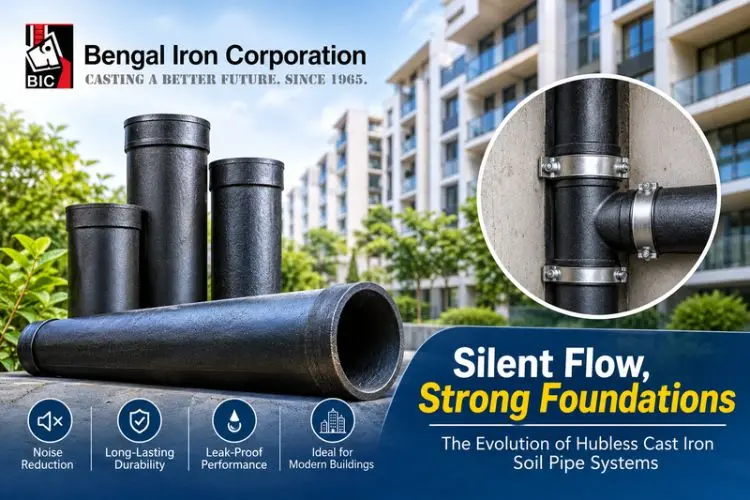
Hubless cast iron soil pipe systems have changed the way modern buildings manage wastewater by offering compact connections, dependable drainage and effective noise control. For homeowners, these systems provide more than a plumbing solution; they contribute to everyday comfort and long-term building performance. Bengal Iron Corporation explores why this technology is becoming an important choice for residential and commercial drainage applications.
What Makes Hubless Cast Iron Soil Pipes Different?
A hubless cast iron soil pipe is a cast iron drainage pipe without an enlarged socket or bell at its end. Instead of traditional socket-and-spigot joints, individual pipe sections are connected using shielded couplings with elastomeric gaskets and stainless-steel bands.
This connection method creates a relatively compact joint, making it particularly useful where plumbing installations must fit within limited spaces. Unlike conventional jointing arrangements, hubless systems rely on properly selected couplings to maintain a secure connection between pipe sections.
Modern hubless cast iron soil pipe solutions are therefore valued for their practical installation characteristics and suitability for organised building drainage networks.
Why Is Quiet Plumbing Becoming More Important?
Plumbing noise is one of those household problems that often goes unnoticed during construction but becomes frustrating after a building is occupied. Water rushing through vertical soil stacks, wastewater passing through bends and vibration travelling through poorly supported pipes can disturb bedrooms, living areas and home offices.
Cast iron is naturally dense, which helps dampen sound generated by flowing wastewater. This makes it an attractive material for buildings where acoustic comfort matters.
How Cast Iron Helps Control Drainage Noise
- Material density: The mass of cast iron helps reduce the transmission of airborne pipe noise.
- Stable installation: Correctly positioned supports help minimise unwanted pipe movement and vibration.
- Secure connections: Properly installed couplings help maintain joint integrity and reduce the possibility of leakage-related problems.
- System planning: Appropriate pipe sizing and routing help prevent unnecessary turbulence and installation-related noise.
However, quiet performance is never determined by the pipe material alone. Poor support spacing, unsuitable fittings and incorrect installation can undermine the benefits of an otherwise good drainage system.
Where Do Hubless Soil Pipe Systems Work Best?
These systems are suitable for several types of buildings where wastewater needs to move safely through a connected drainage network.
- Residential apartments: Vertical soil stacks can serve multiple floors while helping manage plumbing noise near occupied rooms.
- Independent houses: Compact joints are useful where drainage pipes need to pass through restricted service spaces.
- Hotels and guest houses: Acoustic performance is an important consideration when bathrooms are located close to bedrooms.
- Commercial buildings: Properly designed drainage networks help support regular wastewater movement across multiple facilities.
The actual suitability depends on building design, local plumbing requirements, pipe dimensions and the specifications of the selected coupling system.
How Do Hubless Pipe Connections Improve Installation?
One important development in modern drainage engineering is the move towards connection systems that are easier to assemble, inspect and maintain. Hubless pipes support this approach by eliminating the need for enlarged socket ends at every connection.
For homeowners, this can mean a more organised plumbing layout and better use of available installation space.
A Practical Step-by-Step Installation Approach
- Plan the drainage route: Identify vertical stacks, horizontal branches, bends and access points before installation begins.
- Select compatible components: Choose pipes, fittings, couplings and gaskets that match the required dimensions and applicable standards.
- Prepare the pipe ends: Ensure cut ends are clean, square and free from burrs that could damage the gasket.
- Position the coupling: Align the adjoining pipe sections and install the specified coupling according to its manufacturer’s instructions.
- Tighten correctly: Use the recommended torque and installation procedure rather than relying on guesswork.
- Test the system: Conduct appropriate inspection and leakage testing before concealing the pipework.
Following these steps helps prevent common problems such as misalignment, loose connections and avoidable maintenance issues.
Why Do Pipes and Fittings Need to Work Together?
A drainage network is only as dependable as its weakest connection. Even a high-quality pipe cannot deliver the expected performance if the adjoining fitting is unsuitable or the joint has been assembled incorrectly.
This is why homeowners and plumbing professionals should evaluate the complete system rather than selecting individual components solely on price. Compatible cast iron pipes & fittings help create a coordinated drainage arrangement with suitable transitions, bends and branches.
It is also worth checking the product specifications, dimensional compatibility, applicable standards and installation requirements before purchasing.
What Should Homeowners Check Before Choosing a Hubless Pipe?
Price is an obvious consideration, but it should not be the only deciding factor. A drainage system is usually concealed behind walls, ceilings or service shafts. Replacing an unsuitable component later can involve considerably more work than choosing correctly at the beginning.
- Check the pipe diameter and wall specifications against the project requirements.
- Verify that couplings and fittings are compatible with the selected pipe system.
- Ask about applicable Indian Standards and relevant product test documentation.
- Consider corrosion protection and the expected operating environment.
- Confirm that installation is carried out by qualified plumbing professionals.
- Compare the complete system cost rather than looking only at the individual pipe price.
Experienced manufacturers and foundries also play an important role in maintaining product consistency. Bengal Iron Corporation, associated with the cast iron foundry India manufacturing sector, offers infrastructure-related cast iron product solutions.
How Does Modern Drainage Connect With the Wider Infrastructure?
Building drainage does not operate independently of the surrounding infrastructure. Wastewater from internal soil stacks eventually connects with external drainage and sewer networks, where access, inspection and maintenance become equally important.
Products such as recessed drain covers India are relevant to external drainage access applications, although they serve a different function from internal soil pipes. Understanding this distinction helps homeowners appreciate how individual components contribute to a complete wastewater management system.
Frequently Asked Questions
Q. What is a hubless cast iron soil pipe?
A. It is a cast iron drainage pipe without an enlarged socket end. Pipe sections are joined using specialised couplings and gaskets instead of conventional socket joints.
Q. Are hubless cast iron pipes good for residential buildings?
A. Yes. They are suitable for residential drainage systems when correctly specified and installed. Their material density also makes them useful where controlling plumbing noise is important.
Q. Why are hubless cast iron pipes quieter than some plastic pipes?
A. Cast iron has greater material density, which helps dampen sound and vibration generated by wastewater flowing through the drainage system.
Q. How are hubless cast iron soil pipes connected?
A. They are connected using compatible shielded or other specified couplings with elastomeric gaskets. Correct alignment and tightening are essential for reliable joints.
Q. What should I consider when buying hubless cast iron soil pipes?
A. Consider dimensions, material quality, applicable standards, coupling compatibility, product documentation, installation requirements and overall system cost.
Conclusion
The evolution of hubless cast iron soil pipe systems reflects a simple but important shift in building design: drainage should be dependable without compromising everyday comfort. Their dense material, compact jointing arrangement and suitability for organised plumbing layouts make them a practical option for modern buildings.
For homeowners planning new construction or plumbing upgrades, the smartest decision is to consider the complete drainage system, not just the pipe. Bengal Iron Corporation recognises the importance of dependable cast iron infrastructure products in supporting stronger, better-planned buildings.
Blog Development Credit:
Developed through collaborative AI-assisted research and content insights using ChatGPT and Google Gemini, with topic research, SEO strategy, content refinement, and final publishing managed by Bengal Iron Corporation.