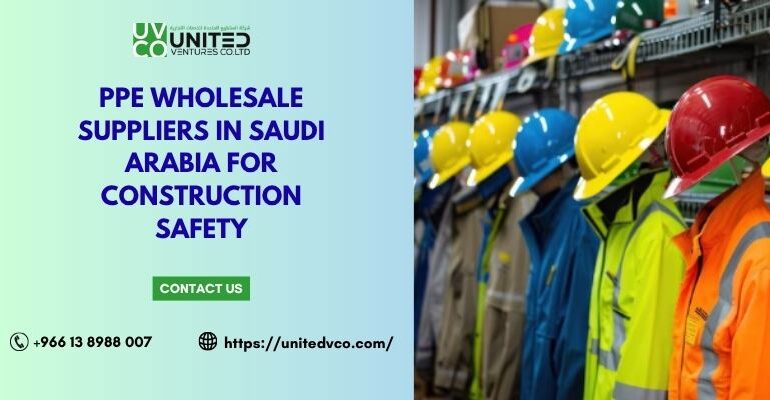
Construction sites rarely give workers a second chance when something goes wrong. From falling objects and dust to noise, chemicals, heat, and moving machinery, everyday hazards demand practical protection. That is where reliable PPE Wholesale Suppliers in Saudi Arabia become valuable partners rather than simply another purchasing source.
Why PPE Matters on Saudi Construction Sites?
Personal protective equipment is the final layer of protection when engineering controls and safe working procedures cannot completely remove a hazard. But PPE only works when it is appropriate for the job, correctly fitted, properly maintained, and consistently worn.
Construction companies in Saudi Arabia operate across demanding environments, including road projects, commercial developments, industrial facilities, and infrastructure sites. Extreme heat can add another challenge, making comfort and suitability just as important as basic protection.
The U.S. Occupational Safety and Health Administration (OSHA) explains that employers should assess workplace hazards before selecting appropriate PPE. The principle is straightforward: don’t buy protective equipment first and figure out the hazard afterward.
What Should a Construction PPE Supplier Provide?
A dependable supplier should be able to support the complete range of protection required across different work areas. A project may need basic equipment for general labourers as well as specialised protection for welders, electricians, machine operators, and workers handling hazardous materials.
Essential PPE Categories
- Head protection: Safety helmets and related accessories for protection against impact and falling objects.
- Eye and face protection: Safety glasses, goggles, and face shields for dust, sparks, splashes, and flying particles.
- Hand protection: Gloves selected according to cutting, abrasion, chemical, heat, or general handling risks.
- Foot protection: Safety footwear designed for impact, compression, puncture, or challenging work environments.
- Hearing protection: Earplugs and earmuffs for workplaces where excessive noise is a concern.
- Respiratory protection: Appropriate masks and respirators where airborne contaminants require additional protection.
The important point is that PPE should match the hazard. A heavy-duty glove designed for mechanical work is not automatically suitable for chemical handling, for example.
Look Beyond the Lowest Supplier Quote
Price matters, especially when a contractor needs equipment for hundreds of workers. Still, choosing solely on the lowest quotation can create problems later. Poor-quality equipment may wear out quickly, fit badly, or fail to provide the protection expected from it.
When comparing construction safety equipment suppliers, procurement teams should consider the complete value of the purchase. Availability, product consistency, specifications, documentation, replacement support, and delivery capability can all affect the actual cost of PPE.
Questions Worth Asking Before Buying
- Does the supplier understand the hazards associated with your specific construction activities?
- Can they provide consistent quantities when workforce requirements increase?
- Are product specifications and compliance documentation available?
- Can replacement items be supplied without unnecessary delays?
- Does the supplier offer different PPE options for different tasks and working conditions?
These questions may seem basic, but they separate a dependable procurement relationship from a one-off transaction.
Why Bulk Purchasing Can Help Contractors?
Large construction projects consume PPE continuously. Helmets can become damaged, gloves wear out, protective eyewear gets scratched, and footwear eventually needs replacement. Maintaining an adequate stock therefore becomes part of everyday site management.
Working with a supplier offering Wholesale & Industrial Supplies can simplify procurement by allowing businesses to coordinate multiple categories through one supply relationship. Bulk purchasing can also make inventory planning easier when quantities and replacement cycles are understood in advance.
However, buying in bulk should not mean buying blindly. PPE has a shelf life in some applications, and storage conditions can affect certain products. Procurement teams should balance volume discounts with actual consumption and storage capacity.
Comfort Is a Safety Issue Too
Here is something that is easy to overlook: uncomfortable PPE can become a compliance problem. If a helmet feels awkward, gloves restrict movement, or protective clothing is excessively uncomfortable in hot weather, workers may be tempted to adjust, remove, or avoid it.
That is why workplace safety supplies in Saudi Arabia should be selected with the working environment in mind. Fit, ventilation, weight, mobility, visibility, and compatibility with other equipment all deserve attention.
- Check whether different worker sizes and fits are available.
- Make sure multiple PPE items can be worn together without interference.
- Consider heat, humidity, dust, and long working hours when selecting products.
- Train workers on correct use, inspection, cleaning, storage, and replacement.
Make PPE Part of the Wider Safety Culture
Even excellent PPE cannot compensate for poor safety procedures. Construction companies should combine protective equipment with hazard assessments, worker training, housekeeping, equipment maintenance, signage, and appropriate engineering controls.
A strong supplier can contribute to that process by helping procurement teams understand product applications and maintain dependable availability. Ultimately, the goal isn’t to have a warehouse full of PPE. It is to have the right protection available to the right worker at the right time.
Frequently Asked Questions
1. What PPE is most commonly required on construction sites?
Common requirements include safety helmets, protective eyewear, gloves, safety footwear, high-visibility clothing, hearing protection, and task-specific respiratory or fall-protection equipment.
2. How should construction companies choose a PPE supplier?
Look at product suitability, quality, documentation, availability, delivery reliability, range, replacement support, and the supplier’s ability to handle bulk requirements consistently.
3. Is buying PPE in bulk always better?
Not necessarily. Bulk purchasing can simplify procurement and improve pricing, but businesses should consider actual consumption, storage conditions, product shelf life, and changing project requirements.
4. Why is PPE fit important?
PPE that fits properly is more likely to provide its intended protection and remain comfortable during work. Poorly fitting equipment can interfere with movement and encourage workers to remove or adjust it.
Final Thoughts
Finding dependable PPE Wholesale Suppliers in Saudi Arabia is ultimately about more than comparing prices. Construction companies need protection that matches real hazards, remains practical in demanding conditions, and can be replenished when workers need it. For additional workplace safety guidance, the International Labour Organization provides useful resources on occupational safety and health. The right supplier, paired with sensible safety management, can make PPE a reliable part of everyday site protection.
Full Audio Version:- Click Here