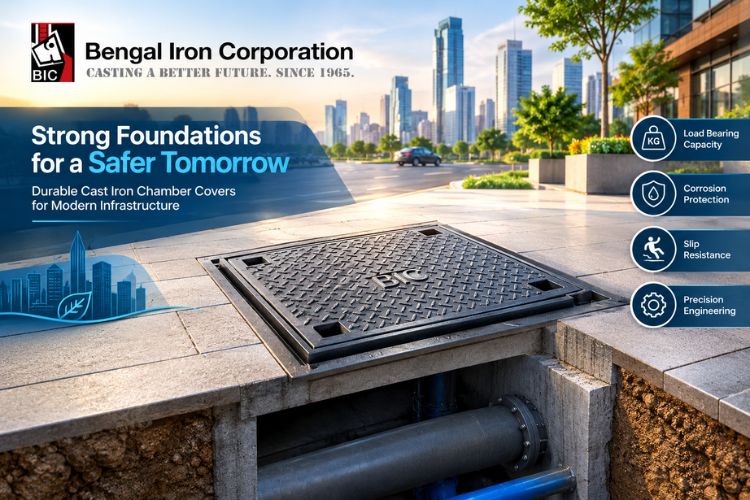
Modern cities are becoming more connected, more crowded, and more dependent on infrastructure hidden beneath roads, pavements, commercial spaces, and industrial sites. Beneath these surfaces are drainage lines, inspection chambers, utility networks, pipelines, and service connections that require regular access without compromising everyday safety.
That is why a chamber cover should no longer be viewed as simply a piece of metal placed over an opening. Its load performance, surface design, fit, material, installation quality, and maintenance requirements can all influence the overall performance of the surrounding infrastructure.
Industry-leading manufacturers increasingly present access-cover solutions around application, load classification, safety, surface integration, and project-specific requirements rather than focusing only on the product itself. For example, EJCO emphasizes load classes, product markings, installation conditions, and project-specific selection, while ACO highlights recessed integration, security, sealing, bespoke sizing, and easier access.
For Indian infrastructure projects, this broader approach can make chamber-cover selection more practical and future-focused.
Why Chamber Covers Are Becoming an Infrastructure Design Element
A modern chamber cover has several responsibilities at the same time.
It must protect underground services from accidental access while allowing authorized personnel to reach those services when inspection or maintenance is required. At the same time, it should integrate properly with the surrounding road, pavement, flooring, or landscaped area.
This becomes particularly important in busy urban environments where vehicles, pedestrians, maintenance equipment, water, dust, and changing weather conditions continuously interact with the installation.
The result is a shift from “covering an opening” to “engineering an access point.”
For buyers searching for a Cast Iron Chamber Cover Near Me India, the most useful starting point is therefore not proximity alone. Material, application, loading conditions, dimensions, frame design, surface requirements, and manufacturer capabilities should all be considered together.
1. Load Capacity Should Match the Real Application
One of the first questions should be: What will actually travel or operate above the chamber?
A cover installed on a pedestrian walkway faces very different conditions from one installed on a road, industrial driveway, parking area, or logistics zone.
International access-cover practice commonly uses load classifications to match products with their intended installation environment. EJCO’s technical material, for example, explains that the appropriate class depends on the place of installation and that designers should consider stronger classifications where there is uncertainty.
This makes load selection more than a specification-sheet exercise.
Engineers should consider:
- Expected vehicle type
- Wheel and axle loads
- Frequency of traffic
- Static and dynamic loading
- Chamber and frame support
- Installation conditions
- Long-term maintenance requirements
A cover with adequate strength but an unsuitable frame or poorly prepared supporting structure may still create problems. The entire cover-and-frame installation needs to work as a system.
2. Recessed Design Can Create Better Surface Integration
Modern architecture increasingly aims for clean, uninterrupted surfaces. This is where a Recessed Chamber Cover can become particularly useful.
Instead of leaving a visibly different metal surface, recessed designs can accommodate a suitable surface finish or infill, allowing the access point to visually integrate with its surroundings.
This concept is already prominent in international access-cover design. ACO, for example, describes recessed covers designed to accommodate different floor finishes, while its paving-cover range is designed to integrate access points into public spaces without disrupting the visual appearance of paved surfaces.
For premium commercial developments, landscaped areas, pedestrian zones, campuses, hospitality projects, and contemporary urban spaces, this combination of accessibility + visual continuity can make a significant difference.
3. Surface Safety Matters More Than It Looks
A chamber cover is part of the walking and driving surface, so its upper profile should be considered carefully.
Rainwater, oil, dust, cleaning agents, and other contaminants can change surface conditions. A suitable textured or slip-resistant surface can help provide better traction.
However, aggressive textures should also be evaluated for cleaning and maintenance. The goal is not simply to create the roughest possible surface; it is to achieve a practical balance between traction, drainage, durability, and ease of maintenance.
Modern access-cover manufacturers increasingly treat surface finish as a functional design feature rather than merely an aesthetic choice. ACO, for instance, highlights raised slip-resistant surfaces on its solid access-cover range.
4. The Frame Deserves Equal Attention
A common mistake is to evaluate the cover while paying less attention to its frame.
In reality, the frame transfers loads from the cover into the surrounding structure. If the frame is inadequately supported, poorly aligned, or incorrectly installed, even a high-quality cover may not perform as intended.
Installation guidance from the access-cover industry emphasizes the importance of proper bedding, supporting structures, and load distribution. EJCO’s technical guidance also notes that where higher traffic loads are expected, the cover specification and supporting arrangement need to reflect those conditions.
This is why procurement teams should evaluate the complete cover-and-frame system, rather than comparing covers only by weight or price.
5. Material Selection Should Follow the Environment
Cast iron and ductile iron are widely used for access and manhole applications because they can provide the strength and durability required for demanding environments.
But material selection should still be connected to the application.
Consider:
- Expected load
- Installation location
- Exposure to moisture
- Chemical environment
- Frequency of opening
- Required service life
- Handling requirements
For projects where lighter handling is valuable, ductile iron solutions may offer useful weight-to-strength characteristics. BIC’s current product information, for example, describes its ductile iron covers in relation to load-bearing performance, reduced handling weight, and EN 124-2 classifications.
The important lesson is simple: choose material according to performance requirements, not simply material name.
6. Think Beyond the Cover
Modern infrastructure does not operate in isolated components.
A drainage network may involve chamber covers, pipes, fittings, gratings, inspection points, and access systems. A properly planned system therefore considers how different components work together.
For example, Hubless Pipe Fittings can form part of cast iron drainage systems where installation flexibility and reliable connections are important. BIC describes hubless systems around easier installation, reorientation, durability, low expansion, and fire resistance.
This broader system-based thinking can help engineers coordinate underground drainage and access requirements rather than treating every component as an independent purchase.
7. Customization Is Becoming More Important
Not every chamber is identical.
Different projects can require different:
- Clear opening dimensions
- Overall frame dimensions
- Shapes
- Load classes
- Surface finishes
- Locking arrangements
- Hinges
- Markings
- Infill requirements
Leading access-cover manufacturers increasingly provide standard as well as engineered or bespoke solutions. ACO, for example, offers bespoke covers based on project size, shape, and load-class requirements.
BIC also highlights multiple cover configurations, including square, rectangular, round, recessed, airtight, and other application-specific designs.
This means buyers should share actual project conditions with the manufacturer instead of selecting a cover from dimensions alone.
What Should Buyers Check Before Ordering?
Before purchasing a chamber cover, create a simple project checklist:
Application → Load → Size → Material → Frame → Surface → Installation → Maintenance
Also ask for relevant technical documentation, testing information, applicable standards, drawings, and installation guidance.
BIC’s manufacturing information states that its facilities include load-testing equipment, an in-house machine shop, laboratory capabilities, and pattern-making facilities, supporting process control from raw-material procurement through finished-product quality checking.
This type of manufacturing capability can be important when a project requires consistency across multiple batches or customized designs.
FAQ
Q. What is a chamber cover used for?
A. chamber cover provides protected access to underground chambers containing drainage, utility, inspection, or service infrastructure while helping maintain a safe surface above.
Q. Why is load classification important?
A. Load classification helps match the cover to the conditions expected at its installation location, including pedestrian, road, parking, or heavier-duty applications.
Q. What makes a recessed chamber cover different?
A. A recessed chamber cover can accommodate an appropriate surface finish or infill, helping the access point blend more naturally with surrounding paving or flooring.
Q. Should the frame be considered separately?
A. No. The cover and frame should be evaluated as a complete structural installation because loads are transferred through the frame into the supporting structure.
Q. How do I choose a Cast Iron Chamber Cover Near Me India?
A. Start by identifying the application, required dimensions, expected load, material, surface requirements, and relevant standards. Then compare manufacturers based on technical capability, testing, customization, quality control, and project support rather than distance alone.
Final Thoughts
The future of chamber-cover design is moving toward a more integrated approach. Strength still matters, but modern infrastructure also demands surface safety, visual integration, installation reliability, maintainability, customization, and system compatibility.
Bengal Iron Corporation brings decades of foundry experience to cast iron and ductile iron infrastructure products. Founded in 1965, BIC manufactures manhole covers, pipes and fittings, industrial castings, gratings, and related products, with stated manufacturing standards including IS 1726, IS 3989, IS 15905, BS EN 124-2, and other listed standards.
For projects where underground infrastructure needs to remain hidden while its performance remains visible, the right chamber cover is not merely a finishing component—it is part of the infrastructure itself.
Blog Development Credit
This article was developed using research and content insights from ChatGPT and Google Gemini, with the industry-focused content strategy, keyword integration, refinement, and final publishing direction managed by Bengal Iron Corporation.