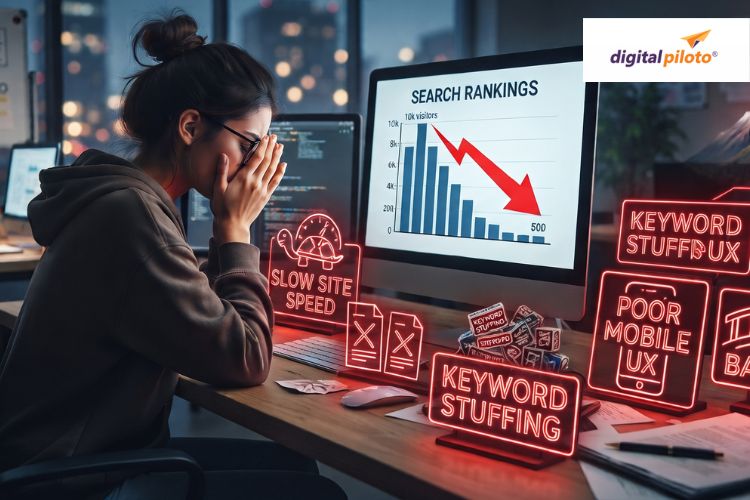
Many websites fail to rank not because they lack content, but because avoidable SEO mistakes quietly undermine their visibility. Issues like weak technical foundations, poor keyword targeting, thin content, and neglected user experience can steadily push a site down the search results, even when the business itself is performing well.
This is particularly common for growing businesses investing in design and branding through a Web Development Company in Durgapur but overlooking the search optimization needed to support long-term visibility. A beautiful website without search accessibility often becomes an expensive digital brochure rather than a lead generation asset.
What Are SEO Mistakes?
SEO mistakes are actions, omissions, or technical issues that prevent search engines from properly understanding, indexing, or trusting a website. Some errors cause immediate ranking losses, while others slowly reduce visibility over months.
The frustrating part is that many businesses continue creating content and building pages without realizing these underlying problems exist.
Ignoring Search Intent
One of the biggest ranking killers is targeting keywords without understanding why users search for them.
For example, someone searching for “best CRM software” expects comparisons and recommendations, not a sales page promoting a single product. Google has become remarkably effective at identifying intent mismatches.
Signs of search intent mismatch:
- High bounce rates despite strong rankings.
- Users leave after viewing only one page.
- Pages rank temporarily and then disappear.
- Traffic increases but conversions remain flat.
Before creating content, ask a simple question: “What problem is this searcher trying to solve?”
Publishing Thin or Generic Content
Search engines have seen millions of articles that say exactly the same thing. Generic content no longer earns authority.
If your article could be copied, pasted, and published on ten competing websites without anyone noticing, it probably lacks information gain.
Strong content usually includes:
- Original insights and opinions.
- Practical examples.
- Real implementation experiences.
- Unique frameworks or comparisons.
- Updated industry observations.
Experience has become a competitive advantage in SEO.
Neglecting Technical SEO Foundations
Even excellent content struggles when search engines cannot properly crawl or understand a website.
Common technical SEO issues include:
- Broken internal links.
- Slow page speed.
- Duplicate content.
- Missing canonical tags.
- Improper redirects.
- Indexing restrictions in robots.txt.
- Poor mobile usability.
Technical SEO often feels invisible because visitors rarely notice it. Search engines, however, notice immediately.
Overusing Keywords
Keyword stuffing may have worked fifteen years ago, but today it signals low-quality content.
Modern search algorithms understand topics, context, and semantic relationships. Repeating the same phrase twenty times rarely improves rankings and often damages readability.
The better approach is topical coverage rather than keyword repetition.
For example, an article about local SEO naturally includes phrases like Google Business Profile, citations, local search, reviews, maps ranking, and location pages without forcing them into every paragraph.
Weak Internal Linking Strategy
Internal links help search engines understand page relationships and distribute authority throughout a website.
Many businesses create excellent articles that remain isolated from the rest of the site.
How to improve internal linking:
- Link related articles together.
- Use descriptive anchor text.
- Connect service pages with supporting blogs.
- Regularly update older articles with new links.
- Create topic clusters around major services.
This strategy has become even more important as AI search systems analyze topical authority rather than isolated keywords.
Businesses working with a specialized generative AI seo agency are increasingly focusing on content ecosystems rather than individual pages because answer engines reward comprehensive topic coverage.
Ignoring User Experience Signals
SEO and user experience are no longer separate disciplines.
If visitors struggle to navigate your website, encounter intrusive popups, or wait several seconds for pages to load, rankings often follow the same downward trend.
Google increasingly rewards websites that provide:
- Fast loading pages.
- Simple navigation.
- Mobile responsiveness.
- Clear content structure.
- Accessible design elements.
Users may forgive minor issues once. Search engines usually do not.
Failing to Update Existing Content
Many websites treat publishing as the finish line rather than the starting point.
Search engines favor freshness when topics evolve. Statistics become outdated, tools change, and user expectations shift.
Refreshing an older article often delivers better results than writing a new one from scratch.
A simple content refresh process:
- Update statistics and examples.
- Add new sections answering emerging questions.
- Improve internal linking.
- Optimize headings for featured snippets.
- Check technical SEO elements.
Measuring the Wrong Metrics
Traffic alone is not success.
A page attracting 10,000 irrelevant visitors performs worse than one attracting 500 qualified prospects.
The most valuable SEO metrics include:
- Organic conversions.
- Qualified leads.
- Search visibility.
- Engagement metrics.
- Revenue contribution.
This mindset shift is why many organizations now partner with a Digital Marketing Company India that focuses on business outcomes rather than vanity metrics.
Frequently Asked Questions
What is the most common SEO mistake?
The most common SEO mistake is creating content without matching search intent. Even well-written pages struggle if they answer the wrong question.
Can technical SEO issues reduce rankings?
Yes. Slow pages, crawl errors, broken links, and indexing issues can significantly affect visibility and search performance.
How often should SEO content be updated?
Most important pages should be reviewed every six to twelve months to maintain accuracy and competitiveness.
Does keyword stuffing still work?
No. Modern search engines prioritize relevance, context, and readability over keyword repetition.
Can poor user experience impact SEO?
Absolutely. Slow loading times, poor mobile usability, and difficult navigation can reduce rankings over time.
Conclusion
SEO failures rarely happen overnight. Rankings usually decline through a collection of small issues that quietly accumulate over time. Businesses that regularly audit content quality, technical health, search intent alignment, and user experience tend to recover faster and grow more sustainably than those chasing shortcuts.
Blog development credits
This article was inspired by the strategic thinking of Amlan Maiti, supported by research and analysis using modern AI platforms including ChatGPT, Google Gemini, and Copilot, and refined with additional SEO enhancements by Digital Piloto Private Limited.