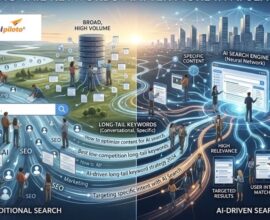
Search behavior is changing quickly. People still use traditional search engines, but they increasingly turn to AI assistants and answer engines to compare options, understand problems, and discover businesses. For companies planning long-term growth, the challenge is no longer just earning rankings. It is becoming a reliable, recognizable source of information wherever customers search.
An effective AI-first search strategy does not mean abandoning established SEO practices or publishing endless AI-generated articles. It means building a stronger discovery system around customer needs, useful content, technical accessibility, and measurable business outcomes. An experienced India SEO company can help businesses connect these elements into a practical strategy rather than treating AI search as a passing trend.
What Does an AI-First Search Strategy Mean?
An AI-first search strategy prepares a business to be discovered across traditional search engines, AI-generated answers, conversational assistants, and other emerging discovery experiences. Instead of focusing exclusively on a list of target keywords, it considers the questions customers ask, the information they need, and the sources they may trust when making decisions.
Imagine a business owner searching for an accounting platform. They might begin with a broad Google query, ask an AI assistant to compare software options, and then search for reviews before requesting a demonstration. Each step reveals a different information need.
A strong strategy makes the business useful throughout that journey. It combines traditional search optimization with clear explanations, credible evidence, relevant brand information, and content that helps people evaluate their options.
Importantly, “AI-first” should describe the planning approach, not an assumption that every customer now uses AI. Traditional search, referrals, social platforms, and direct visits remain relevant. Businesses should follow the behavior of their actual audiences rather than reorganizing everything around a fashionable label.
Understand How Customers Discover Businesses
Before changing content or technology, map the way customers move from a question to a decision. Search journeys are rarely as tidy as a marketing funnel diagram suggests. A prospect may compare providers, revisit an earlier question, ask an assistant for clarification, and return to a search engine to verify a claim.
Research the questions behind the keywords
Keyword research still provides useful demand signals, but it should be combined with customer questions and commercial context. A phrase such as “CRM software” indicates a broad interest. Questions like “How can a small sales team prevent missed follow-ups?” reveal a specific problem and suggest what a useful answer should contain.
Gather insights from sales calls, support tickets, customer interviews, website search data, competitor content, and relevant search queries. Look for repeated concerns rather than assuming every trending topic deserves an article.
Organize your findings around three broad stages:
- Discovery: People want to understand a problem, a new concept, or a possible opportunity.
- Evaluation: They compare methods, providers, features, risks, and costs.
- Decision: They look for proof, implementation details, service terms, and reasons to trust one option over another.
This structure helps businesses create content that serves different needs instead of repeatedly publishing introductory articles.
Build Content That AI Systems and People Can Understand
AI search experiences can use different methods to find, interpret, and summarize information. Some may retrieve relevant passages from web pages, while others may combine search results with structured or connected sources. There is no universal formula that guarantees a page will be selected.
Still, clear and well-supported content gives readers a better experience and provides search systems with information that is easier to interpret.
Answer the main question early
Do not make readers work through several paragraphs of background before revealing what a page is about. Introduce the problem, provide a direct explanation, and then explore the details. This is not about reducing every topic to a short answer; it is about making the central point easy to find.
For example, an article about website migration should explain what a migration involves before discussing redirects, URL mapping, analytics checks, and recovery planning. Each section can then address one practical question in sufficient depth.
Develop a connected library of expertise
A single article rarely covers every question associated with a complex business subject. Build related resources that work together: a central guide, supporting explainers, comparisons, troubleshooting advice, and original case studies where evidence is available.
For a company working on AI search optimization, that library might cover semantic SEO, entity consistency, structured data, content quality, technical SEO, and AI visibility measurement. Each page should offer a distinct benefit and link to related material when it genuinely helps the reader.
Avoid publishing near-identical articles simply to target small variations of a keyword. A focused, accurate resource is usually more valuable than several pages competing to answer the same question.
Strengthen Brand Credibility Across the Web
Visibility is only part of the challenge. When customers encounter a brand in an AI-generated answer, they may investigate the company before deciding whether to engage. Clear and consistent business information helps them understand who the organization is, what it offers, and why it might be relevant.
Make sure your website communicates your services, expertise, service areas, and contact details accurately. Keep business profiles updated, use consistent brand descriptions where appropriate, and ensure that important claims can be verified.
Credibility also depends on the quality of the information itself. Include qualified author details when relevant, cite original research, distinguish documented outcomes from illustrative examples, and update content when facts or services change.
These actions support a broader concept often described as brand authority in AI search. However, no single profile, mention, backlink, or schema implementation guarantees a recommendation from an AI platform. Different services use different systems, and their selection criteria are not fully interchangeable.
Make Technical SEO Part of the Strategy
Useful content needs a dependable technical foundation. If important pages cannot be crawled, contain broken links, or hide essential information behind inaccessible interactions, they may be harder for search systems and users to reach.
Technical SEO remains a core part of AI-first search because it helps businesses maintain accessible, organized websites. Begin with the fundamentals rather than searching for a special technical trick designed exclusively for AI.
- Check crawling, indexing, redirects, canonical tags, and HTTP status codes.
- Use descriptive page titles, logical headings, and readable URL structures.
- Connect related pages with meaningful internal links.
- Keep important business and product information accurate and accessible.
- Implement relevant structured data that matches the visible page content.
- Review mobile usability, page speed, and navigation on key landing pages.
Google’s SEO Starter Guide explains foundational practices for helping search engines understand website content. Google also provides guidance on creating helpful, reliable, people-first content.
These are useful foundations, not promises of AI inclusion. Businesses should also review the current documentation for the specific AI search products that matter to their audience.
Use AI Carefully in Your Content Workflow
AI tools can help teams research topics, organize customer questions, generate content outlines, identify gaps, and summarize large collections of feedback. Used thoughtfully, they can reduce repetitive work and free specialists to focus on deeper analysis.
The risk appears when speed becomes the main objective. Publishing unverified statements or large volumes of generic material can weaken a site’s usefulness and credibility. AI-generated content still needs editorial judgment, factual checks, and a clear reason to exist.
A responsible workflow might follow these steps:
- Research: Use analytics, customer conversations, and credible sources to identify genuine information needs.
- Plan: Assign each page a clear audience, purpose, and primary question.
- Create: Combine subject expertise with AI assistance where it adds value.
- Verify: Check factual claims, links, examples, product details, and any statistics before publishing.
- Improve: Review performance and reader feedback, then update pages where the evidence suggests a real need.
For organizations modernizing their broader digital operations, a digital innovation company in India can help align content processes, website technology, analytics, and customer experience. The aim should be a more useful and efficient system, not automation for its own sake.
Measure Visibility Beyond Traditional Rankings
An AI-first strategy needs measurable objectives. Rankings and organic traffic remain important, but they do not show the entire customer journey. A business may also want to understand whether its brand appears in relevant AI responses, whether those appearances lead to qualified visits, and whether organic discovery contributes to revenue.
Choose a small set of indicators that reflect your goals:
- Search performance: Organic impressions, clicks, rankings, and landing-page engagement.
- AI visibility: Brand mentions, cited URLs, and presence across a consistent set of relevant questions and platforms.
- Content effectiveness: Qualified traffic, useful engagement, and progression to relevant service or product pages.
- Commercial results: Qualified leads, conversion rates, sales opportunities, and revenue where attribution is reliable.
AI answer monitoring requires care. Outputs can vary by platform, query wording, geography, language, and time. A brand appearing once does not establish sustained visibility, and absence from one response does not prove that a content strategy has failed.
Build a repeatable test set from real customer questions, record observations periodically, and compare them with analytics and CRM data. A digital marketing services in India strategy can then connect discovery insights to lead generation and conversion performance, without confusing correlation with proven causation.
Create a Practical Roadmap for Future Growth
Businesses do not need to transform every page at once. A phased approach makes it easier to prioritize work, evaluate results, and learn where AI discovery matters most.
- Audit existing assets: Identify your most important pages, technical issues, content gaps, and inconsistent brand information.
- Prioritize commercial topics: Focus first on customer questions closely connected to your products, services, and expertise.
- Improve core resources: Strengthen key guides, comparison pages, service pages, and evidence-led content.
- Connect the experience: Improve internal links and ensure visitors can move naturally from education to evaluation and action.
- Establish measurement: Track search performance, selected AI visibility observations, and business outcomes.
- Review and adapt: Use results and customer feedback to refine the strategy instead of following every new AI trend.
Future growth is more likely to come from sustained improvement than from chasing a supposedly perfect AI-search formula. The strongest plan is one that your team can maintain, evaluate, and improve as customer behavior evolves.
Frequently Asked Questions
1. What is an AI-first search strategy?
An AI-first search strategy prepares a business for discovery across traditional search engines and AI-powered experiences. It combines customer-focused content, technical SEO, brand credibility, and measurement rather than relying on keyword rankings alone.
2. Does AI-first SEO replace traditional SEO?
No. Technical accessibility, useful content, internal linking, and relevant search optimization remain important. An AI-first approach builds on these foundations while considering how customers discover information through conversational assistants and generated answers.
3. How can businesses improve their chances of appearing in AI answers?
Publish accurate and useful information, answer specific customer questions, organize related resources clearly, maintain technical accessibility, and support important claims with credible evidence. These practices can improve content quality but cannot guarantee a mention or citation on any platform.
4. How should companies measure AI search performance?
Track a consistent set of relevant questions across selected AI platforms and record brand mentions and source citations. Compare those observations with organic search metrics, qualified website visits, leads, and sales to understand whether visibility contributes to business outcomes.
Final Thoughts
An AI-first search strategy is not about predicting every change in technology. It is about making your business easier to discover, understand, and trust. By combining useful content, strong technical foundations, credible brand information, and meaningful measurement, companies can build a flexible search strategy that supports sustainable growth as customer discovery continues to evolve.
Blog Development Credits
Amlan Maiti shaped the article’s concept, with research and drafting supported by AI tools before editorial refinement and SEO improvements from Amlan Maiti and Digital Piloto Private Limited.