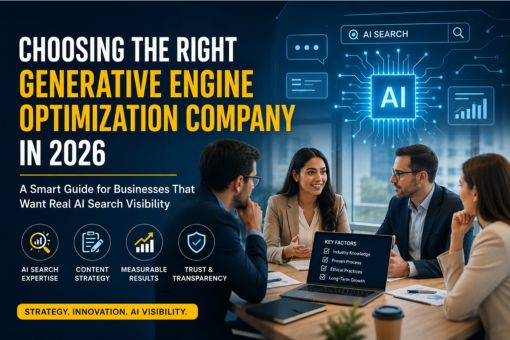
Search engines are changing faster than most businesses expected. In 2026, it’s no longer just about ranking on page one of Google—it’s about being discovered inside AI-generated answers, conversational search tools, and intelligent recommendation systems. That shift has pushed many brands to look for a reliable generative engine optimization company that understands how modern AI-driven search actually works.
But here’s the tricky part: not every agency claiming “AI optimization” truly understands generative search behavior. Some are simply repackaging traditional SEO tactics with new buzzwords. Choosing the right partner now requires a deeper look at strategy, adaptability, and technical understanding.
What Is Generative Engine Optimization?
Generative Engine Optimization, often called GEO, focuses on improving how brands appear in AI-powered search environments. Unlike traditional SEO, which mainly targets keyword rankings, GEO aims to make content understandable, trustworthy, and contextually useful for AI models.
Think about how people search today. Instead of typing “best CRM software,” users now ask full conversational questions like, “Which CRM works best for small agencies with remote teams?” AI systems generate summarized responses rather than simple blue links. If your brand isn’t optimized for those systems, visibility drops quietly—even if your website traffic once looked healthy.
According to research published by Pew Research Center, AI-assisted information discovery continues to rise across industries, especially among younger internet users who prefer conversational search experiences over traditional browsing.
Also Read: Hyper-Personalisation: Reach the Right Customer Instantly
Why Businesses Are Prioritizing GEO in 2026
There’s a growing realization among brands that traditional SEO alone may not sustain long-term visibility. AI-generated search summaries are reshaping how users consume information online.
Here’s why GEO matters now more than ever:
- AI-first search is expanding: More platforms are integrating generative AI into search experiences.
- User behavior is evolving: People increasingly ask conversational, detailed questions.
- Trust signals matter more: AI engines prioritize credible, structured, and authoritative content.
- Brand visibility is shifting: Being cited in AI-generated answers can drive high-quality traffic.
Honestly, it’s a little similar to the early days of SEO. Businesses that adapt early often gain a lasting competitive advantage while others struggle to catch up later.
How to Choose the Right GEO Company
1. Look Beyond Marketing Buzzwords
A surprising number of agencies talk confidently about AI optimization without offering clear methodologies. Ask practical questions instead:
- How do they optimize content for AI-generated answers?
- Do they understand semantic search and entity-based optimization?
- Can they explain structured data implementation clearly?
A genuine GEO agency should comfortably discuss topics like natural language processing, AI content visibility, knowledge graphs, and search intent modeling—not just backlinks and rankings.
2. Check Their Technical Depth
Modern search optimization now overlaps heavily with technology. That’s why companies with strong software and development backgrounds often perform better in GEO campaigns.
For example, partnering with a technically experienced Kolkata based software company can sometimes offer an advantage because they understand both AI systems and backend optimization requirements.
Technical SEO used to be optional for some businesses. In 2026, it’s foundational.
3. Evaluate Content Strategy Carefully
Here’s where many brands still make mistakes. AI engines value content that sounds natural, answers questions directly, and demonstrates expertise. Thin keyword-heavy articles rarely perform well anymore.
The right generative engine optimization partner should help you create:
- Conversational long-form content
- Topical authority clusters
- Structured FAQ sections
- Expert-driven informational resources
According to guidance from Google Search Central, high-quality content should prioritize user experience, expertise, and trustworthiness rather than simply targeting algorithms.
Red Flags to Watch Out For
Not every agency advertising GEO services is prepared for the complexity involved. A few warning signs are worth paying attention to.
Potential Red Flags
- Guaranteed AI rankings: No company can honestly promise fixed placements inside generative systems.
- Overuse of automation: Excessive AI-generated content without human refinement often performs poorly.
- No reporting transparency: You should understand what metrics are being tracked and why.
- Ignoring brand voice: GEO still requires authentic communication tailored to real audiences.
Sometimes, the most impressive sales pitch hides the weakest strategy. A little skepticism can actually save your marketing budget.
Questions to Ask Before Hiring
Before signing any contract, take time to ask thoughtful questions. It reveals how prepared the company really is.
- How do you measure AI search visibility?
- What industries have you worked with?
- How do you combine traditional SEO with GEO?
- What role does human editing play in content creation?
A confident agency usually welcomes detailed conversations instead of avoiding specifics.
FAQs
Q1. What does a generative engine optimization company do?
A generative engine optimization company helps businesses improve visibility within AI-powered search systems by optimizing content structure, authority, conversational relevance, and semantic understanding.
Q2. Is GEO different from traditional SEO?
Yes. Traditional SEO focuses heavily on keyword rankings and search engine results pages, while GEO emphasizes AI-generated answers, contextual relevance, and conversational search experiences.
Q3. Can small businesses benefit from GEO services?
Absolutely. Smaller businesses often gain visibility opportunities through high-quality niche content and expert positioning in AI-driven search environments.
Q4. How long does GEO take to show results?
Results vary based on competition, industry, and existing website authority. Some improvements may appear within months, while broader authority-building strategies take longer.
Final Thoughts
Choosing the right GEO company in 2026 isn’t simply about finding another digital agency—it’s about finding a long-term strategic partner that understands how AI is reshaping online discovery. The companies that adapt thoughtfully today will likely remain visible tomorrow, while others risk fading quietly into digital background noise.
Also Read: Best IT & Software Companies in Kolkata: A Complete Guide
Blog Development Credits:
This article idea was originally shaped by Amlan Maiti. It was researched and drafted using AI platforms such as ChatGPT, Gemini, and Copilot, and later refined with SEO insights from Digital Piloto Private Limited.