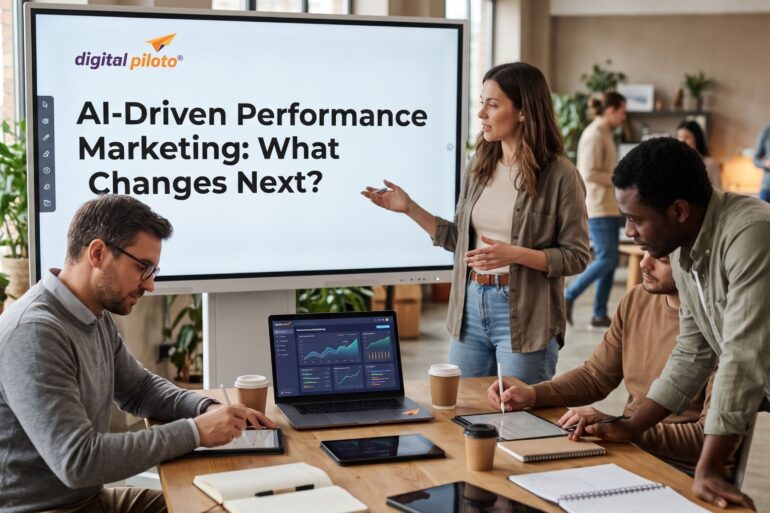
Performance marketing has always been about accountability: spend money, attract the right audience, and measure what happens next. But AI is changing how campaigns make decisions, use data, and respond to customers. The next phase will involve more than automated bidding. It will reshape how businesses plan, personalise, optimise, and measure growth.
From Campaign Automation to Intelligent Marketing
Imagine running an online campaign for a business selling premium office furniture. Traditionally, the marketing team would select an audience, create advertisements, set a budget, and monitor clicks and conversions. If performance dropped, someone would investigate the reports and adjust the campaign.
Now imagine a system that can analyse audience behaviour, identify patterns across campaigns, recommend creative changes, and adjust bids as new information becomes available. The marketing team still sets the direction, but AI helps process information and make routine decisions faster.
This is the direction in which performance marketing is moving. A forward-looking digital marketing agency in India must increasingly combine human strategy with machine-assisted optimisation. The goal is not to remove marketers from the process. It is to help them spend less time managing repetitive tasks and more time understanding customers and improving business outcomes.
What AI Actually Changes in Performance Marketing
Artificial intelligence is not a single feature that can be switched on to make every campaign successful. It includes several technologies and capabilities, such as machine learning, predictive analytics, natural language processing, recommendation systems, and generative AI.
Each can support a different part of the marketing process. Machine learning can identify patterns in campaign data. Predictive models can estimate the likelihood of future actions. Generative AI can help produce creative variations. Recommendation systems can support personalised product or content suggestions.
The real opportunity appears when these capabilities work together within a carefully managed marketing strategy.
1. Smarter audience targeting
Traditional targeting often relies on broad categories such as age, location, interests, or previous website activity. These signals can still be useful, but they do not always explain whether someone is ready to buy.
AI-assisted audience analysis can help identify patterns associated with stronger conversion potential. For example, an ecommerce business may discover that visitors who compare product specifications, return to a pricing page, and read delivery information behave differently from people who only browse the homepage.
Rather than treating every visitor equally, marketers can use these insights to shape more relevant campaigns. However, predictions are not guarantees. A person who looks likely to purchase may still change their mind, so audience models should be evaluated against actual results.
2. Predictive analytics for better decisions
One of the most useful changes is the move from simply reporting what happened to estimating what may happen next.
Predictive marketing tools can help teams examine historical performance, customer interactions, and other permitted data to identify potential trends. A business might use these insights to estimate which leads deserve quicker follow-up or which customer groups are more likely to respond to a particular offer.
This can improve planning, but it depends on data quality. Incomplete records, outdated assumptions, and sudden changes in customer behaviour can make predictions unreliable. Human review remains essential, especially when decisions affect budgets or customer treatment.
Creative Development Will Become More Adaptive
For years, advertising teams have faced a familiar challenge: producing enough creative variations without losing quality. Different audiences respond to different messages, and a campaign that works well for one group may perform poorly with another.
Generative AI can help teams explore more creative directions. It can support headline variations, image concepts, product descriptions, video scripts, and alternative calls to action. Instead of spending hours creating every first draft manually, marketers can use AI to develop options and then apply their judgement.
Why creative testing still needs people
More variations do not automatically mean better advertising. An AI-generated headline may be grammatically polished but fail to communicate the brand’s actual value. A product image may look attractive while presenting a misleading impression of what customers will receive.
A sensible creative workflow should include:
- Human-led positioning: Define the audience, product benefit, brand voice, and campaign objective before generating variations.
- AI-assisted production: Develop alternative headlines, descriptions, formats, and creative concepts.
- Editorial review: Check accuracy, originality, tone, visual quality, and compliance with platform policies.
- Structured testing: Compare creative performance using meaningful conversion metrics rather than clicks alone.
The strongest arrangement is collaborative. AI expands the range of ideas that can be tested, while people decide which ideas deserve to represent the brand.
Campaign Optimisation Will Become More Continuous
Campaign optimisation has traditionally involved reviewing reports at regular intervals and making adjustments based on performance. Automated advertising platforms already use machine learning for functions such as bidding, delivery, and audience optimisation.
The next stage is likely to involve more connected decision-making across campaign activities. Systems may help marketers identify underperforming segments, suggest budget adjustments, detect creative fatigue, and surface changes in conversion patterns.
Consider a lead-generation campaign for a business software provider. The campaign may generate many form submissions, but a large share of those leads might be unsuitable. A more useful optimisation process would examine which audience and creative combinations generate qualified opportunities, not merely the lowest cost per form submission.
Move beyond clicks and cheap leads
A low cost per click can look impressive in a dashboard. Yet if those visitors never enquire, purchase, or return, the campaign may not be creating meaningful value.
Businesses should connect advertising data with downstream outcomes wherever practical. This may involve integrating analytics, customer relationship management systems, and sales feedback to understand what happens after a conversion event.
That connection helps teams distinguish between activity and genuine commercial progress.
Personalisation Will Become More Contextual
Customers rarely follow identical journeys. Someone researching a product for the first time needs a different message from someone who has compared several options and is close to purchasing.
AI can help marketers recognise these differences and deliver more relevant experiences. For example, a returning visitor to an ecommerce store might receive recommendations based on products they previously explored, while a first-time visitor may benefit more from a clear introduction to the brand.
Personalisation can also extend to timing, communication channels, and content formats. But there is a fine line between relevance and intrusion. Businesses should use appropriate data, respect customer preferences, and explain how personal information is handled.
The Role of Data and Digital Infrastructure
AI-powered campaigns depend on more than clever algorithms. They need reliable data, connected platforms, clear measurement, and a website that can turn interest into action.
For example, an advertisement may attract the right visitor, but a slow landing page or confusing enquiry form can still lose the opportunity. Similarly, disconnected customer records can make it difficult to understand whether an advertising lead eventually became a paying customer.
This is why business digital transformation services can play an important role in a broader performance strategy. Integrating marketing platforms, analytics, websites, and CRM systems gives businesses a more connected view of the customer journey.
Build a dependable measurement foundation
Before investing heavily in advanced AI features, businesses should check whether their existing measurement setup is trustworthy. Useful foundations include:
- Consistent conversion definitions across advertising and analytics platforms.
- Accurate tracking of purchases, qualified leads, and other meaningful actions.
- Clear data ownership, access controls, and privacy practices.
- Reliable CRM records and feedback from sales teams.
- Regular checks for duplicate, missing, or incorrectly attributed conversions.
Without these foundations, an AI system may optimise towards the wrong outcome with impressive efficiency. Better automation cannot compensate for misleading inputs.
What Happens to the Marketer’s Role?
As AI takes on more repetitive analysis and campaign operations, the marketer’s role will evolve. The value of a marketing professional will increasingly come from asking better questions, setting meaningful objectives, interpreting results, and making decisions that reflect the wider business context.
For example, an automated system might identify that a particular audience segment is producing more conversions. A skilled marketer still needs to ask whether those conversions are profitable, whether the customers fit the brand, and whether the trend is likely to continue.
Strategic thinking, creative judgement, customer understanding, and ethical responsibility will remain important. In fact, they may become more valuable as the volume of machine-generated recommendations increases.
For businesses also investing in organic growth, SEO marketing in India can complement paid performance campaigns by building discoverability, relevant website traffic, and long-term content value. Paid and organic channels should not operate as isolated departments when they influence the same customer journey.
How Businesses Can Prepare for the Next Phase
There is no need to automate every marketing activity at once. A more practical approach is to identify areas where AI can solve a clear problem and test its impact before expanding its role.
- Audit current campaigns: Identify where teams spend time on repetitive reporting, manual segmentation, or routine creative production.
- Improve data quality: Check conversion tracking, CRM integration, consent practices, and attribution assumptions.
- Choose a focused use case: Start with a manageable application, such as creative testing or lead-quality analysis.
- Keep human approval: Set clear rules for budget changes, customer communications, and sensitive decisions.
- Measure business outcomes: Compare qualified leads, revenue, customer acquisition cost, and profitability where data is available.
- Expand based on evidence: Scale the applications that demonstrate consistent value rather than adopting AI simply because it is new.
This measured approach reduces unnecessary complexity and helps teams understand where automation genuinely improves performance.
Challenges Businesses Should Not Ignore
AI-driven marketing brings real opportunities, but it also introduces risks. Poor-quality data can lead to poor decisions. Automated creative can produce inaccurate claims. Over-personalisation can damage customer trust. Platform automation may also make it harder to understand exactly why a campaign changed direction.
Businesses should establish clear governance around data access, creative approval, platform permissions, and budget controls. They should also review AI-generated recommendations rather than assuming that an automated decision is necessarily a good one.
Another concern is overdependence on a single advertising platform. If a business relies entirely on one channel’s automated targeting and reporting, changes to platform policies or measurement systems can create unexpected disruption. A balanced strategy should develop customer relationships and brand visibility across multiple relevant channels.
Frequently Asked Questions
1. What is AI-driven performance marketing?
AI-driven performance marketing uses artificial intelligence and machine learning to support activities such as audience analysis, bidding, creative development, personalisation, and campaign optimisation. Its purpose is to improve decision-making and marketing efficiency while keeping business outcomes at the centre.
2. Can AI reduce the cost of customer acquisition?
AI may help reduce customer acquisition costs by improving targeting, identifying stronger-performing campaigns, and supporting more relevant customer experiences. However, results depend on data quality, competition, campaign strategy, and the value of the customers acquired. Lower costs are not guaranteed.
3. Will AI replace performance marketing professionals?
AI is more likely to change marketing responsibilities than eliminate the need for skilled professionals. Marketers will continue to provide strategic direction, creative judgement, customer understanding, governance, and oversight of automated systems.
4. How can a small business start using AI in advertising?
A small business can begin with accessible tools for creative assistance, reporting, audience insights, or automated bidding. It should first establish reliable conversion tracking, test one practical use case, and evaluate whether the results improve qualified leads or sales.
Final Thoughts: Smarter Decisions, Not Just More Automation
The future of performance marketing will not be defined by how many tasks a business can automate. It will be defined by how intelligently it combines data, technology, creativity, and human judgement. AI can help campaigns become more responsive and efficient, but lasting growth still depends on understanding customers and delivering genuine value. The businesses that get this balance right will be better prepared for what comes next.
Blog Development Credits
This article was conceptualised by Amlan Maiti, shaped through research and AI-assisted content development, and refined with editorial and SEO expertise from Digital Piloto Private Limited.