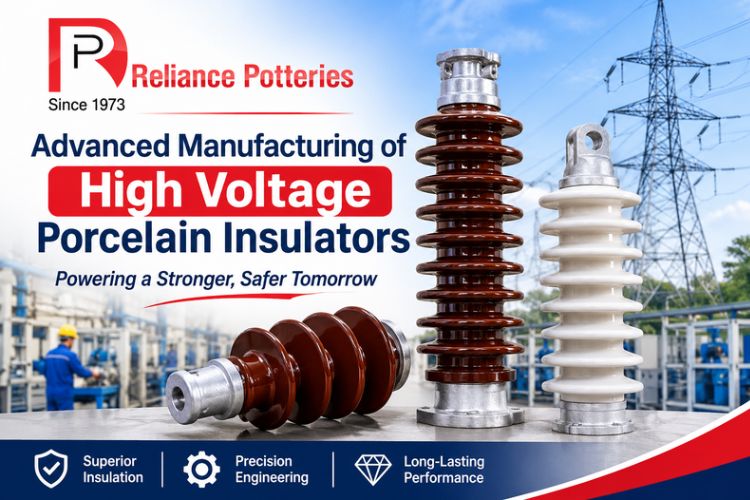
High-voltage porcelain insulators are essential components in electrical transmission, distribution, transformers and industrial power systems. Their reliability depends on more than the quality of ceramic materials. Precise manufacturing, controlled firing, accurate shaping and rigorous electrical and mechanical testing all contribute to their performance. When evaluating Porcelain Insulators Manufacturers in India, electrical engineers and procurement professionals should understand these manufacturing requirements before selecting a supplier.
Also Read: Common Mistakes Industrial Buyers Make When Selecting Electrical Insulators
Understanding High-Voltage Porcelain Insulators
High-voltage porcelain insulators are engineered ceramic components designed to provide electrical insulation while supporting mechanical loads in power equipment. They are used in transformer bushings, switchgear, substations, electrostatic precipitators (ESP), and other industrial electrical installations.
Electrical porcelain commonly uses carefully proportioned clay or kaolin, feldspar and quartz. Depending on the application, high-alumina formulations and other constituents may also be used to achieve specific mechanical, dielectric and thermal properties.
Advanced Manufacturing Process of Porcelain Insulators
1. Raw Material Selection and Preparation
Manufacturing begins with selecting suitable raw materials. Chemical composition, particle size and material consistency influence the final ceramic body’s electrical and mechanical properties. Manufacturers must inspect incoming materials and maintain controlled proportions to reduce variations between production batches.
2. Grinding, Mixing and Filtration
Selected materials are processed through ball mills with controlled water addition to create a uniform ceramic slurry. Sieving removes unwanted particles, while filtration and filter pressing help achieve the required moisture content.
Consistent material preparation helps reduce contamination, uneven composition and defects that can affect subsequent forming and firing operations.
3. Vacuum De-Airing and Shaping
The prepared ceramic body is processed through vacuum pug mills or extrusion equipment to remove entrapped air and improve material uniformity. Depending on product geometry, pressing, extrusion, turning or other forming techniques can be used.
Accurate shaping is particularly important for porcelain bushings and support insulators because dimensional variation can affect fitting alignment, assembly tolerances and electrical design requirements.
4. Controlled Drying and Surface Preparation
Freshly formed components contain moisture that must be removed under controlled conditions. Uneven drying can produce cracks, warping and dimensional inconsistencies. Trimming and grinding operations help achieve the required geometry and surface finish before subsequent processing.
5. Glazing and High-Temperature Firing
Glazing and kiln firing are important stages in electrical porcelain production. The firing schedule must be matched to the ceramic formulation and component dimensions to achieve appropriate vitrification, density and mechanical properties.
Correctly controlled firing helps limit excessive porosity and supports the electrical insulation performance of the finished body. An unsuitable firing profile can compromise strength, dimensional accuracy and product consistency.
6. Assembly and Finishing
After firing and inspection, components requiring metallic fittings are assembled according to the product design. Alignment, interface condition, dimensional tolerance and fitting quality are important considerations for transformer bushings and other assembled insulators.
7. Electrical and Mechanical Testing
Finished insulators require inspection and testing according to their application and applicable specifications. Depending on product type, tests may include dimensional verification, power-frequency voltage withstand, impulse withstand, mechanical loading, thermal-mechanical performance and other specified checks.
Different tests identify different potential weaknesses. A visual inspection alone cannot establish dielectric integrity or confirm mechanical performance.
Advanced Machinery and Process Control
Modern porcelain manufacturing requires suitable equipment at every production stage. Reliance Potteries’ published ESP manufacturing facilities identify vacuum pug mills, ball mills, vibration sieves, filtering machines, trimming machines, grinding machines and advanced oil furnaces.
The company also identifies CAD/CAM-based design facilities for developing products according to customer requirements. These capabilities support controlled material preparation, component shaping, finishing and customized product development.
Such equipment is particularly relevant when manufacturing cylindrical and conical ESP support insulators, shaft insulators, wall-through bushings and other specialized ceramic components.
Quality Standards and Testing Requirements
High-voltage porcelain products must be evaluated against standards appropriate to their design and application. Relevant references include:
- IEC 60137: Insulated bushings for alternating voltages above 1,000 V.
- IEC 60168: Testing of indoor and outdoor ceramic or glass post insulators above 1,000 V.
- IS 2099: Indian Standard reference for bushings operating at alternating voltages above 1,000 V.
- IS 5621: Indian Standard reference for hollow insulators used in electrical equipment.
- IEC 60507: Artificial pollution testing of high-voltage ceramic and glass insulators used in AC systems.
The Central Electricity Authority’s 2026 quality assurance guidance emphasizes type tests, routine tests and special tests, supported by documented manufacturing controls and inspection. Manufacturers and purchasers should agree on the precise testing schedule and applicable standard editions for each product.
Choosing Reliable Porcelain Insulators Manufacturers in India
Industrial buyers should evaluate more than product price when selecting a porcelain insulator manufacturer. Important considerations include:
- Raw material quality and batch consistency.
- Suitable manufacturing machinery and forming capabilities.
- Controlled drying, glazing and firing processes.
- Dimensional accuracy and finishing standards.
- Product-specific electrical and mechanical testing facilities.
- Technical documentation, inspection records and traceability.
- Customization capabilities and delivery commitments.
Manufacturers should also understand the operating environment, including pollution levels, temperature variations, moisture exposure and mechanical loading. These conditions influence product design and specification.
Why Consider Reliance Potteries?
Established in 1973, Reliance Potteries is a Kolkata-based manufacturer and exporter of high-tension electro-porcelain insulators. The company provides products for power equipment and industrial applications, including transformer bushings, hollow porcelain bushings, ESP support insulators, shaft insulators, solid-core insulators and other specialized ceramic components.
Its published manufacturing information highlights Total Quality Management, advanced testing facilities, customized design capabilities and machinery supporting its porcelain production operations.
For electrical equipment manufacturers, industrial buyers and power-sector organizations seeking dependable Insulator Suppliers, selecting a manufacturer with appropriate engineering capabilities and documented quality processes is an important step toward reliable equipment performance.
Frequently Asked Questions
What materials are used to manufacture high-voltage porcelain insulators?
Common materials include kaolin or clay, feldspar and quartz. High-alumina formulations and other constituents may be used according to the required application and material properties.
Why is vacuum pugging important in porcelain manufacturing?
Vacuum pugging helps remove trapped air from the ceramic body, improving material uniformity and supporting consistent forming.
Which tests are important for high-voltage porcelain insulators?
Depending on the product, important tests include dimensional inspection, electrical withstand testing, mechanical loading and thermal-mechanical performance testing.
Which standards apply to porcelain bushings?
IEC 60137 covers insulated bushings for AC voltages above 1,000 V. IS 2099 is another relevant Indian standard reference. The applicable edition and purchaser specification should be verified before testing.
How can buyers evaluate a porcelain insulator manufacturer?
Evaluate raw material controls, machinery, manufacturing processes, application-specific testing, technical documentation and the ability to meet customized specifications.
Conclusion
Advanced manufacturing of high-voltage porcelain insulators combines material science, precision forming, controlled firing, accurate assembly and systematic testing. Every stage contributes to the final product’s electrical and mechanical characteristics.
Reliance Potteries combines its established manufacturing background with specialized porcelain products and customized design capabilities for industrial electrical applications. Explore its product collections and contact the team to discuss your specific insulator requirements.
Also Read: Why HV Bushing Quality Matters in Transformers
Blog Development Credits
This blog was developed by Reliance Potteries with research support from advanced AI platforms including ChatGPT, Google Gemini, and Copilot. The content was further reviewed, refined, and optimized for SEO performance by Reliance Potteries.