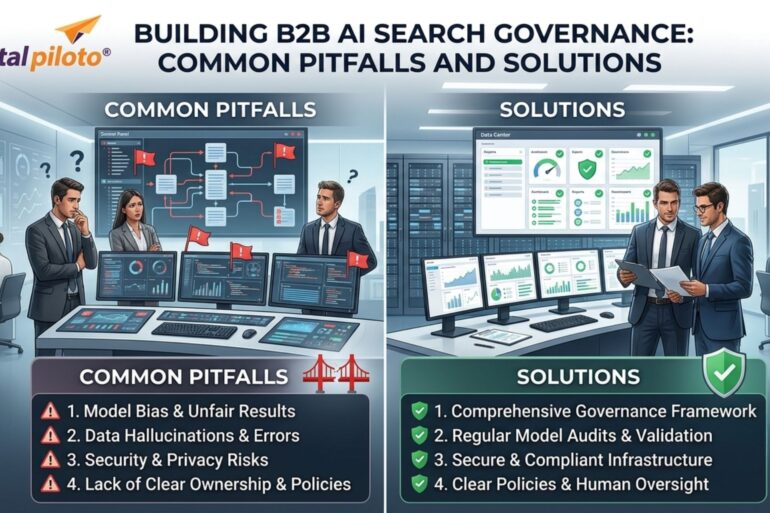
B2B search is becoming harder to manage because discovery no longer happens only through traditional rankings. Buyers can encounter a company through AI-generated answers, conversational search, recommendation systems and conventional results. For any digital marketing agency, the challenge is no longer visibility alone. It is controlling accuracy, consistency, access and accountability.
Why B2B AI Search Needs Governance
Imagine a potential buyer researching your company before a sales call. They ask an AI system what your business does, which industries you serve, what products you offer and whether you are suitable for an enterprise project.
The answer may be useful. It may also contain an outdated service description, an old product name, a missing capability or a claim your company never made.
That creates an unusual B2B problem.
Your website may be perfectly accurate, yet the information being surfaced about your brand can come from a wider collection of pages, documents, directories, reviews, third-party publications and other publicly accessible sources.
AI search governance is therefore about creating a repeatable system for managing how business information is represented, discovered, evaluated and measured across AI-assisted search environments.
It is not about trying to control every answer. That would be unrealistic.
It is about making the underlying information ecosystem clear enough, trustworthy enough and well-maintained enough that AI systems have better material to work with.
What B2B AI Search Governance Actually Covers
Governance can sound like a legal department’s word for “more paperwork.” In practice, good governance should do almost the opposite. It should reduce confusion.
A useful B2B AI search governance framework brings together five areas:
- Information governance: Which facts about the company are official, current and approved?
- Content governance: Who creates, reviews, updates and retires search-facing content?
- Technical governance: Can search engines and AI crawlers access the information they need?
- Risk governance: How are inaccurate, sensitive, misleading or outdated claims identified?
- Measurement governance: How does the company know whether AI-search visibility is improving?
The goal is not to create another isolated SEO process. It is to connect marketing, sales, product, legal, communications, IT and subject-matter experts around a shared information standard.
Pitfall #1: Treating AI Search Like Traditional SEO
This is probably the easiest mistake to make.
A company builds a keyword list, assigns rankings to an SEO team and assumes AI search can be managed in exactly the same way.
Traditional SEO remains important. In fact, Google explicitly says its foundational SEO practices continue to apply to AI features such as AI Overviews and AI Mode. Google explains that its generative search experiences are grounded in core Search systems and can use retrieval-augmented generation and related query processes to find supporting information. Google’s guide to optimizing for generative AI search provides the current guidance.
But governance requires a wider lens.
A B2B organization should not only ask, “Where do we rank?” It should also ask:
- What does an AI system understand about our company?
- Which business facts are consistently represented across important sources?
- Which pages explain our expertise clearly?
- Where could outdated information create buyer confusion?
- Which AI-search experiences are actually driving qualified discovery?
Search ranking is a performance signal. Governance is the operating system behind the information being discovered.
Solution: Create an AI Search Information Map
Start by listing the facts an AI system might need when answering questions about the business.
For a B2B company, that could include company name, ownership, headquarters, products, industries served, geographic coverage, certifications, pricing approach, integrations, customer segments, expertise, leadership and contact information.
Then classify each fact.
Official. Verified. Time-sensitive. Restricted. Deprecated.
This simple classification can reveal something surprising: different departments often maintain different versions of the same truth.
Marketing might describe a service one way. Sales might use another description in proposals. The product team may have changed the feature six months ago. An old PDF may still be publicly accessible.
AI search makes these inconsistencies more consequential because buyers increasingly use conversational systems to synthesize information.
Pitfall #2: Publishing AI Content Without Ownership
Generative AI can dramatically accelerate content production. That is useful—but it also creates a governance trap.
If nobody owns the final output, the company can end up with hundreds of pages that sound polished but contain little distinctive expertise.
Google’s guidance says generative AI can be useful for research and structuring original content, but generating many pages without adding value can fall under its scaled content abuse policies. Google’s guidance on generative AI content explains the distinction.
The issue is not whether AI touched the draft.
The issue is whether someone accountable checked it.
Solution: Establish a human approval chain
Every important B2B content asset should have a clear owner.
A practical workflow might look like this:
- AI-assisted research: identify questions, themes, gaps and supporting information.
- Subject-matter review: validate technical claims, industry terminology and real-world accuracy.
- Editorial review: improve clarity, usefulness and differentiation.
- Compliance review: check claims, confidential information and regulated statements where necessary.
- Publication: publish through the approved content workflow.
- Refresh: review the content according to its business and information shelf life.
This turns AI from an uncontrolled publishing machine into a supervised production tool.
Pitfall #3: Ignoring Third-Party Information
A B2B brand does not exist only on its own website.
Potential buyers may encounter the company through industry publications, partner websites, directories, review platforms, conference pages, social profiles, analyst reports or old press releases.
Some of these sources may contain information that the company has not reviewed for years.
That creates what could be called an external information debt.
It accumulates quietly. An old executive title remains online. A discontinued product appears in a directory. A former office address survives on a third-party profile. A partnership is described as current even though it ended years ago.
When an AI system encounters several sources, inconsistencies can become part of the information landscape from which it constructs an answer.
Solution: Run an entity consistency audit
Review the most important external references to the company and categorize discrepancies by business risk.
Prioritize:
- Company identity and ownership information.
- Products, services and current capabilities.
- Locations and geographic service areas.
- Leadership and subject-matter experts.
- Certifications, partnerships and industry credentials.
- Claims about customers, performance or market position.
The objective is not to manufacture mentions everywhere. In fact, Google’s current generative AI search guidance specifically warns against pursuing inauthentic mentions as an optimization tactic. Quality and genuine relevance matter more than simply accumulating references. Google’s AI search guidance discusses this directly.
Pitfall #4: Confusing Visibility With Control
Some businesses approach AI search governance with an unrealistic objective: “We need to make AI say exactly what we want.”
That is the wrong mental model.
Search systems evaluate information dynamically. Different users can receive different answers. Results can change as sources are updated, models evolve and query context changes.
Governance should therefore focus on influence through trustworthy information, not absolute control over generated answers.
This distinction is important for B2B brands because it changes the operating question.
Instead of asking, “How do we force the model to mention us?” ask, “Have we made our company information clear, useful, accurate and independently supportable?”
The second question is much more productive.
Pitfall #5: Creating “AI-Optimized” Content That Sounds Artificial
Another common mistake is over-engineering content for machines.
Some teams start breaking every paragraph into tiny fragments, repeating target phrases, inserting awkward definitions or producing separate pages for every imaginable question.
Google’s current guidance pushes in the opposite direction. It says there is no ideal page length, no requirement to create tiny content chunks, and no need to rewrite content specifically for AI systems because Google’s systems can understand synonyms and broader meaning. Google’s generative AI optimization documentation explains these points.
For B2B brands, the better approach is surprisingly human.
Answer the real question. Explain the difficult part. Add evidence. Define the terminology that genuinely needs definition. Show what happens in practice.
Good governance should protect content quality from the pressure to produce endless “optimized” pages.
Solution: Build an AI Search Content Standard
Create a short editorial standard that every important search-facing asset must satisfy.
It might require:
- A clearly defined audience and business question.
- Fact verification for important claims.
- Named subject-matter ownership where appropriate.
- Evidence for statistics, research and performance claims.
- Clear distinctions between facts, opinions and projections.
- A review date for information likely to change.
- Removal or updating of obsolete content.
This standard becomes particularly valuable when several teams publish content independently.
Instead of asking everyone to become an SEO expert, the company creates a shared quality baseline.
Pitfall #6: Forgetting Technical Access
Governance cannot stop at editorial policy.
If important information is difficult for crawlers to access, buried behind technical barriers or inconsistently represented across the site, the content strategy may not translate into visibility.
Google states that pages appearing as supporting links in AI Overviews or AI Mode need to be indexed and eligible for normal Search, with no separate technical requirement specifically for AI features. It also recommends established SEO practices such as crawlability, internal linking, good page experience and making important content available in text. Google’s AI features documentation provides the technical guidance.
OpenAI has also published guidance for publishers explaining that public websites can appear in ChatGPT search and that sites wishing to be discoverable and cited should avoid blocking OAI-SearchBot. OpenAI’s publisher and developer FAQ outlines the relevant crawler controls.
That means AI search governance should include technical stakeholders, not just marketers.
Pitfall #7: Measuring Only Rankings
Traditional SEO dashboards often emphasize impressions, clicks, rankings and organic sessions.
Those metrics still matter. But B2B AI-search governance needs additional questions.
Are prospects discovering the company through AI-assisted research? Which pages appear in AI search experiences? Are AI-driven visits producing qualified enquiries? Are sales teams hearing better-informed questions from prospects?
Google expanded Search Console in 2026 with dedicated generative AI performance reporting for Search and Discover. The reporting includes visibility information such as impressions, pages, countries, devices and time periods for generative AI features. Google’s Search Console announcement describes the new reporting capabilities.
That makes AI-search measurement more tangible, but B2B companies should go further by connecting visibility data with CRM and revenue information where possible.
Build Governance Around Risk, Not Bureaucracy
A mature governance model should not treat every page or every AI interaction as equally risky.
A blog explaining general marketing concepts does not carry the same business risk as a page describing medical capabilities, financial services, security products, contractual commitments or technical specifications.
NIST’s AI Risk Management Framework is useful here because it approaches AI risk through functions including Govern, Map, Measure and Manage. Its Generative AI Profile extends the framework to risks that can be introduced or amplified by generative AI systems. NIST’s Generative AI Profile provides the framework and recommended risk-management perspective.
B2B organizations can borrow this mindset without turning their SEO program into a compliance project.
Classify content according to factors such as:
- Business impact: Could an incorrect answer affect revenue or reputation?
- Accuracy sensitivity: Does the information change frequently?
- Regulatory exposure: Are there legal or industry-specific requirements?
- Confidentiality: Could the content expose sensitive information?
- Customer dependency: Could buyers make an important decision based on the information?
High-risk information deserves tighter review cycles. Low-risk content can move faster.
A Practical B2B AI Search Governance Framework
If the organization is starting from scratch, keep the first version simple.
Step 1: Establish ownership. Assign one executive sponsor and operational owners across marketing, content, technology and subject-matter teams.
Step 2: Build the information inventory. Identify important company facts, pages, documents and external profiles.
Step 3: Define content rules. Establish standards for evidence, authorship, AI assistance, approvals and updates.
Step 4: Audit technical accessibility. Check crawling, indexing, internal links, structured data, important textual content and crawler controls.
Step 5: Monitor AI visibility. Track Search Console data, important queries, AI-generated representations and qualified traffic.
Step 6: Connect search with sales. Feed useful discovery and conversion signals into the CRM so marketing can understand whether visibility is contributing to pipeline.
Step 7: Review continuously. AI search changes quickly. Governance should therefore be a living process, not a document stored in a forgotten company folder.
For organizations already investing in SEO services in India, this framework can sit naturally alongside technical SEO, content strategy, analytics and conversion programs.
Where Generative AI Search Optimization Fits
The emergence of generative search does not require B2B businesses to create an entirely separate marketing universe.
Instead, generative AI search engine optimization can be treated as an extension of the broader search strategy: improve the quality of information, clarify entities, strengthen evidence, make important content accessible and understand how customers ask questions in AI environments.
Google’s current guidance is particularly useful here because it pushes back against many supposed AI-search “hacks.” Google says there is no special schema required for AI search and that tactics such as creating unnecessary machine-readable files or chasing artificial mentions do not provide a special advantage in Google Search. Google’s official AI optimization guide recommends returning to useful content and foundational SEO instead.
That is an important governance principle in itself: do not let fashionable tactics outrun verified evidence.
FAQs About B2B AI Search Governance
1. What is B2B AI search governance?
B2B AI search governance is a structured approach to managing the accuracy, accessibility, consistency, quality and measurement of company information across traditional search and AI-assisted discovery environments.
2. Who should own AI search governance?
It should not belong exclusively to SEO. Marketing can coordinate the program, while subject-matter experts, sales, product, IT, communications and legal or compliance teams contribute according to the information and risk involved.
3. Does AI search governance replace traditional SEO?
No. Foundational SEO remains important for AI search. Governance expands the scope by adding information ownership, cross-channel consistency, AI visibility monitoring, risk management and stronger coordination between business teams.
4. How often should a B2B company review its AI-search information?
Review frequency should depend on how quickly the information changes and how much business risk an error creates. Core company information should be checked regularly, while highly sensitive or frequently changing information may require much tighter review cycles.
Final Thoughts
B2B AI search governance is ultimately an information discipline.
The companies that handle it well will not necessarily be the ones trying hardest to “hack” AI visibility. They will be the ones that know what is true about their business, know who owns each important fact, publish genuinely useful expertise, maintain technical accessibility and measure how discovery affects real customers.
AI search is changing quickly. Governance gives businesses something valuable amid that uncertainty: a repeatable way to keep their information trustworthy, discoverable and commercially useful.
Blog Development Credit
Conceptualized by Amlan Maiti, developed through AI-assisted research, and refined with final SEO expertise by Digital Piloto Private Limited.