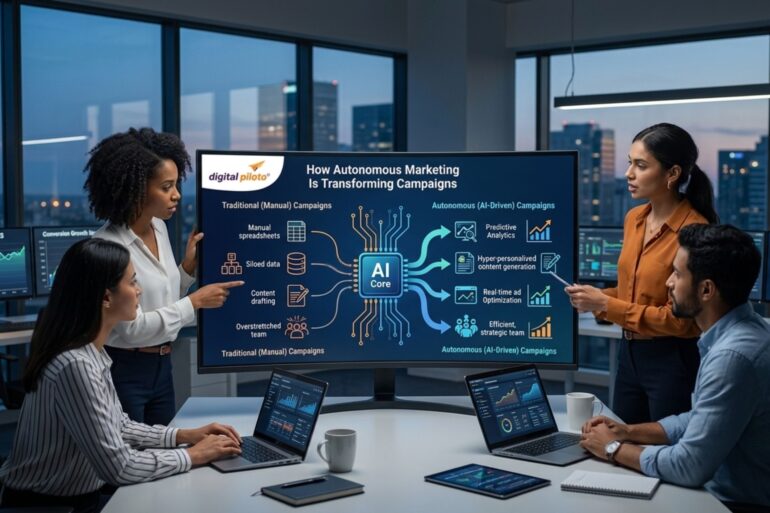
Autonomous marketing is turning campaigns from scheduled, manually managed activities into continuous systems that can interpret customer signals, make decisions, execute actions, measure outcomes, and adapt. Humans still set objectives, budgets, brand rules, and risk boundaries, but AI agents increasingly handle the repetitive decisions and execution that once required marketers to manage every step.
What Is Autonomous Marketing?
Autonomous marketing is a marketing operating model in which AI agents can independently perform multiple connected steps of campaign work—from interpreting signals and selecting audiences to creating content, activating channels, monitoring performance, and recommending or executing changes.
The important word is connected. Generating an email subject line with AI is not autonomous marketing. Automatically adjusting a campaign after performance changes is closer. A system that identifies an opportunity, selects an audience, chooses an action, executes it, evaluates the result, and changes its next action is closer still.
That is why autonomous marketing is best understood as a decision-and-action loop, not simply another name for AI content generation.
Autonomous Marketing vs. Traditional Automation
Marketing automation follows rules that people define. Autonomous marketing introduces systems that can interpret changing conditions and determine the next action within predefined boundaries.
| Marketing model | Who makes the decision? | How it works | Typical example |
|---|---|---|---|
| Manual marketing | Human | People plan and execute most activities | Marketer builds and launches a campaign |
| Rules-based automation | Human-defined rules | Predefined triggers execute predefined actions | Send an email after a form submission |
| AI-assisted marketing | Human with AI assistance | AI recommends, generates or analyzes | AI suggests ad copy or audience segments |
| Agentic marketing | Human + AI agents | Agents coordinate multi-step tasks toward an objective | Agent builds and monitors a campaign workflow |
| Autonomous marketing | AI within human-defined boundaries | Agents continuously sense, decide, act and optimize | System dynamically determines next-best actions for customers |
The boundaries between these categories are not absolute. Most organizations will operate across several maturity levels at the same time.
How Does an Autonomous Marketing Campaign Work?
An autonomous campaign typically operates as a continuous loop rather than a one-time launch.
- Define the objective: Establish the business outcome, such as qualified pipeline, profitable revenue, retention or repeat purchase.
- Collect signals: Bring together customer, product, campaign, behavioral and business data.
- Interpret context: Identify intent, audience characteristics, performance changes and relevant opportunities.
- Select the next action: Decide what should happen next based on the objective and available evidence.
- Generate or select content: Produce or retrieve the appropriate message, offer, creative or asset.
- Choose execution conditions: Determine channel, timing, audience, frequency or budget within permitted limits.
- Execute: Activate the action through connected marketing systems.
- Measure: Observe conversion, engagement, cost, revenue and quality signals.
- Learn: Feed the outcome back into the next decision.
The strategic difference is simple: traditional campaigns often end when they are launched. Autonomous systems are designed to continue making decisions after launch.
Why Campaigns Are Becoming More Autonomous
The pressure comes from three directions: customers expect faster and more relevant interactions, marketing channels are becoming more complex, and AI systems are increasingly capable of working across multiple steps instead of producing one response at a time.
BCG’s 2026 research illustrates the transition. Its survey of 300 global CMOs found that 96% said AI is driving end-to-end transformation, while only about one-third had actually moved into agent-led workflows. Only 8% reported campaigns where multiple agents operated autonomously.
That gap is important. Marketing leaders are increasingly convinced about the direction of travel, but the infrastructure and operating models required to support autonomous execution are still being built.
What Changes Inside the Campaign?
1. Planning becomes continuous
Instead of creating one campaign plan and revisiting it during scheduled reviews, agents can continuously monitor signals and identify where the plan needs adjustment.
Human marketers still determine the business objective. The system increasingly handles the operational question: what should happen next?
2. Segmentation becomes more dynamic
Traditional segmentation groups customers into relatively stable categories. Autonomous systems can evaluate changing behavior and adjust audience membership as new signals appear.
This makes personalization less about creating dozens of static campaigns and more about dynamically selecting an appropriate action for each context.
3. Creative becomes modular
Autonomous marketing works best when creative assets are treated as reusable components rather than isolated campaign files.
Agents can potentially combine approved headlines, product information, images, offers, calls to action and audience-specific messaging according to defined rules.
That does not mean every piece of AI-generated creative should go live automatically. Brand-sensitive or high-risk assets may still require human approval.
4. Paid media becomes more adaptive
Modern advertising platforms already use AI extensively for bidding, targeting and optimization. The next step is increasingly conversational and agentic: marketers can use AI systems to interpret performance, identify opportunities and assist with campaign actions.
Google’s 2026 marketing announcements, for example, describe Ask Advisor as an AI experience spanning Google Ads, Merchant Center and Google Analytics, designed to turn insights into action.
5. Lifecycle marketing becomes more responsive
Email, SMS, messaging and retention programs can move away from rigid sequences toward context-aware next actions.
A customer who repeatedly views a product, abandons checkout and then returns with a high-intent search may not need the same message as someone who has simply opened an email.
The autonomous approach attempts to interpret the complete signal rather than reacting to one trigger in isolation.
6. Reporting becomes decision support
Traditional reporting tells marketers what happened. Agentic systems can increasingly help explain what changed, identify possible causes, suggest actions and monitor the result.
This shifts reporting from a retrospective activity toward an operational control system.
Why Data Quality Matters More in Autonomous Marketing
Autonomy increases the importance of data quality because agents make decisions from the context they can access.
Salesforce’s 2026 State of Marketing research found that 84% of surveyed marketers still run generic campaigns, while 98% reported barriers to personalization. Marketers who said their customer data was satisfactorily unified were also 60% more likely to use AI agents to scale their efforts.
The lesson is straightforward:
The New Autonomous Marketing Stack
A practical autonomous marketing system can be understood as five connected layers.
Layer 1: Data
CRM, analytics, ecommerce, customer behavior, product data, advertising data, conversion data and other business signals.
Layer 2: Intelligence
Models and analytical systems interpret customer intent, performance, propensity, audience characteristics and business conditions.
Layer 3: Agent orchestration
Agents determine which tasks need to be completed, which tools they should use and when another agent or human needs to become involved.
Layer 4: Execution
Connected systems activate email, paid media, CRM updates, website changes, content workflows, commerce experiences and other approved actions.
Layer 5: Measurement and governance
Every action should be measurable, auditable and constrained by business rules, privacy requirements, budgets, brand standards and approval policies.
BCG’s 2026 research similarly emphasizes data foundations, brand intelligence, agent orchestration and organizational capability as key parts of the emerging agentic marketing stack.
What Should Humans Still Control?
Autonomous marketing should not mean unlimited autonomy.
Humans should generally retain responsibility for decisions involving strategic direction, financial risk, brand identity, regulatory exposure and major customer-impact decisions.
- Business objectives: What outcome matters?
- Budget boundaries: How much can the system spend?
- Brand rules: What can and cannot be communicated?
- Privacy and consent: What data may be used and how?
- Risk thresholds: Which actions require approval?
- High-impact decisions: Which customer or commercial situations must remain human-led?
- Strategic positioning: What should the brand stand for?
Agents can increasingly manage execution inside those boundaries. Humans remain accountable for the boundaries themselves.
What Are the Benefits of Autonomous Marketing?
Faster execution
Agents can reduce the amount of manual coordination required to move from insight to action. McKinsey estimates that agentic systems could eventually accelerate campaign creation and execution by 10–15×, although this is an estimate dependent on successful workflow redesign and implementation.
More personalization
Automation becomes difficult when every customer requires a different combination of message, timing and channel. Agents can make those decisions at greater scale.
Continuous optimization
Instead of waiting for a weekly or monthly performance review, systems can respond to changes as they happen.
Lower operational workload
Repetitive tasks such as data gathering, campaign setup, reporting and routine optimization can increasingly be delegated.
Cross-channel coordination
An agentic system can potentially consider multiple channels together rather than optimizing every channel in isolation.
More experimentation
When campaign setup and analysis become faster, teams can test more hypotheses without increasing manual workload at the same rate.
What Are the Risks?
Autonomous marketing introduces a different category of risk: the system can make the wrong decision faster and at greater scale.
| Risk | What can go wrong | Control |
|---|---|---|
| Bad data | Wrong audience or recommendation | Data validation and monitoring |
| Brand drift | Messaging gradually moves away from brand standards | Brand intelligence and approval rules |
| Budget leakage | Optimization prioritizes volume over profitability | Hard spend and profitability limits |
| Privacy | Unauthorized use of customer information | Consent, access and data-governance controls |
| Over-optimization | Short-term conversion harms long-term value | Multi-objective measurement |
| Attribution error | Agent optimizes against misleading signals | Incrementality and causal measurement |
| Creative sameness | AI-generated content becomes interchangeable | Human creative direction and distinctive brand assets |
Autonomous Marketing Does Not Mean “Set and Forget”
This is one of the most important misconceptions to avoid.
A genuinely autonomous marketing system still needs supervision.
Think of it less like a machine that replaces the marketing department and more like a highly capable operating layer that can perform work within a defined policy.
The more consequential the decision, the stronger the required human oversight should be.
A Practical 90-Day Roadmap to Autonomous Marketing
Days 1–30: Build the foundation
- Audit existing marketing workflows.
- Identify repetitive decisions and manual bottlenecks.
- Map available customer and campaign data.
- Document brand rules and approval requirements.
- Define measurable business objectives.
- Choose one low-risk workflow for an initial pilot.
Do not begin by attempting to automate the entire marketing department.
Days 31–60: Pilot one agentic workflow
Choose a workflow where the outcome is measurable and the downside of an incorrect decision is manageable.
Examples include:
- lead qualification
- campaign reporting and anomaly detection
- audience recommendations
- email personalization
- creative testing support
- paid-media optimization recommendations
- customer reactivation workflows
Start with human approval if the workflow affects customer communications, spending or brand-sensitive content.
Days 61–90: Instrument and scale
- Measure performance against the pre-agent baseline.
- Track agent errors and human overrides.
- Identify where the system needs better data.
- Expand tool/API access carefully.
- Introduce automated actions only after the recommendation layer is reliable.
- Document governance policies.
- Decide whether the workflow should remain supervised or become more autonomous.
Which KPIs Should Measure Autonomous Marketing?
ROAS and conversion rate still matter, but they do not fully explain whether an autonomous operating model is working.
| KPI category | Useful metrics |
|---|---|
| Business impact | Revenue, pipeline, profit, CAC, conversion rate, retention |
| Efficiency | Time-to-launch, manual touches, operating cost |
| Optimization | Experiment velocity, time-to-insight, test win rate |
| Quality | Error rate, complaint rate, opt-outs, brand-compliance rate |
| Autonomy | Percentage of eligible decisions executed without manual approval |
| Governance | Policy violations, approval overrides, audit exceptions |
One especially useful metric is autonomy rate: the proportion of predefined, eligible decisions that the system can execute successfully without human intervention.
However, a higher autonomy rate is not automatically better. The goal is appropriate autonomy, not maximum autonomy.
How Autonomous Marketing Changes SEO, GEO and Search
Autonomous marketing is not limited to paid advertising and CRM. Search visibility is also becoming part of the decision system.
Traditional SEO focuses heavily on helping search engines discover, understand and rank content. In an AI-mediated search environment, businesses also need information that AI systems can interpret, connect and confidently use when answering questions or recommending options.
This makes structured information, topical authority, entity clarity, factual consistency, useful content and trustworthy evidence increasingly important.
For businesses building this capability, a generative AI SEO agency can help connect traditional organic visibility with Generative Engine Optimization and AI-search considerations.
The relationship between SEO and autonomous marketing therefore becomes circular:
Search signals → customer intent → content/action → engagement → performance data → optimization → new search strategy.
At the same time, a strong organic foundation remains important. An SEO agency India can support the technical, content and authority foundations that autonomous systems depend on when interpreting a brand and its digital ecosystem.
Why AI-Mediated Buying Changes the Definition of Visibility
Marketing increasingly has to account for systems that help customers evaluate products before the customer ever reaches a conventional website.
Accenture’s 2026 research found that 74% of respondents across its 16-country survey said they would trust a personal AI agent more than their best friend to make a purchase on their behalf.
That does not mean consumers are universally handing purchasing decisions to agents today. It does indicate that brands should begin preparing for a world where AI systems participate more directly in discovery and evaluation.
For marketers, that means product claims, pricing information, reviews, specifications, policies, customer experience and brand reputation all become part of the machine-readable evidence surrounding a brand.
Where Should Businesses Start?
The best starting point is not “build an autonomous marketing department.” It is to find one workflow where three conditions are true:
- The task happens frequently.
- The outcome can be measured.
- The risk of an incorrect decision can be contained.
For example, a business might begin with automated campaign analysis rather than autonomous budget allocation.
Once the system consistently identifies useful insights, the next step can be recommendations. After those recommendations prove reliable, selected actions can be automated under strict boundaries.
This creates a progression:
Observe → Recommend → Approve → Execute → Optimize autonomously.
The Bigger Shift: From Campaign Management to Marketing Orchestration
The most important transformation may not be the automation of individual tasks. It is the change in the unit of work.
Marketing has traditionally been organized around channels and campaigns: SEO, email, social, paid search, content, CRM and so on.
Agentic systems make it more practical to organize work around the customer objective.
Instead of asking:
“What should our email campaign do this week?”
the system can increasingly work toward:
“What is the most useful next action for this customer while protecting profitability, experience and brand standards?”
BCG describes this as a movement toward agent-native next-best action, where the system starts with the customer context and selects an appropriate action from available modular assets.
That is a much bigger change than adding AI copywriting to an existing campaign workflow.
What Marketing Leaders Should Do Now
- Audit workflows before buying more tools. Find decisions, not just tasks, that could benefit from AI.
- Fix data foundations. Autonomous execution is only as useful as the context behind it.
- Start with measurable workflows. Choose areas where performance can be compared against a baseline.
- Define autonomy boundaries. Explicitly document what an agent can recommend, approve or execute.
- Build reusable content and data components. Autonomous systems work better when information is structured and accessible.
- Measure quality as well as performance. Revenue alone can hide brand, privacy or customer-experience problems.
- Keep humans accountable. Automation should transfer execution—not responsibility.
What Is the Future of Autonomous Marketing?
Confirmed current development: AI agents are already appearing in marketing workflows, including campaign analysis, optimization, personalization, content operations and advertising-platform assistance. Google, Salesforce and other major platforms are actively building agentic capabilities.
Emerging trend: Marketing organizations are moving from isolated AI assistance toward connected workflows in which multiple systems and agents coordinate around a business objective. BCG’s 2026 research shows that this transition has begun but remains far from universal.
Professional prediction: The most competitive marketing teams are unlikely to be those that simply use the most AI-generated content. They will be the teams that build the best combination of proprietary data, customer context, brand intelligence, experimentation, governance and agent-enabled execution.
In other words, the advantage will move from having AI to designing a marketing system that AI can operate intelligently.
Frequently Asked Questions
What is autonomous marketing?
Autonomous marketing is a marketing approach where AI agents can independently perform connected activities such as analyzing signals, selecting audiences, creating or selecting content, executing campaigns and optimizing future actions within human-defined objectives and boundaries.
How is autonomous marketing different from marketing automation?
Traditional marketing automation generally follows rules and triggers that humans define in advance. Autonomous marketing uses AI agents to interpret changing conditions, make multi-step decisions and adapt execution within defined constraints.
Can AI agents run marketing campaigns without human approval?
Yes, selected campaign actions can be executed without individual human approval, but the appropriate level of autonomy depends on risk. Low-risk, repetitive decisions can be automated more aggressively, while major budget, brand, privacy or strategic decisions should retain stronger human oversight.
What marketing tasks should businesses automate first?
Businesses should usually begin with frequent, measurable and relatively low-risk workflows such as campaign reporting, anomaly detection, audience recommendations, lead qualification, content personalization or optimization recommendations.
What are the biggest risks of autonomous marketing?
The main risks include poor data, incorrect objectives, brand drift, privacy violations, budget leakage, attribution errors and over-optimization. Governance, monitoring, approval thresholds and reliable measurement are therefore essential.
How does autonomous marketing affect SEO and GEO?
Autonomous marketing expands SEO and GEO from isolated optimization activities into a broader intelligence loop. Search behavior can become a signal for customer intent, while structured information, content quality, entity clarity and evidence help AI systems understand and represent the brand.
What KPIs should be used to measure autonomous marketing?
Measure business outcomes such as revenue, pipeline and conversion alongside operational metrics such as time-to-launch, manual touches, experiment velocity, error rate, human overrides and the percentage of eligible decisions successfully executed without manual intervention.
Conclusion
Autonomous marketing is transforming campaigns by changing how decisions are made. Marketing is moving from static schedules and manually coordinated channels toward continuous systems that can interpret signals, select actions, execute workflows and learn from outcomes.
But the winning model is not “AI replaces marketers.” It is humans define the strategy and boundaries while AI agents increasingly operate the execution loop.
For businesses, the practical path is clear: strengthen data, choose one measurable workflow, introduce human-supervised agents, measure outcomes, establish governance and expand autonomy only when the system has earned it.
If your marketing strategy needs to connect SEO, paid media, content, CRO, AI search visibility and automation into a more intelligent operating model, Digital Piloto can help evaluate where AI-enabled workflows can create the greatest business impact. A broader digital marketing agency India approach can be especially useful when autonomous workflows need to connect multiple acquisition and conversion channels rather than operating in isolation.