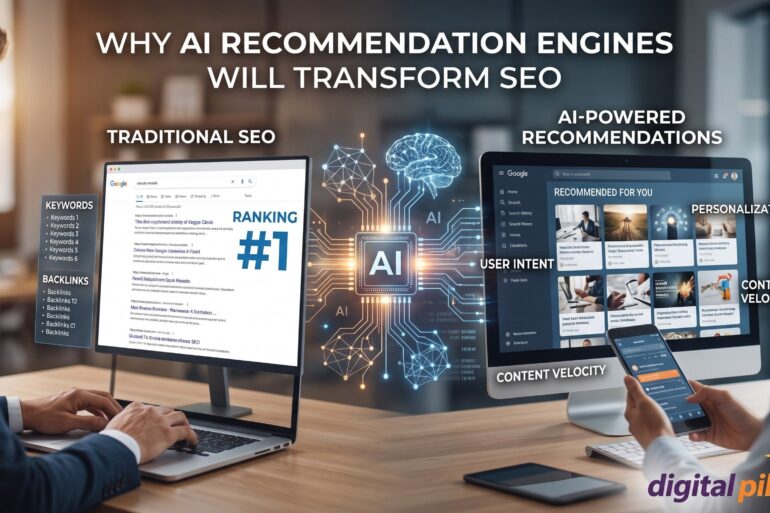
Search used to be a fairly simple exchange: someone typed a query, Google returned links, and brands competed to earn the best position. That model is changing quickly. AI can now interpret intent, compare options, summarize information, and recommend what seems most useful. The result? SEO is moving from ranking pages to influencing decisions.
This shift makes AI SEO services in India increasingly important for brands that want to remain visible when customers stop searching with exact keywords and start asking conversational, detailed questions. In other words, the next SEO battle may not be about being the first blue link. It may be about becoming the recommendation an AI system trusts enough to mention.
Search Is Becoming a Recommendation Layer
Think about how people traditionally searched for a product. They might type “best running shoes for beginners,” scan several results, open a few websites, compare prices, read reviews, and eventually make a decision.
Now imagine asking an AI assistant: “I run three times a week, mostly on roads, have mild ankle discomfort, and want something under ₹8,000. Which running shoes should I consider?”
That is a completely different search experience.
The user is no longer simply requesting information. They are asking the system to interpret a situation and narrow down the possibilities. The AI becomes a filter between the user and the enormous amount of information available online.
Google itself is moving in this direction. In 2026, Google reported that AI Overviews had surpassed 2.5 billion monthly users, while AI Mode had crossed 1 billion monthly users. Google also said AI-powered features were contributing to higher overall Search usage. Google’s 2026 investor presentation provides the underlying figures.
That scale matters for SEO because recommendations are becoming part of the search journey rather than something that happens after search.
From Ranking for Keywords to Being Chosen
Traditional SEO has always cared about relevance, authority, technical quality, links, content, and user experience. Those fundamentals are not disappearing. What changes is the final question.
Instead of asking only, “Can this page rank for the query?” marketers increasingly need to ask, “Does this brand have enough useful evidence online for an AI system to recommend it?”
That distinction is subtle but significant.
A search engine can rank a page because it matches a keyword. A recommendation engine has to make a judgment about usefulness, context, trust, suitability, and potentially even preference.
For example, an ecommerce brand selling laptops might create a page optimized around “best laptops under ₹70,000.” That is useful traditional SEO. But an AI recommendation system may receive a much more specific request:
- Which laptop is best for a software developer who travels frequently?
- Which model offers good battery life without sacrificing performance?
- Which options have reliable after-sales support in India?
Suddenly, generic keyword optimization is not enough. The brand needs authoritative information covering specifications, use cases, customer experiences, comparisons, availability, support, and real-world suitability.
Why AI Recommendation Engines Need More Context
Recommendation engines thrive on context. They are designed to connect several pieces of information instead of treating every search as an isolated phrase.
This creates an interesting challenge for SEO professionals. Content needs to become more connected, more specific, and more useful across the entire customer journey.
1. Entity clarity becomes essential
AI systems need to understand what a company actually is, what it offers, who it serves, where it operates, and how it differs from competitors.
A website that clearly explains its services, expertise, products, locations, authorship, customer outcomes, and supporting evidence gives intelligent systems more context to work with.
This is one reason brand mentions across credible websites, industry publications, directories, reviews, and professional profiles can become increasingly valuable. SEO is gradually becoming less about one isolated webpage and more about the consistency of an entire digital identity.
2. Content must answer combinations of questions
Old-school content often targeted one primary keyword and a handful of variations. Recommendation-driven search encourages something broader.
A strong content ecosystem should address the questions people ask before, during, and after making a decision.
- Discovery: What solutions exist?
- Evaluation: Which option is better for my situation?
- Comparison: How does one brand differ from another?
- Validation: Can I trust this company or product?
- Action: What should I do next?
When these answers are available across a coherent website and supported by credible external signals, the brand becomes easier for both humans and machines to understand.
The Click Is No Longer the Only SEO Outcome
This may be one of the biggest mindset changes for marketers.
For years, organic traffic was one of the clearest indicators of SEO success. Rankings generated impressions, impressions generated clicks, and clicks generated visits. The funnel was relatively straightforward.
AI-generated answers complicate that model.
A 2025 Pew Research Center analysis of nearly 69,000 Google searches found that traditional search-result clicks occurred on about 8% of visits when an AI-generated summary appeared, compared with 15% when there was no AI summary. Only around 1% of visits with an AI summary involved a click on a link inside the summary itself. Pew Research Center published the full methodology and findings.
That does not mean websites are becoming irrelevant. Quite the opposite. It means visibility can happen before the click.
A brand may be mentioned in an AI answer, influence the user’s shortlist, and receive a direct visit later through branded search, referral, social media, or another channel.
SEO measurement therefore needs to expand beyond rankings and organic sessions.
Recommendation Visibility Could Become a New SEO KPI
Imagine two brands selling similar products.
Brand A ranks highly for several commercial keywords but is rarely mentioned when consumers ask AI systems for recommendations.
Brand B ranks slightly lower for some traditional queries but is repeatedly referenced in comparison content, reviews, expert discussions, product lists, and authoritative sources. AI systems frequently associate Brand B with the relevant category.
Which brand has stronger future search visibility?
That question does not have to be answered entirely through traditional ranking reports.
Marketers may increasingly monitor metrics such as:
- AI recommendation frequency: How often is the brand included in relevant AI-generated answers?
- Entity association: Which products, services, topics, and attributes does AI associate with the brand?
- Source visibility: Which pages and third-party websites are influencing AI-generated recommendations?
- Brand sentiment and context: Is the company being mentioned positively and accurately?
These metrics will not replace conventional SEO reporting. They will sit alongside it.
What This Means for Content Strategy
The easiest mistake would be to respond to AI search by publishing thousands of AI-generated articles. More content does not automatically create more authority.
In fact, the opposite can happen. A website filled with repetitive, shallow pages gives recommendation systems very little unique information to work with.
The better approach is to build content with genuine information gain.
Build evidence, not just articles
Suppose a cybersecurity company wants AI systems to recommend it for small businesses. Instead of publishing another generic article about “What Is Cybersecurity?”, it could publish original threat assessments, implementation guides, industry comparisons, customer case studies, security checklists, expert commentary, and practical explanations of common vulnerabilities.
Now the website contains evidence of expertise.
That distinction matters because recommendation engines need signals from which to construct an answer.
Make expertise easy to identify
Author pages, company information, credentials, transparent service descriptions, case studies, original research, and trustworthy citations can all contribute to a clearer digital identity.
For brands competing in finance, healthcare, legal services, technology, education, or other high-trust categories, this becomes particularly important.
The goal is not to write for an algorithm. The goal is to make the brand genuinely understandable and credible enough that intelligent systems have a strong reason to include it.
GEO and SEO Will Start Working Together
This is where a thoughtful geo strategy enters the picture.
Generative Engine Optimization focuses on improving the likelihood that a brand is discovered, interpreted, cited, or recommended within AI-generated experiences. It does not replace SEO. Rather, it expands the visibility objective.
Traditional SEO asks, “How do I improve this page’s ability to rank?”
GEO adds another question: “How do I make this brand useful enough, credible enough, and clearly understood enough to become part of an AI-generated answer?”
The two disciplines overlap heavily around technical accessibility, high-quality content, structured information, authority, brand consistency, and user intent.
That overlap is likely to become even stronger as search platforms blend classic results with conversational answers, shopping recommendations, agents, and personalized discovery.
Local SEO Will Feel the Impact Too
AI recommendation engines will not only influence national brands. Local businesses could experience an even more interesting transformation.
Consider someone asking, “Where should I take my parents for a quiet Bengali dinner in Kolkata this weekend?”
The query contains intent, location, audience, preference, and timing. A traditional keyword strategy might optimize around “Bengali restaurant Kolkata.” A recommendation engine can process the entire context.
Google’s own guidance says local results are primarily influenced by relevance, distance, and prominence, while complete business information, reviews, and information from across the web help Google understand a business. Google Business Profile guidance explains these factors in detail.
This suggests a broader local SEO opportunity: businesses need to create a digital footprint that accurately describes what they are good at, who they serve, and where they operate.
For local businesses, that can mean:
- Keeping business profiles complete and consistent.
- Building genuine reviews and responding thoughtfully to customers.
- Creating location-specific content with real local value.
- Publishing detailed service and product information.
- Earning credible mentions from relevant local and industry sources.
The old idea of “near me” optimization is therefore evolving into something more contextual: “right for me, near me, and suitable for my situation.”
Why Brand Authority Will Matter More
There is an uncomfortable truth about AI recommendations: nobody wants an assistant that confidently recommends something unreliable.
That puts pressure on brands to build authority outside their own websites.
Imagine an AI system trying to determine whether a company is genuinely good at enterprise SEO. Its confidence may improve when it finds consistent information across the company’s website, industry publications, expert profiles, customer reviews, professional networks, case studies, and independent discussions.
One page can make a claim. A wider ecosystem can provide evidence.
This is why digital PR, reputation management, content marketing, technical SEO, local SEO, and thought leadership are becoming increasingly interconnected. A brand’s search presence is no longer neatly divided into separate marketing channels.
The Best SEO Strategy Will Become More Holistic
None of this means keywords are dead. Links are not dead. Technical SEO is not dead. Search rankings are certainly not dead.
What is changing is the role those elements play.
Think of SEO as building a case in court. A keyword may identify the subject. Technical SEO makes the evidence accessible. Content explains the argument. Links and mentions provide supporting references. Reviews and reputation add credibility. Structured information clarifies the facts.
An AI recommendation engine may then act like the person deciding whether the evidence is strong enough to make a recommendation.
That is why the brands most prepared for AI search will probably not be the ones chasing every new optimization trick. They will be the ones creating the clearest, most useful, most credible digital footprint in their category.
Businesses working with the best digital marketing company in India should therefore think beyond individual rankings and start mapping how their entire online presence contributes to discoverability, credibility, and recommendation potential.
How Businesses Can Prepare Now
The transition does not require rebuilding an entire marketing strategy overnight. A practical starting point is to audit how clearly the business can be understood by someone—or something—encountering it for the first time.
- Clarify the brand entity: Make your company, products, services, locations, expertise, and differentiators unmistakably clear.
- Map customer questions: Identify the questions people ask before choosing your product or service, not just the keywords they type.
- Strengthen evidence: Add case studies, reviews, original research, expert contributions, demonstrations, and useful comparisons.
- Improve technical foundations: Ensure important information is crawlable, accessible, well structured, and easy to interpret.
- Track AI visibility: Regularly test important customer questions across AI-powered search experiences and monitor how your brand appears.
Most importantly, do not treat AI visibility as a separate content project. It should become part of the wider search strategy.
Frequently Asked Questions
1. What are AI recommendation engines?
AI recommendation engines are systems that interpret user context and preferences to suggest products, services, brands, information, or actions. Unlike traditional search, they can synthesize multiple sources and provide a more personalized recommendation.
2. Will AI recommendation engines replace traditional SEO?
No. Traditional SEO remains important because AI systems still rely heavily on accessible, relevant, authoritative web information. However, SEO is expanding from ranking individual pages toward building broader brand visibility and trust across search and AI experiences.
3. How can businesses become more visible in AI recommendations?
Businesses should develop authoritative content, maintain accurate brand information, strengthen technical SEO, build credible third-party mentions, collect genuine reviews, demonstrate expertise, and create content that answers detailed customer questions.
4. Is GEO different from SEO?
GEO, or Generative Engine Optimization, focuses specifically on visibility within AI-generated answers and recommendation experiences. It overlaps with SEO but places greater emphasis on entity understanding, citations, brand context, and being included in generated responses.
Final Thoughts
SEO has always evolved whenever the way people search changes. AI recommendation engines represent another major turning point—but perhaps a more fundamental one than another algorithm update.
The future will not belong only to websites that rank. It will increasingly favor brands that are understood, trusted, referenced, and recommended.
That is the real opportunity. Instead of asking how to manipulate the next search system, businesses should ask a much more useful question: “If an intelligent assistant had to recommend one brand in my category, would it have enough reasons to choose me?”
If the answer is yes, the brand is already preparing for the next generation of SEO.
Blog Development Credits
This article was conceptualized by Amlan Maiti, developed with AI-assisted research and writing tools, and refined through SEO-focused optimization by Digital Piloto Private Limited.