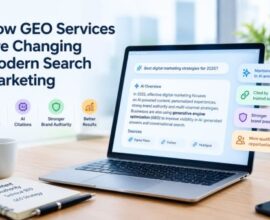
Your business needs a Generative Engine Optimization (GEO) agency if you want your brand to remain visible as customers increasingly use AI tools to research products, services, and companies. A generative engine optimization agency helps structure your content, authority, and online presence so AI-driven search systems can understand, trust, and potentially reference your brand.
This does not mean traditional SEO is becoming irrelevant. It means search is becoming more layered. People may discover a business through Google today, but tomorrow the same customer could ask ChatGPT, Gemini, or another AI assistant to recommend three suitable providers. Being visible in that answer requires a somewhat different approach.
What Is Generative Engine Optimization?
Generative Engine Optimization is the process of improving a brand’s online presence so generative AI systems can accurately understand, evaluate, and reference its information when answering user queries.
Traditional SEO largely focuses on helping pages appear prominently in search results. GEO goes a step further by considering how information is interpreted and synthesized by AI-powered search and answer engines.
For example, imagine someone asks an AI tool, “Who are the best digital marketing agencies for a growing business in Kolkata?” The system may not simply return a list of pages ranked for that exact phrase. It can evaluate information from multiple sources and formulate its own response.
That changes the optimization challenge. Your business needs to be understandable and credible, not merely keyword-relevant.
Why Is AI Search Changing Digital Visibility?
Search behaviour is moving from short keyword queries toward longer, conversational questions. Users increasingly expect search engines and AI assistants to interpret context rather than make them sort through dozens of individual results.
This creates a new visibility layer for businesses. A company can have a technically strong website and still miss opportunities if its expertise, services, location, and credibility are difficult for AI systems to interpret.
A strong GEO strategy therefore considers questions such as:
- Can AI systems clearly identify what the business does?
- Is the company’s expertise supported by useful, authoritative content?
- Are important facts about the business consistent across the web?
- Does the website answer the questions potential customers actually ask?
- Are there credible third-party sources supporting the brand’s reputation?
Why Hiring a GEO Agency Makes Sense
1. AI visibility requires more than keyword placement
Simply adding phrases such as “best digital marketing agency” throughout a website is unlikely to create meaningful AI visibility. Generative systems need context.
They need to understand your services, areas of expertise, target audience, experience, differentiators, and the evidence supporting your claims. A GEO agency can bring these elements together into a more coherent digital footprint.
2. A GEO agency can identify gaps traditional audits miss
A conventional SEO audit may uncover broken links, missing metadata, crawlability problems, slow pages, or keyword opportunities. Those remain important, but GEO introduces additional questions.
For instance, your website might rank well for “SEO services in Kolkata” but provide little clear information about what makes your approach different, which industries you serve, or what outcomes clients can reasonably expect.
An experienced GEO professional looks at the information architecture from an answer-first perspective.
How Does a GEO Agency Improve AI Search Visibility?
There is no single technical trick that guarantees an AI system will mention a business. Effective GEO is better understood as a process of making a brand’s information easier to discover, interpret, verify, and use.
A practical GEO process usually involves these steps:
- Analyse the brand: Identify services, expertise, locations, audiences, differentiators, and existing online authority.
- Research conversational queries: Find the questions customers are likely to ask AI systems rather than focusing exclusively on traditional keyword variations.
- Build answer-focused content: Create genuinely useful pages that provide clear answers, comparisons, explanations, examples, and supporting evidence.
- Strengthen entity understanding: Make important information about the company, people, services, and locations consistent and clearly connected across relevant digital properties.
- Improve authority signals: Earn credible mentions, references, reviews, citations, and other forms of third-party validation where appropriate.
- Measure and refine: Monitor changes in AI visibility, search behaviour, content performance, and brand mentions, then adjust the strategy.
Why Website Quality Still Matters in GEO
GEO does not eliminate the need for a technically sound website. In fact, the website remains one of the most important sources of first-party information about a business.
Clear navigation, logical page structure, useful service pages, fast performance, descriptive headings, strong internal linking, and accessible content all contribute to a better digital experience.
For businesses that need a more advanced digital platform, working with a web application development agency in Kolkata can also help create a website structure capable of supporting more sophisticated content and customer journeys.
What Should a GEO Strategy Include?
A useful GEO strategy should not revolve around publishing hundreds of AI-generated articles. More content is not automatically better. The objective is to build a reliable information ecosystem around the business.
Key areas can include:
- Answer-focused content: Pages that address real customer questions clearly and completely.
- Topical authority: Consistent coverage of subjects closely connected to the company’s expertise.
- Entity optimization: Clear information that helps systems understand the business and its relationships with services, locations, and people.
- Brand authority: Relevant reviews, publications, industry mentions, partnerships, and other credible references.
- Technical SEO: A crawlable, accessible, well-structured website that supports both users and search systems.
- Content accuracy: Current information, specific claims, and evidence wherever it strengthens credibility.
Can GEO Replace Traditional SEO?
No. GEO should generally complement SEO rather than replace it.
Search engines and generative engines overlap in many of the signals they value, including useful content, authority, relevance, technical accessibility, and a positive user experience. The difference is that GEO places greater emphasis on how information can be interpreted and incorporated into generated answers.
In practical terms, businesses should think beyond rankings. The broader objective is to become a reliable source of information within the topics and questions that matter to their customers.
When Should a Business Invest in GEO?
GEO becomes particularly valuable when customers make research-heavy decisions before contacting a company. Professional services, healthcare, education, technology, finance, hospitality, B2B services, and other knowledge-driven industries can benefit from being clearly represented in conversational search.
It is also worth considering if competitors are already producing authoritative content while your website mainly contains basic service descriptions. AI search rewards context, and thin pages leave very little context for a system to work with.
Frequently Asked Questions
What does a Generative Engine Optimization agency do?
A GEO agency improves a brand’s digital presence so AI-powered search and answer systems can better understand its expertise, relevance, authority, and information.
Is GEO the same as SEO?
No. SEO focuses heavily on improving visibility in traditional search results, while GEO focuses on visibility and representation within AI-generated answers. The two strategies work best together.
Can GEO guarantee that my business will appear in ChatGPT answers?
No legitimate agency can guarantee specific AI mentions or rankings. AI-generated results can change based on the query, context, sources, model, location, and other factors.
What type of content works well for GEO?
Useful content that directly answers customer questions tends to be valuable. Detailed guides, comparisons, definitions, expert explanations, original research, case studies, and well-structured FAQs can all contribute to a stronger information footprint.
How long does GEO take to produce results?
There is no universal timeframe. Results depend on the website’s existing authority, content quality, competition, industry, digital footprint, and how consistently the strategy is implemented. GEO should be treated as a long-term visibility strategy rather than a quick ranking tactic.
Final Thoughts
The biggest reason to consider a Generative Engine Optimization agency is simple: search is becoming more conversational, contextual, and answer-driven. Businesses that continue to think only in terms of rankings may overlook an important way customers now discover information.
The goal isn’t to manipulate AI systems into mentioning your company. It is to make your expertise genuinely useful, your information easy to understand, and your brand credible enough to deserve inclusion. That is where thoughtful GEO can make a meaningful difference.
Also Read: Why Flexible Digital Marketing Packages Work Better
Blog Development Credits:
This article idea was originally shaped by Amlan Maiti. It was researched and drafted using AI platforms such as ChatGPT, Gemini, and Copilot, and later refined with SEO insights from Digital Piloto Private Limited.