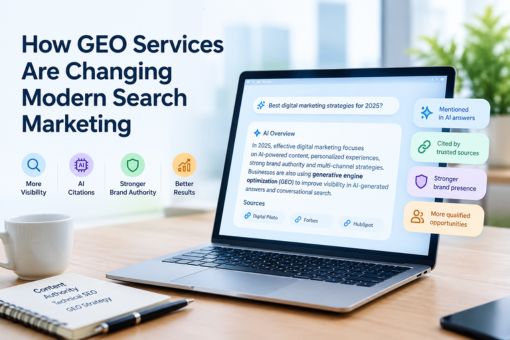
Generative engine optimization services are changing modern search marketing by helping businesses prepare their content, websites, brand information, and digital authority for AI-generated answers as well as traditional search results. Instead of focusing only on where a page ranks, GEO considers whether a business can be discovered, understood, mentioned, cited, and accurately represented across AI-powered search experiences.
This does not mean that SEO is disappearing. Google states that its core SEO practices remain relevant to AI Overviews and AI Mode, making GEO better understood as an extension of modern search visibility rather than a replacement for search engine optimization. Businesses exploring this shift can learn more about generative engine optimization services as part of a broader AI-search strategy.
What Is Generative Engine Optimization?
Generative Engine Optimization, commonly called GEO, is the practice of improving how a brand’s information can be discovered, understood, selected, cited, and represented in AI-generated search answers.
Traditional SEO generally aims to improve visibility in search engine results pages. GEO adds another objective: making useful information easy for AI-powered systems to retrieve and use when generating an answer. These systems may synthesize information from multiple sources rather than simply presenting a ranked list of webpages.
The academic research that introduced the GEO concept demonstrated that certain optimization methods could improve source visibility in a controlled generative-search environment. However, those experimental findings should not be interpreted as a guarantee that a particular GEO tactic will produce the same outcome across today’s commercial AI platforms.
Why Is GEO Becoming Important for Search Marketing?
Search behavior is becoming more conversational, while search platforms are increasingly capable of generating answers directly on the results page. This changes the relationship between visibility, clicks, and conversions.
A 2025 Pew Research Center analysis of browsing data found that 18% of Google searches in its U.S. dataset produced an AI-generated summary. The study also found that users clicked traditional search results less frequently when an AI summary appeared. This indicates that appearing inside an answer can become strategically important even when a user does not immediately click through to a website.
For marketers, the implication is significant: a brand can be visible without receiving the same kind of organic click that traditional SEO reporting has historically emphasized.
GEO vs SEO: What Has Actually Changed?
| Traditional SEO | GEO |
|---|---|
| Focuses strongly on search-result visibility | Focuses on visibility within AI-generated answers and discovery experiences |
| Measures rankings, impressions and organic clicks | Adds citations, mentions, AI visibility and brand representation |
| Often begins with keyword research | Also considers conversational questions, entities and complete user prompts |
| Optimizes pages for search engines and users | Also makes information easy for AI systems to retrieve and interpret |
| Relies heavily on on-site relevance and authority | Also considers broader brand presence and third-party evidence |
The distinction should not be exaggerated. Strong technical SEO, useful content, crawlability, authority and good user experience remain important foundations for both approaches. The main change is that marketers now have more discovery surfaces to consider.
How Are GEO Services Changing Content Strategy?
GEO encourages marketers to create content that answers real questions clearly and supports important claims with evidence. Instead of writing primarily to satisfy a keyword, teams increasingly need to understand the underlying information need behind a query.
A useful GEO-oriented page may therefore include a direct answer near the beginning, clear subheadings, definitions, examples, comparisons, relevant data, expert context, source references and concise explanations. These elements help human readers while also creating clearly defined information units that search and AI systems can process.
This is particularly relevant for longer conversational queries. Pew’s research found that question-based searches and longer queries were more likely to produce AI-generated summaries than very short searches.
Why Brand Authority Matters More in AI Search
AI search visibility is not purely an on-page content problem. AI systems can draw from multiple sources when constructing an answer, so a company’s wider digital footprint can influence how easily its information is discovered and corroborated.
This makes authoritative third-party mentions, credible publications, expert contributions, original research, customer information and consistent business data increasingly valuable. The objective should not be to manufacture mentions. It should be to build genuine evidence that establishes what a company does, who it serves, where it operates and why its information is credible.
For businesses whose websites require stronger technical foundations, the connection between GEO and web development is also important. A fast, accessible and logically structured website makes information easier for both users and search systems to access. Businesses evaluating a Web Design And Development Company in Kolkata should therefore consider not only visual design, but also technical SEO, content architecture, accessibility and long-term search discoverability.
What Do Generative Engine Optimization Services Typically Include?
A practical GEO programme should combine several disciplines rather than rely on a single content tactic.
- AI-search visibility auditing: Identify how the brand currently appears across relevant AI search experiences.
- Query and prompt mapping: Build a set of real customer questions across awareness, comparison and purchase stages.
- Content optimization: Improve clarity, factual accuracy, structure, depth and answerability.
- Technical SEO: Address crawling, indexing, rendering, performance and site architecture.
- Entity optimization: Make the relationships between the company, products, services, locations and expertise clearer.
- Authority building: Develop credible third-party evidence and brand mentions.
- Structured data: Use appropriate structured information where it helps search engines understand page entities and content.
- Measurement: Track AI visibility, citations, mentions, referral traffic, branded searches and business outcomes.
Google’s current guidance is important here: there is no special technical shortcut that guarantees inclusion in AI Overviews or AI Mode. Pages still need to meet Google’s normal technical and search eligibility requirements and follow people-first content principles.
How Should Businesses Measure GEO Success?
GEO measurement should extend beyond traditional rankings. A useful reporting framework separates visibility from traffic and business outcomes.
| Metric | What it tells you |
|---|---|
| AI answer mentions | Whether the brand appears for relevant prompts |
| Citation frequency | Whether the brand’s content is being used as supporting evidence |
| Brand representation | Whether AI systems describe the business accurately |
| AI referral traffic | Whether AI discovery produces measurable website visits |
| Branded search growth | Whether broader visibility may be generating additional brand interest |
| Leads and conversions | Whether search visibility contributes to commercial outcomes |
Because AI responses can vary by query, location, platform, time and user context, GEO reporting should be based on repeated measurements rather than a single prompt check.
What Should Businesses Do First?
The best starting point is not publishing dozens of AI-generated articles. First establish which questions matter commercially, determine how the brand currently appears, audit the website’s technical accessibility, identify content gaps and assess the quality of the company’s wider digital evidence.
From there, businesses can prioritize a small set of high-value topics. Each topic should have a clear search intent, useful supporting content, credible evidence and a logical path toward the relevant product or service.
Most importantly, GEO should remain connected to business objectives. A company that generates thousands of AI mentions but receives no qualified interest has not necessarily created meaningful marketing value.
Is GEO Replacing SEO?
No. GEO is better viewed as an evolution of search visibility in which SEO remains foundational.
Google explicitly states that its existing SEO best practices remain relevant to AI search features. Technical accessibility, useful content, indexing, authority and strong user experience continue to matter. GEO adds attention to how information is selected, summarized and cited by AI-powered discovery systems.
For marketing teams, the practical answer is to build one integrated search strategy rather than separate SEO and GEO silos. The same high-quality content architecture, technical foundation and authority-building activities can support several search surfaces at once.
The Future of Search Marketing
Modern search is becoming less dependent on a single results page. Users may discover a business through a traditional result, an AI-generated overview, a conversational assistant, a recommendation, a third-party article or a combination of these experiences.
That means the future of search marketing is likely to reward businesses that make their information accurate, accessible, authoritative and easy to understand across the web.
GEO services are therefore not simply about trying to make AI mention a brand. Their larger role is helping businesses build a digital presence that search engines and AI systems can understand, validate and use while still providing real value to people.
Final Takeaway
Generative engine optimization services are changing modern search marketing by expanding the definition of visibility. Rankings and organic traffic remain important, but marketers increasingly need to consider AI citations, brand mentions, answer inclusion, information accuracy and discovery across conversational search.
The businesses best prepared for this transition will not abandon SEO. They will strengthen the fundamentals while making their content, technical infrastructure, expertise and digital authority more useful to both people and the systems that help people find information.
Also Read: Why Your Business Needs a Generative Engine Optimization Agency
Blog Development Credits:
This article idea was originally shaped by Amlan Maiti. It was researched and drafted using AI platforms such as ChatGPT, Gemini, and Copilot, and later refined with SEO insights from Digital Piloto Private Limited.