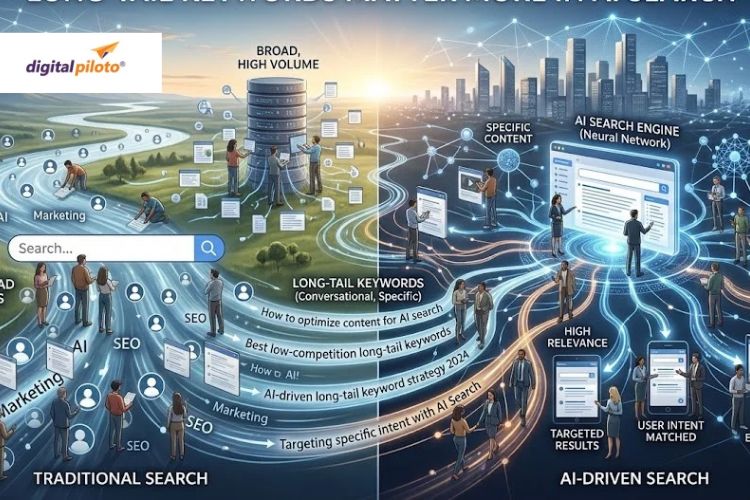
Search behaviour is changing as people increasingly use AI-powered search tools to ask detailed questions, compare solutions, and discover businesses. Instead of entering a few general words, users often describe exactly what they need, explain their situation, or ask follow-up questions. This shift makes long-tail keywords an important consideration for businesses that want to improve organic visibility and attract relevant visitors. For businesses targeting local customers, an experienced SEO Agency in Asansol can help develop a search strategy based on customer intent, useful content, and location-specific needs.
However, succeeding in AI search is not simply about adding more long phrases to website content. Businesses need to understand what users are trying to accomplish and provide clear, trustworthy answers. When combined with strong SEO fundamentals, long-tail keyword research can help brands create more relevant content for traditional search engines, AI Overviews, and conversational search experiences.
What Are Long-Tail Keywords?
Long-tail keywords are specific search phrases that usually communicate a more focused need than broad keywords. They often contain several words, although their defining characteristic is specificity rather than length alone.
For example, “SEO” is a broad keyword. “How can a small business improve local SEO in Asansol?” is a more specific query that reveals the user’s topic, audience, location, and goal.
Long-tail searches can indicate different levels of intent. Someone asking how SEO works may be researching, while someone looking for an SEO agency for a local business may be comparing service providers. Understanding these differences helps businesses create content that matches the user’s stage in the decision-making process.
Why Long-Tail Keywords Matter More in AI Search
1. AI Search Supports More Conversational Questions
Traditional keyword searches often use short phrases, but AI-powered search experiences can handle detailed, natural-language questions. Users may ask for explanations, recommendations, comparisons, or solutions to a particular problem.
For example, a user might ask, “Which digital marketing strategy is suitable for a small business with a limited budget?” This query expresses more context than simply searching for “digital marketing.” Content that directly addresses the budget, business size, and decision criteria can be more relevant to that search intent.
Businesses should therefore research the questions their audiences actually ask and answer them naturally. They do not need to reproduce every possible wording variation. Google’s official guidance confirms that its AI search features can understand related queries and that foundational SEO practices remain important.
2. They Reveal Search Intent More Clearly
Search intent refers to the reason behind a query. A person may want to learn something, compare alternatives, find a local provider, or make a purchase.
Long-tail keywords often provide useful clues about that purpose. Consider these examples:
- Informational: How does generative engine optimization work?
- Comparative: SEO versus GEO for a small business website.
- Commercial: What should I look for in an SEO agency?
- Local: Which digital marketing services are available in Asansol?
Each query requires a different response. A beginner’s guide may satisfy an informational search, while a service page with clear deliverables and contact details may better serve someone evaluating providers.
3. They Help Businesses Address Specific Customer Problems
Broad content often struggles to address every audience’s needs in sufficient detail. Long-tail keyword research helps identify specific challenges that deserve dedicated explanations.
For example, rather than publishing only a general article about SEO, a business could explain how local service companies can improve Google Business Profile information, create useful location pages, or measure qualified enquiries.
These focused topics can improve the usefulness of a website by answering practical questions. The objective is not to create a separate page for every minor keyword variation, but to cover meaningful customer needs with original and helpful information.
4. They Can Attract More Relevant Prospects
A broad keyword may attract visitors with many different goals. A more specific query can help a business reach people whose needs closely match its products or services.
For example, someone searching for “website marketing” may be exploring several topics. Someone searching for “digital marketing services for a local retail business” has expressed a more defined requirement.
Specific queries do not guarantee higher conversion rates, and long-tail keywords do not always have low competition. Nevertheless, matching content to a clear need can make the visitor journey more relevant and help businesses attract better-qualified enquiries.
5. They Support AI Search Visibility Through Better Content
AI search systems may retrieve and reference webpages when generating answers. Content that explains a topic clearly, provides useful details, and supports claims with reliable evidence can be valuable to readers and search systems alike.
Long-tail research can help writers identify the subtopics, comparisons, and practical questions that a useful resource should cover. This can make a page more comprehensive without forcing repetitive keywords into every paragraph.
Businesses exploring AI search can also learn about generative AI seo agency services and Generative Engine Optimization (GEO). The underlying priority should remain helpful, original, people-first content. No particular keyword length or GEO tactic guarantees inclusion in an AI-generated answer.
How to Find Long-Tail Keywords for AI Search
A practical research process starts with customer questions rather than a list of phrases to insert into an article.
- Study customer conversations. Review sales enquiries, customer support questions, reviews, and common objections to identify real information needs.
- Use search data. Google Search Console can reveal queries already bringing impressions and clicks to your website. Keyword research tools can provide additional ideas and estimates.
- Explore question variations. Consider what people ask before choosing a product, comparing services, or solving a problem. Use these questions to guide research, not to create unnecessary pages.
- Classify search intent. Group queries into informational, comparative, commercial, and local themes so each page has a clear purpose.
- Evaluate business relevance. Prioritise topics that match your expertise, audience needs, and services rather than chasing every available keyword.
- Review and update content. Use performance data and customer feedback to identify missing answers, outdated information, and opportunities to improve existing pages.
Best Practices for Using Long-Tail Keywords in AI Search
Once you have identified relevant queries, use them as a guide for building useful content rather than treating them as a checklist for keyword placement.
- Answer the main question early. Provide a concise, accurate response before expanding with examples and supporting detail.
- Use descriptive headings. Organise related questions into logical sections that readers can scan easily.
- Add original information. Include practical examples, expert explanations, genuine experience, or useful comparisons instead of repeating generic information.
- Connect related pages. Use descriptive internal links to help visitors discover relevant guides and service pages.
- Support claims with reliable sources. Link to authoritative documentation when discussing technical requirements or search guidance.
- Maintain technical SEO. Ensure important content is crawlable, indexable, mobile-friendly, and available as readable text.
- Measure meaningful outcomes. Review search impressions, clicks, qualified leads, conversions, and engagement rather than judging success by keyword rankings alone.
Businesses seeking a coordinated local strategy can explore Digital Marketing Services in Asansol to understand how SEO, content marketing, and other digital channels can work together to support customer acquisition.
Common Long-Tail Keyword Mistakes to Avoid
One common mistake is assuming that every long-tail keyword has low competition or high conversion potential. Search demand and competition vary, and some specific phrases may attract very few relevant visitors.
Another mistake is creating many near-identical pages to target slightly different question variations. This can produce repetitive content and a poor user experience. Google’s guidance emphasises valuable, original content rather than generating pages simply to capture every possible query.
Businesses should also avoid awkward keyword repetition, unsupported claims about AI rankings, and neglecting the technical foundations of SEO. Long-tail keywords are useful research signals, but they cannot replace strong content, credibility, or a good website experience.
Frequently Asked Questions
1. Why are long-tail keywords useful in AI search?
Long-tail keywords can reveal the specific questions, circumstances, and goals behind a search. This helps businesses create content that addresses user intent. Their value comes from relevance and usefulness, not from keyword length alone.
2. Do AI search engines prefer long-tail keywords?
There is no universal rule that AI search engines prefer long-tail keywords. Google’s guidance says its systems can understand related queries and that traditional SEO fundamentals remain relevant. Specific query research is useful for planning content, but keyword length does not guarantee visibility.
3. How many long-tail keywords should one blog target?
Focus on one primary topic and a sensible group of closely related questions. The right number depends on the subject and the reader’s needs. Avoid adding unrelated keywords or creating repetitive sections just to increase keyword coverage.
4. How can I find long-tail keywords for my business?
Use customer questions, Google Search Console, keyword research tools, search suggestions, and sales enquiries. Group the resulting ideas by intent and prioritise those that match your audience and business goals.
5. Can long-tail keywords help local SEO?
Yes. Specific location-based queries can help businesses understand what nearby customers are looking for. Create genuinely useful local pages with accurate service information, relevant examples, and clear contact details rather than publishing duplicate pages for every location variation.
Final Thoughts
Long-tail keywords matter in AI search because they help marketers understand the questions, context, and goals behind customer searches. They provide a useful foundation for planning relevant content, addressing specific problems, and connecting visitors with appropriate products or services.
However, success does not come from inserting as many detailed phrases as possible. It comes from combining thoughtful keyword research with helpful content, reliable information, sound technical SEO, and a clear customer journey. Focus on the questions your audience genuinely needs answered, measure the results, and improve your content over time.
About the Author: Amlan Maiti is the Founder & Director at Digital Piloto Pvt. Ltd. Connect with him on LinkedIn.
SEO Credits: SEO, GEO & Digital Marketing Team at Digital Piloto.
Research reference: Google Search Central: Optimizing your website for generative AI features on Google Search.