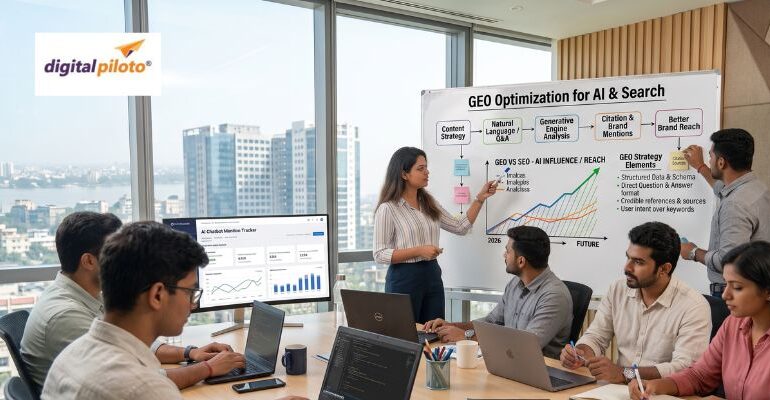
Search is moving beyond the traditional list of blue links. Users can now ask complex questions and receive synthesized answers through AI-powered search experiences, including Google AI Overviews, AI Mode and Bing’s generative search. For brands, this creates a new visibility challenge: being present online is no longer enough. Their information must also be understandable, trustworthy and useful enough to be selected as a source for AI-generated answers. This is where Digital Marketing Company in Delhi teams and modern search specialists can incorporate Generative Engine Optimization, or GEO, into broader digital strategies.
What Is Generative Engine Optimization?
Generative Engine Optimization (GEO) is the practice of improving digital content so that AI-powered search and answer systems can better understand, retrieve, reference and potentially cite a brand’s information in generated responses.
Traditional SEO focuses heavily on helping pages become discoverable and competitive in search results. GEO extends that objective into environments where an AI system may synthesize information from multiple sources before presenting an answer. Academic research introduced GEO as a framework for improving visibility in generative-engine responses, demonstrating that optimization strategies can influence how content is represented in AI-generated answers.
Why AI Search Changes Brand Visibility
Traditional search generally requires users to scan several results and choose which page to visit. Generative search can instead summarize information and provide sources within the answer itself.
Google has continued expanding its generative search documentation, and its current guidance confirms that AI Overviews and AI Mode are part of the evolving Search experience. Microsoft has similarly developed generative search and AI-focused web infrastructure around retrieving and grounding answers in web information.
This changes an important marketing question from “How do we rank for this keyword?” to “How can our information become useful evidence for the answer users are receiving?”
How GEO Helps Brands Become More Visible?
1. It Makes Information Easier for AI Systems to Understand
AI systems need to interpret entities, relationships, context and factual claims. Content with descriptive headings, clear definitions, logical sections and explicit explanations gives both people and machines a stronger understanding of what a page actually covers.
Instead of writing a vague statement such as “we provide innovative solutions,” a brand can explain exactly what it offers, who it serves, what problems it solves and how its products or services differ.
2. It Strengthens Topical Authority
One article rarely establishes expertise around a commercially important subject. GEO therefore works best as part of a broader topical strategy covering related questions, definitions, comparisons, applications, limitations and decision criteria.
For example, a B2B technology company could build interconnected resources covering implementation, security, integrations, pricing considerations, use cases and troubleshooting rather than publishing dozens of disconnected keyword-targeted pages.
3. It Prioritizes Evidence and Verifiable Information
AI-generated answers depend heavily on information available across the web. Brands can improve their information quality by supporting important claims with authoritative references, original research, documented specifications, transparent authorship and clearly dated information.
Google’s current people-first guidance specifically encourages original information, research and analysis rather than content created primarily to manipulate search rankings.
4. It Improves Answer Readiness
GEO encourages brands to answer important questions directly before expanding into deeper explanations. This structure helps readers quickly find information while making key passages easier for search and answer systems to interpret.
A strong page might begin a section with a two-sentence answer, followed by evidence, examples, limitations and practical recommendations. This is more useful than burying the answer underneath several paragraphs of promotional copy.
GEO Is Not a Replacement for SEO
One of the biggest misconceptions is that brands need to abandon traditional SEO to succeed in AI search. Current Google documentation points in the opposite direction: SEO fundamentals remain relevant to visibility in generative AI features.
Technical accessibility, crawlability, useful content, internal linking, page experience, structured information and strong site architecture still matter. GEO adds another layer by focusing more explicitly on how information can be interpreted and reused in AI-generated experiences.
In practical terms, the relationship is straightforward:
- SEO helps search engines discover, understand and rank content.
- GEO focuses on making useful information more likely to contribute to AI-generated answers and citations.
- Content strategy connects both approaches to actual customer questions and business objectives.
What Should Brands Optimize for AI Search?
A useful GEO strategy should extend beyond individual keywords. Brands should examine the questions customers ask before, during and after a buying decision.
- Define important products, services and industry entities clearly.
- Answer high-value customer questions directly.
- Publish original insights instead of repeating commodity information.
- Use statistics only when their source, date and scope can be verified.
- Demonstrate expertise through credible authorship and transparent business information.
- Connect related pages through logical internal linking.
- Keep important factual information current.
- Use suitable structured data where applicable.
- Include useful images, videos and other formats where they genuinely improve understanding.
Google’s current AI-search guidance specifically emphasizes non-commodity content and continues to recommend established SEO practices rather than a separate set of secret optimization techniques.
How Brands Can Measure GEO Performance?
GEO measurement is still developing, so brands should avoid relying on a single “AI visibility score.” Instead, monitor multiple signals.
Track whether important brand, product and category queries produce accurate references to the business across relevant AI search environments. Monitor referral traffic, branded searches, conversions and the pages that appear to support AI-generated answers.
There is also growing support for more direct measurement. Bing Webmaster Tools now provides AI Performance reporting with grounding queries, citation counts and page-level citation data, giving publishers a clearer view of how their content participates in AI-generated experiences.
The Role of Original Content in GEO
AI search makes generic content less strategically valuable. If hundreds of websites repeat the same basic definition, an additional version may contribute little information gain.
Brands should instead create content containing something distinctive: original analysis, first-party observations, documented processes, unique datasets, expert interpretation, product specifications, meaningful comparisons or genuinely useful explanations.
This approach also aligns with Google’s warning against producing large quantities of low-value content simply to capture search traffic. Generative AI can assist with research and structure, but automatically producing pages without adding meaningful value can violate Google’s spam policies.
Why GEO Matters for Long-Term Digital Strategy?
AI search is changing how people discover brands, compare options and research solutions. A company that only optimizes for conventional rankings may overlook opportunities to become part of the answer layer itself.
For organizations operating across competitive markets, GEO should therefore sit alongside SEO, content marketing, digital PR, conversion optimization and brand building. A Digital Marketing Agency in India can incorporate these disciplines into one search strategy rather than treating AI visibility as an isolated content exercise.
Frequently Asked Questions
1. What is GEO in digital marketing?
GEO stands for Generative Engine Optimization. It focuses on improving content so AI-powered search and answer systems can understand, use and potentially cite a brand’s information in generated responses.
2. Is GEO the same as SEO?
No. GEO and SEO overlap significantly, but they emphasize different search experiences. SEO supports discovery and visibility in conventional search, while GEO focuses specifically on visibility within generative and AI-assisted answer experiences.
3. Does GEO replace traditional SEO?
No. Current Google guidance indicates that established SEO fundamentals continue to matter for AI search features. GEO should be treated as an extension of a strong search and content strategy rather than a replacement for SEO.
4. How can a brand improve its GEO strategy?
Start by creating accurate, original and well-structured content that answers real customer questions. Clearly define entities, support important claims with evidence, demonstrate expertise, maintain strong internal linking and keep factual information current.
5. Can GEO guarantee that a brand will appear in ChatGPT or AI Overviews?
No. AI systems use complex retrieval, ranking, grounding and generation processes, and there is no reliable method that guarantees citation or placement. GEO should therefore focus on improving the quality, relevance and discoverability of a brand’s information rather than promising guaranteed visibility.
Final Thoughts
GEO is becoming an important evolution in search visibility because users increasingly receive synthesized answers instead of relying exclusively on traditional search-result pages. The brands most prepared for this shift will not simply publish more content; they will publish better information that is original, credible, clearly structured and genuinely useful.
The practical opportunity is to combine GEO with established SEO principles. Build topical authority, answer customer questions directly, support claims with evidence, strengthen entity clarity and continuously measure how brand information appears across emerging AI search experiences. For businesses that approach AI visibility as a long-term information and authority strategy rather than a shortcut, GEO can become a meaningful part of modern digital growth.
Blog Development Credits
This article was conceived by Amlan Maiti, developed with AI-assisted research, and refined for SEO and digital performance by Digital Piloto Private Limited.