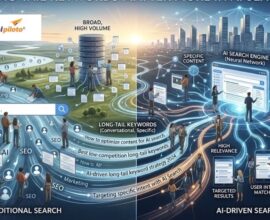
AI Search Optimization—combining GEO (Generative Engine Optimization), AEO (Answer Engine Optimization), and LLM SEO—is the practice of structuring digital content so it is understood, retrieved, and cited by AI systems like ChatGPT, Google SGE, and other large language models. It focuses on meaning, entities, and answer clarity rather than traditional keyword ranking alone.
For any modern AI SEO agency in Kolkata, this shift is no longer optional. It’s the foundation of visibility in AI-driven discovery systems where users may never even click a traditional search result.
What is AI Search Optimization really solving?
Traditional SEO was built for ranking pages. AI Search Optimization is built for being selected as an answer. That difference sounds small, but in practice it changes everything—from how content is written to how authority is established.
Instead of asking “How do I rank #1?”, we now ask:
- How does an AI model understand this brand or page?
- Can it extract a clean answer from the content?
- Does it trust this information enough to cite it?
This is where GEO, AEO, and LLM SEO come together as one system rather than separate tactics.
GEO, AEO, and LLM SEO explained in simple terms
Generative Engine Optimization (GEO)
GEO focuses on optimizing content for generative AI systems. These systems don’t just list links—they synthesize answers. GEO ensures your content is structured so AI can confidently use it inside generated responses.
Answer Engine Optimization (AEO)
AEO is about clarity and extractability. It ensures that every key question has a direct, unambiguous answer. Think of it as writing for “featured snippets,” but for AI conversation layers.
LLM SEO (Large Language Model SEO)
LLM SEO focuses on how models interpret meaning, relationships, and authority. It’s less about keywords and more about entities, context, and semantic trust signals.
A strong strategy today requires all three layers working together, not in isolation.
Why AI systems don’t behave like Google search
One of the biggest mistakes marketers make is assuming AI search behaves like traditional SERPs. It doesn’t.
AI models:
- Summarize multiple sources instead of ranking them
- Prefer structured, factual clarity over keyword density
- Rely heavily on entity relationships and context consistency
- Filter out content that feels vague, promotional, or repetitive
This means a page can rank well on Google but still be ignored by AI systems if it lacks structured meaning.
Core framework for AI Search Optimization
If you break down how AI systems “decide” what to use, it comes down to four core signals.
- Entity clarity: Are brands, topics, and concepts clearly defined?
- Answer density: Does the content directly answer real user questions?
- Context depth: Are relationships between ideas logically explained?
- Trust signals: Is the content consistent, expert-driven, and non-contradictory?
This is exactly how modern optimization is evolving inside every forward-thinking generative AI SEO agency.
How to optimize content for GEO + AEO + LLM SEO
Step 1: Build entity-first content structure
Start by defining key entities before writing. For example, if you mention a tool, brand, or concept, explain it once clearly and consistently use that reference.
Step 2: Write in answer blocks, not paragraphs
Break content into question-driven sections. Each section should answer one intent clearly instead of blending multiple ideas.
Step 3: Reinforce semantic relationships
Connect related ideas naturally. For example, don’t just mention “SEO” and “AI”—explain how AI changes SEO behavior in ranking, indexing, and interpretation.
Step 4: Add structured clarity signals
- Short definitions at first mention
- Bullet-based breakdowns for processes
- Clear examples instead of abstract claims
This structured clarity is what separates modern AI-optimized content from traditional SEO content, even for a strong digital marketing agency in Kolkata.
Common mistakes brands make in AI search optimization
- Writing long, unstructured paragraphs without clear answers
- Overusing keywords instead of focusing on meaning
- Ignoring entity relationships (brands, people, concepts)
- Creating content that sounds promotional instead of informational
The uncomfortable truth is that AI systems don’t reward effort—they reward clarity.
How GEO, AEO, and LLM SEO work together
Think of it as a three-layer intelligence stack:
- AEO ensures your content is readable as direct answers
- GEO ensures your content is usable inside AI-generated responses
- LLM SEO ensures your content is trusted and contextually understood
When combined, they create a system where your content is not just indexed—but actively used in AI-generated discovery.
Future outlook: where this is heading
In the next phase of search evolution, visibility won’t be measured by rankings alone. It will be measured by “AI inclusion rate”—how often your content is used inside generated answers.
This means brands will shift from optimizing pages to optimizing knowledge structures. Content will behave less like blog posts and more like structured intelligence assets.
FAQs
What is AI Search Optimization?
It is the process of optimizing content so AI systems like ChatGPT and Google SGE can understand, extract, and use it in generated answers.
How is GEO different from traditional SEO?
GEO focuses on optimizing for AI-generated responses instead of search rankings, emphasizing meaning and structure over keywords.
Why is LLM SEO important?
Because large language models decide what information to trust and cite, making semantic clarity and entity relationships essential.
Can traditional SEO still work?
Yes, but only when combined with AI-focused optimization strategies like AEO and GEO.
What is the biggest success factor in AI search?
Clear, structured, and entity-rich content that directly answers user intent without ambiguity.
Conclusion
AI Search Optimization is not a trend—it’s a structural shift in how information is discovered and consumed. GEO, AEO, and LLM SEO together define how brands will be represented in AI-driven search ecosystems.
The winners in this new landscape won’t be the ones producing the most content, but the ones producing the clearest and most machine-understandable knowledge.
Blog Development Credits:
This blog was conceptualized by Amlan Maiti, researched and written using advanced AI tools like ChatGPT, Google Gemini and Copilot. Received final optimization and SEO enhancements from Digital Piloto Private Limited.