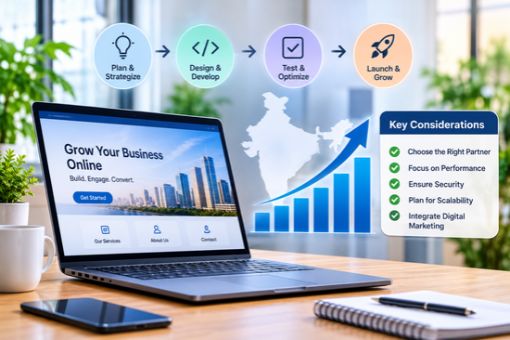
A professional website is more than an online representation of a business. It helps companies communicate their value, showcase products and services, attract potential customers and build credibility. Choosing the right website company in India can help businesses create a digital platform that supports their long-term goals rather than simply providing an attractive design.
However, website development involves several decisions, including technology, design, functionality, security, search engine readiness and ongoing maintenance. Understanding these elements before hiring a development partner can help businesses make better investments.
What Does a Website Development Company Do?
A website development company plans, designs, builds, tests and maintains websites according to a business’s requirements. Its work may include website architecture, user interface design, frontend and backend development, content management systems, ecommerce functionality, integrations and technical optimisation.
Depending on the project, a development team may create a simple business website, a large corporate platform, an online store or a custom web application. The objective is to build a website that works reliably, provides a useful visitor experience and supports measurable business requirements.
What Type of Website Does Your Business Need?
The right website depends on what the business wants visitors to accomplish. A service provider may need an informative website with enquiry forms, while an online retailer requires product catalogues, payment integration and order management.
- Business websites: Present company information, services, contact details, testimonials and business credentials.
- Ecommerce websites: Support product listings, shopping carts, payment gateways, order processing and customer accounts.
- Corporate websites: Organise extensive information, multiple departments, resources and stakeholder communication.
- Custom web applications: Provide specialised functions such as dashboards, booking systems, portals and workflow automation.
- Landing pages: Focus on a specific campaign, product, service or lead-generation objective.
Defining the website’s purpose first helps prevent unnecessary features and keeps the development budget aligned with business priorities.
How to Choose the Right Website Development Company in India
Choosing a development partner should involve more than comparing quotations. Businesses should evaluate the company’s technical capabilities, communication process and ability to deliver the required functionality.
1. Review its portfolio and relevant experience
Examine completed projects and check whether the company has developed websites similar to yours. Review navigation, mobile layouts, loading behaviour and functionality. A visually appealing portfolio is useful, but working websites provide stronger evidence of implementation quality.
2. Understand its technology expertise
Ask which technologies and platforms suit your requirements. WordPress can work well for many content-driven websites, while Shopify is designed for ecommerce operations. Custom frameworks may be appropriate when a project needs specialised functionality or integrations. The technology should follow the business requirement, not the other way around.
3. Check SEO, performance and security practices
A website should have a clear URL structure, crawlable content, descriptive page titles, responsive layouts and appropriate technical SEO foundations. Ask about HTTPS, software updates, backups, access controls and protection against common security risks.
4. Clarify ownership and post-launch support
Confirm who will own the domain, hosting account, source code, design files and website content. The agreement should explain maintenance responsibilities, support availability, backup procedures and any recurring charges.
What Is the Website Development Process?
A well-managed project generally moves through a sequence of stages:
- Discovery and planning: Define business goals, target users, required pages, features and project scope.
- Structure and design: Prepare the sitemap, wireframes, visual direction and user journeys.
- Development: Build the frontend, backend, CMS, integrations and required functionality.
- Content and optimisation: Add page content, images, metadata and technical SEO elements.
- Testing: Check mobile responsiveness, browser compatibility, forms, navigation, security and performance.
- Launch and maintenance: Configure hosting, connect the domain, monitor the live website and perform ongoing updates.
Businesses should review the website at agreed milestones rather than waiting until the final launch to identify problems.
What Makes a Business Website Effective?
An effective website combines usability, reliable functionality and a clear purpose. Important elements include intuitive navigation, readable content, accessible design, prominent contact options, relevant calls to action and secure connections.
Performance also matters. Google recommends that websites aim for a Largest Contentful Paint (LCP) of 2.5 seconds or less, Interaction to Next Paint (INP) below 200 milliseconds and Cumulative Layout Shift (CLS) below 0.1. These Core Web Vitals targets help assess loading, responsiveness and visual stability; meeting them does not guarantee higher search rankings.
Mobile usability deserves particular attention because Google primarily uses the mobile version of website content for indexing. Responsive design helps provide a consistent experience across smartphones, tablets and desktop devices.
What Factors Affect Website Development Cost in India?
Website development costs vary according to project scope rather than a single standard price. A basic template-based website generally requires less work than a custom-designed platform or ecommerce store.
Major cost factors include the number of unique page layouts, design complexity, content creation, custom features, third-party integrations, ecommerce requirements, hosting, security and maintenance. Businesses should compare written quotations with the same project scope and check whether taxes, licences, content, testing and post-launch support are included.
It is also important to plan for recurring expenses such as domain renewal, hosting, premium plugins, software subscriptions, backups and technical maintenance.
Why Website Development and Digital Marketing Should Work Together
A website should be developed with its future marketing requirements in mind. Search engine optimisation, content strategy, conversion tracking and paid campaigns work more effectively when the website has a clear structure and useful landing pages.
Businesses can coordinate development with relevant digital marketing solutions to create a more connected customer journey. This may include search-friendly content, analytics integration, lead forms and conversion-focused page layouts.
Final Thoughts
Selecting a website development company in India is an important business decision. The right partner should understand your objectives, recommend suitable technology, explain project costs clearly and provide support beyond launch. Instead of choosing only by price or appearance, evaluate performance, security, ownership, scalability and long-term usability.
A well-planned website can become a dependable business asset—helping customers discover your company, understand your offerings and take meaningful action. Start with a clear project brief, compare proposals carefully and choose a development approach that supports your business as it grows.
Also Read: How Indian B2B Businesses Can Reach Global Customers Online
Blog Development Credits:
This article idea was originally shaped by Amlan Maiti. It was researched and drafted using AI platforms such as ChatGPT, Gemini, and Copilot, and later refined with SEO insights from Digital Piloto Private Limited.