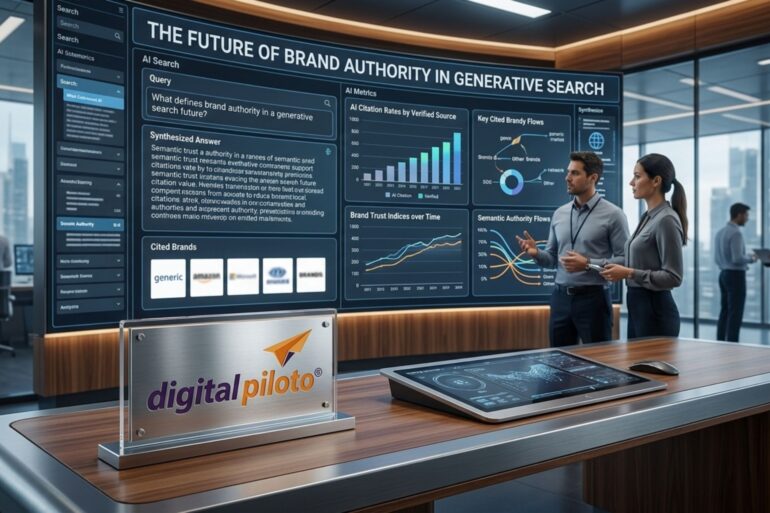
Brand authority in generative search will increasingly depend on whether AI systems can recognize, verify, and confidently cite a business across trusted sources. Unlike traditional search, where ranking a page can be enough to earn visibility, generative search evaluates broader signals: expertise, consistency, reputation, context, and corroboration. For brands, the goal is shifting from simply being discoverable to becoming a reliable answer.
That shift makes strategic SEO agency Kolkata support more valuable than ever. A strong search strategy now needs to build the information ecosystem around a brand, not just optimize individual pages.
What Is Brand Authority in Generative Search?
Brand authority in generative search is the degree to which AI-driven search systems recognize a brand as a credible, relevant, and trustworthy source within a particular topic or category.
Traditional SEO often asks, “Where does this page rank?” Generative search introduces a different question: “Which sources does the system trust enough to use when constructing an answer?”
That distinction matters. A brand may rank reasonably well for several keywords yet rarely appear in AI-generated recommendations because its authority signals are fragmented or weak.
Why authority is becoming harder to fake
Generative systems can draw information from multiple sources and compare context before producing an answer. A polished website alone may therefore carry less weight than a consistent body of evidence surrounding the business.
- Independent mentions can reinforce brand credibility.
- Expert-led content can demonstrate topical knowledge.
- Consistent business information reduces ambiguity.
- Reviews and third-party references can strengthen reputation signals.
- Original research gives AI systems useful information to associate with a brand.
Why Traditional Rankings Are No Longer Enough
Search visibility used to be largely page-centric. If a page matched intent, earned authority, and performed well technically, it had a strong chance of attracting clicks.
Generative search is more entity-centric. The system needs to understand who the brand is, what it is known for, where it operates, and why it deserves to be included in an answer.
Imagine a software company with hundreds of optimized landing pages but very little independent discussion online. Another competitor publishes fewer pages but has original studies, expert commentary, customer references, industry mentions, and consistent company information.
The second brand may have a stronger foundation for generative visibility, even if its traditional keyword footprint is smaller.
The New Authority Stack for Generative Search
A useful way to think about future brand authority is as an authority stack. No single signal guarantees visibility. Instead, several layers reinforce one another.
1. Entity clarity
AI systems need to distinguish your company from similarly named businesses and understand its category, services, locations, products, and expertise.
2. Topical depth
Your website should demonstrate genuine knowledge rather than simply publishing large volumes of keyword-focused articles.
3. External corroboration
Independent sources, industry publications, reviews, directories, interviews, and credible mentions can help validate what your brand says about itself.
4. Original information
Research, proprietary insights, expert commentary, case studies, statistics, and practical frameworks create information that other websites can reference.
5. Reputation signals
Customer experiences, brand sentiment, reviews, and consistent public information contribute to the broader perception of a business.
This is where modern digital marketing agency strategies need to move beyond publishing and ranking toward building a recognizable, evidence-backed brand entity.
How to Build Generative Search Authority Step by Step
Building authority does not require publishing hundreds of articles. In practice, a focused system often works better.
Step 1: Define what you want to be known for
Choose the subjects, services, products, or problems where your brand genuinely has expertise. Avoid trying to become authoritative on everything.
Step 2: Build a clear knowledge base
Create useful pages that explain your offerings, expertise, processes, customer outcomes, people, locations, and areas of specialization.
Step 3: Publish evidence, not just opinions
Turn internal experience into public knowledge. Case studies, experiments, original surveys, expert interviews, benchmarks, and detailed comparisons are particularly valuable.
Step 4: Earn credible third-party references
Look beyond traditional backlinks. Relevant editorial mentions, expert contributions, partnerships, industry profiles, and citations can help establish context around your entity.
Step 5: Monitor how AI systems describe your brand
Test realistic questions that potential customers might ask. Look for incorrect descriptions, missing services, competitors being preferred, or situations where your brand is absent altogether.
Why Citations Will Matter More Than Visibility Alone
In generative search, being mentioned is useful, but being cited as supporting evidence can be even more meaningful.
Consider two businesses. One is occasionally named in an AI-generated answer. The other is repeatedly referenced when users ask detailed questions about its category, with supporting sources pointing back to its research, documentation, or expertise.
The second brand has something more durable: informational authority.
This changes how marketers should evaluate performance. Instead of tracking only rankings and organic sessions, businesses should also examine:
- How frequently the brand appears in relevant AI answers.
- Whether AI systems describe the brand accurately.
- Which sources are associated with the brand.
- Whether competitors are cited instead for important topics.
- Which brand claims lack independent support.
Where Paid and Organic Strategies Fit
Generative search does not eliminate traditional marketing channels. It changes how they work together.
For example, best PPC company in Kolkata campaigns can create immediate demand and expose audiences to a brand, while organic content and authority-building efforts establish deeper credibility over time.
The smart approach is not to treat paid search, SEO, content, PR, and brand building as isolated activities. Each should strengthen the same underlying entity and message.
What Brands Should Stop Doing
The future of authority will reward substance over volume. Some familiar tactics are becoming increasingly inefficient.
- Publishing thin articles simply to target more keywords.
- Creating multiple pages with almost identical information.
- Making unsupported claims about expertise or market leadership.
- Chasing irrelevant mentions purely for link acquisition.
- Optimizing for rankings without considering customer questions.
A useful test is simple: Would an independent researcher find enough evidence online to believe your brand deserves to be recommended? If the answer is no, more keyword optimization alone probably will not solve the problem.
The Practical Framework: Authority Before Scale
Before expanding your content operation, strengthen the foundation.
Clarify → Demonstrate → Corroborate → Distribute → Measure.
Clarify what your brand represents. Demonstrate expertise through genuinely useful information. Corroborate those claims through credible external sources. Distribute knowledge where your audience and industry already pay attention. Then measure whether generative systems increasingly understand and reference your brand.
This framework is deliberately slower than content-at-scale tactics. That is also its advantage. Authority compounds when every new piece of evidence reinforces the same brand identity.
FAQs About Brand Authority in Generative Search
What is generative search brand authority?
It is the level of trust and relevance an AI search system associates with a brand when generating answers, recommendations, or explanations about a topic.
How can a brand become more visible in AI search?
Build clear entity information, demonstrate topical expertise, publish original evidence, earn credible third-party mentions, and maintain consistent information across important sources.
Are backlinks still important for generative search?
Links remain useful, but context matters. Relevant, credible references that help establish expertise can be more valuable than large numbers of unrelated links.
Can small businesses build generative search authority?
Yes. Smaller brands can compete by developing strong niche expertise, publishing original insights, maintaining accurate business information, and earning relevant industry recognition.
How should businesses measure generative search visibility?
Track brand mentions, citations, answer accuracy, source associations, competitor presence, and the topics for which AI systems recognize your expertise.
Conclusion
The future of brand authority in generative search is not about finding one new ranking trick. It is about becoming a brand that can be confidently understood, verified, and referenced.
That requires a different mindset: stop asking only how to rank a page and start asking how to build evidence around the brand. In generative search, authority is becoming less about occupying a position and more about earning a place in the answer.
Blog Development Credits
This article was conceptualized by Amlan Maiti, developed with AI-assisted research, and refined with SEO expertise from Digital Piloto Private Limited.