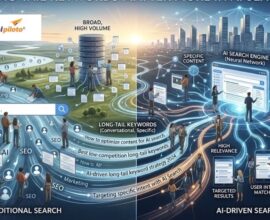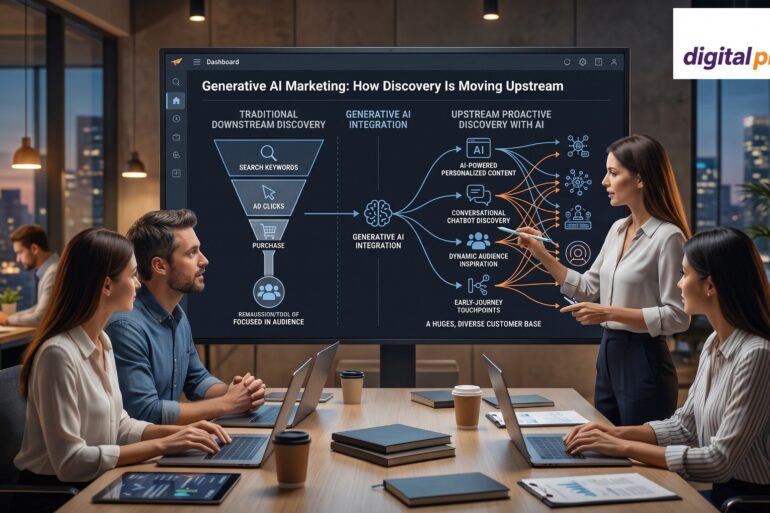
For years, marketing has started with a familiar idea: get discovered, earn attention, then persuade the customer to buy. Generative AI is quietly rearranging that sequence. People can now ask broader questions, compare options, and explore brands before visiting a website. Discovery is moving upstream, and marketers need to rethink where influence actually begins.
This shift does not make traditional marketing irrelevant. It changes where its foundations matter. A modern digital marketing agency India strategy increasingly has to account for AI-generated answers, conversational research, brand mentions, entity understanding, and the content signals that influence whether a company enters a customer’s consideration set in the first place.
What Does “Discovery Moving Upstream” Mean?
Think about how someone used to buy a product online.
They might search Google, open several websites, compare prices, read reviews, and eventually make a decision. The brand often had plenty of opportunities to speak directly to that person.
Generative AI can compress much of that research.
A customer might instead ask an AI system, “I need an affordable project management platform for a 30-person remote team. Which options are worth considering, and what are the trade-offs?”
That is no longer a simple keyword search. It is a research brief.
The AI system may synthesize information from multiple sources, explain categories, compare products, identify limitations, and provide links for deeper investigation. The customer may encounter a shortlist before ever searching for an individual brand.
That is what “upstream” means here. Brands are increasingly competing for attention before the conventional branded search or website visit occurs.
AI Is Expanding the Discovery Layer
Google’s development of AI Overviews and AI Mode provides a useful illustration. Google says AI Mode is designed for longer, more complex questions and uses a technique called query fan-out to break a question into related searches and investigate multiple subtopics.
That changes the shape of discovery.
A traditional search might be:
“best CRM for startups”
An AI-assisted search might become:
“Compare affordable CRMs for a 15-person startup that needs automation, WhatsApp integration, simple reporting, and easy onboarding.”
The second query contains preferences, constraints, context, and intent. It gives an AI system considerably more material to work with.
Google reported in 2025 that early AI Mode testers were submitting queries two to three times longer than traditional searches. It also said AI Overviews were associated with more than 10% growth in usage for the types of queries where they appeared in major markets including India and the United States.
The exact behavior will vary by market and query, but the broader direction is significant: search is becoming more conversational, exploratory, and context-rich.
The New Competition Happens Before the Click
This creates an uncomfortable question for marketers: what if a customer forms an opinion about your brand without visiting your website?
That is not entirely new. Reviews, social media, marketplaces, news articles, forums, and word-of-mouth have influenced brands for years.
Generative AI simply brings those information sources into a conversational decision environment.
A customer may ask which companies are reliable. The AI may summarize what it finds. The customer may then ask which options are best suited to a particular budget or use case.
Your website is no longer necessarily the first conversation.
Your broader digital footprint is.
Brand visibility becomes an ecosystem problem
That ecosystem can include:
- Official website content and product or service pages.
- Independent reviews, editorial coverage, and industry publications.
- Business directories, local profiles, marketplaces, and partner websites.
- Expert commentary, original research, and publicly available documentation.
- Social and community discussions where customers genuinely exchange experiences.
The objective is not to manipulate every mention. It is to make the brand’s identity, expertise, products, services, and differentiators consistently understandable across the web.
Generative AI Is Changing the Meaning of “Top of Funnel”
Marketing teams have traditionally treated awareness as the top of the funnel and purchase as the bottom. But generative search blurs those boundaries.
A single AI conversation can contain awareness, education, comparison, objection handling, and even product selection.
Consider a customer looking for a cybersecurity provider. Their conversation might move like this:
- “What should a 100-person company look for in a cybersecurity provider?”
- “Which providers specialize in companies of this size?”
- “Compare their managed detection services.”
- “Which one has experience with healthcare businesses?”
- “What questions should I ask before requesting a proposal?”
Notice what happened. The customer did not start with a brand name. The brand became relevant only after the AI helped define the category and the customer’s criteria.
This is why AI brand discovery deserves its own strategic attention.
Being Mentioned Is Not the Same as Being Chosen
There is another subtle point here.
AI visibility is not automatically commercial success.
A brand might be mentioned in an AI-generated response but still lose the customer because its website is confusing, its reviews are weak, its pricing is unclear, or its product does not actually match the user’s needs.
Discovery creates an opportunity. It does not complete the sale.
Google has emphasized that AI experiences continue to link users to web content, and in August 2025 Google reported that overall organic click volume from Search to websites was relatively stable year over year, while describing higher average click quality. Those are Google’s own aggregate observations, not a guarantee for an individual website or industry.
The practical lesson is simple: marketers should not measure AI discovery only through mentions. They need to connect visibility with downstream engagement and revenue.
Content Has to Become More Decision-Oriented
Generative AI changes what useful content looks like.
There is still a place for introductory articles. But a library filled with generic explanations will not necessarily give an AI system strong reasons to understand or recommend a brand.
Decision-oriented content is different.
It addresses the questions customers ask immediately before taking an action:
- How does this solution compare with realistic alternatives?
- Who is it suitable for, and who should avoid it?
- What does implementation actually involve?
- What limitations, costs, requirements, or trade-offs should buyers understand?
- What evidence demonstrates that the company knows what it is doing?
This type of content gives both humans and AI systems richer context.
It also tends to be more useful commercially because it helps customers make decisions rather than simply consume information.
Why Entity Clarity Matters More
One of the less obvious changes brought by generative search is the importance of entity understanding.
Search engines have long tried to understand entities: companies, people, products, places, organizations, services, and relationships between them. Generative systems make that understanding particularly visible because an AI response needs to connect concepts coherently.
If your company has three different descriptions across its website, inconsistent service names, outdated profiles, and vague product information, the system has more ambiguity to resolve.
Strong entity signals can include:
- A consistent company identity across authoritative profiles.
- Clear descriptions of products, services, locations, and industries served.
- Structured data where it accurately represents visible information.
- Detailed author and organization information where relevant.
- Consistent terminology across important pages and external references.
This is not about writing content specifically to “please the AI.” It is about making the business easier to understand.
Generative Search Requires a Different SEO Mindset
Traditional SEO often asks: “Which query should this page rank for?”
Generative search adds another question: “Which questions should this brand be considered relevant to?”
That is a broader challenge.
A company selling accounting software, for example, may want to be associated not only with “accounting software” but also with questions about startup bookkeeping, multi-currency workflows, financial reporting, automation, integrations, compliance, and implementation.
The opportunity is not to stuff those phrases into pages. It is to demonstrate genuine competence across the surrounding topic.
This is where a generative engine optimization company can help connect conventional SEO with broader AI discovery objectives, particularly around entity clarity, topical authority, citation-worthy content, and brand representation across generative search environments.
The Brand’s Digital Footprint Becomes Part of the Product
There was a time when a company could treat its website as the definitive version of its story.
That assumption is getting weaker.
AI systems can encounter information from many parts of the public web. Google says AI Mode combines web content with other information systems and can conduct multiple related searches to build a response.
That means reputation, third-party validation, product information, reviews, and expert commentary can influence the context surrounding a brand.
For marketers, this creates a useful distinction between owned visibility and distributed visibility.
Owned visibility is what you publish and control. Distributed visibility is how your brand is represented elsewhere.
The strongest strategy works on both.
AI Discovery Is Also Becoming More Commercial
This shift is not limited to informational searches.
Google has increasingly connected AI Search with shopping and commercial journeys. Its 2025 Search announcements described AI-powered experiences for comparing products and exploring options, while later updates expanded conversational and visual shopping experiences. Google said its Shopping Graph contained more than 50 billion product listings in 2025, with billions of listings refreshed regularly.
In India, Google has also continued expanding AI-powered shopping experiences, including conversational product discovery and comparisons.
The implication is straightforward: discovery is not staying at the “awareness” end of marketing.
It is moving closer to consideration and transaction.
What Marketers Should Do Now
Businesses do not need to abandon their existing SEO strategy and start from scratch. A better approach is to extend it.
Start with a practical audit:
- Map customer questions: Identify the questions people ask before they ever search for your brand.
- Strengthen answer-worthy content: Build original pages around comparisons, use cases, problems, trade-offs, and buying considerations.
- Improve entity consistency: Make sure your business, products, services, people, and locations are represented accurately across important sources.
- Build independent credibility: Earn relevant reviews, editorial references, partnerships, expert mentions, and other legitimate signals.
- Connect discovery to conversion: Make the next step obvious once someone reaches your site.
For technical and content teams, this is a useful moment to work together. Content creates context. SEO creates discoverability. Brand strategy creates differentiation. Conversion optimization turns attention into action.
The Role of Human Expertise in an AI Discovery World
Ironically, the rise of generative AI makes genuine expertise more valuable, not less.
If everyone can produce a thousand generic articles, generic articles become cheap. What stands out is experience, original data, informed analysis, useful opinions, documented processes, and evidence that a company understands its customers.
That is particularly important when AI systems are deciding which sources help answer a complex question.
A strong SEO service provider in India should therefore think beyond rankings and help brands build content and authority that remain useful across changing search interfaces.
A New Marketing Funnel Is Emerging
The old funnel was often visualized as Awareness → Consideration → Conversion.
The AI-era journey may look more like:
Question → AI-assisted exploration → Brand discovery → Validation → Comparison → Action.
Sometimes the customer will still click a traditional search result. Sometimes they will move between an AI response, a product page, a review, and a marketplace. Sometimes an AI assistant may handle parts of the journey.
The path is becoming less linear.
That does not make marketing impossible. It makes the definition of visibility broader.
Frequently Asked Questions
1. What does upstream discovery mean in generative AI marketing?
Upstream discovery means customers can encounter and evaluate brands earlier in their decision journey through AI-generated research, comparisons, recommendations, and conversational exploration before they perform a traditional branded search or visit a website.
2. Does generative AI replace traditional SEO?
No. Traditional SEO remains important because AI-powered search experiences still depend on web content, search systems, links, and other information sources. Generative AI expands the environment in which SEO and brand visibility operate.
3. How can a brand improve AI discovery?
Brands can strengthen AI discovery by creating authoritative and useful content, maintaining consistent business and product information, developing clear entities and relationships, earning credible third-party references, and answering the questions customers ask throughout the buying journey.
4. Should businesses track AI mentions as a marketing metric?
AI mentions can be useful as an emerging visibility indicator, but they should not be treated as the only success metric. Businesses should connect discovery signals with qualified traffic, engagement, leads, sales, and other commercial outcomes.
Final Thoughts
Generative AI is not simply creating another search box. It is changing when and how people encounter brands. The first meaningful interaction may happen while a customer is still describing a problem, comparing possibilities, or figuring out what they actually need.
That is why discovery is moving upstream. Brands now have to earn relevance before the click, not merely optimize for the click itself. The winners of this shift will be the businesses that combine strong information, genuine expertise, consistent digital signals, and a clear reason for customers to continue the journey.
Blog Development Credits
This article was conceptualized by Amlan Maiti, researched and developed with ChatGPT, Google Gemini and Copilot, then given final SEO refinement by Digital Piloto Private Limited.