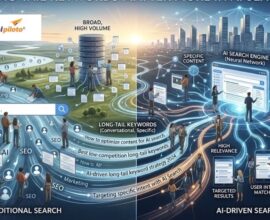
A website can look healthy in an SEO report while quietly losing valuable prospects. Rankings may be stable, impressions may be rising, yet enquiries remain flat. The missing piece is often visibility quality rather than visibility volume. An AI SEO audit helps uncover those hidden gaps across technical SEO, search intent, content, brand signals, AI discovery, and conversion paths.
For businesses investing in a digital marketing agency India, this wider view is becoming increasingly important. Google has expanded AI Overviews to more than 200 countries and territories and over 40 languages, while reporting increased usage of the types of searches that trigger AI Overviews in markets including India and the U.S.
Why a Traditional SEO Check Is No Longer Enough
SEO audits have traditionally focused on familiar territory: crawlability, indexation, broken links, metadata, page speed, keyword targeting, backlinks, and content gaps.
Those fundamentals still matter. In fact, ignoring them would be a mistake.
But search has developed another layer. People are increasingly asking longer, more conversational questions and expecting search systems to interpret context rather than simply match words.
Google’s AI Mode provides a useful illustration. In 2025, Google reported that early users were asking queries two to three times longer than traditional searches. The company later reported that AI Mode queries in India were becoming nearly three times longer than traditional searches.
That changes what an SEO audit needs to ask.
It is no longer enough to say, “This page ranks for the keyword.”
You also need to ask:
Can search engines and AI systems understand the page, its purpose, the business behind it, and the problem it solves?
And perhaps more importantly: does that visibility create a credible path toward a lead?
What an AI SEO Audit Actually Examines
An AI SEO audit should not be a fashionable rename for an ordinary technical audit. The useful version combines established SEO diagnostics with a broader examination of how information is understood and represented across modern search environments.
At a practical level, it should investigate:
- Technical accessibility: Can important pages be crawled, rendered, indexed, and reached efficiently?
- Search intent: Does the content answer the actual problem behind the query?
- Content depth: Does the website cover the questions customers ask before making a decision?
- Entity clarity: Is the company, its people, services, products, and locations described consistently?
- AI search visibility: Is the brand positioned clearly enough to be understood in AI-generated discovery experiences?
- Conversion readiness: Does the website turn relevant discovery into a sensible next action?
These areas overlap, but they reveal different types of leakage.
A website may have excellent technical health and poor commercial intent. Another may have brilliant content but weak brand signals. A third may rank well but lose leads because its service pages create uncertainty.
The audit needs to find the actual bottleneck rather than assuming every visibility problem is a keyword problem.
Start With Revenue-Critical Pages
One of the simplest ways to make an audit more useful is to stop treating every URL as equally important.
A website might contain hundreds or thousands of pages. But perhaps ten or twenty are responsible for most commercial opportunities.
Those pages deserve the first inspection.
Prioritize pages that:
- Target high-intent commercial searches
- Describe core products or services
- Receive substantial organic impressions
- Attract qualified visitors but generate few enquiries
- Support important locations or customer segments
- Have historically contributed to leads or assisted conversions
This prevents a common auditing mistake: spending hours fixing minor issues on low-value pages while a major visibility problem sits on the homepage or primary service page.
SEO should eventually support business priorities. The audit should reflect that from the beginning.
Gap #1: Important Pages Are Not Fully Discoverable
Sometimes the first problem is painfully basic.
The page that should be generating leads is not being properly discovered, indexed, or connected to the rest of the site.
Google explains Search as a process involving crawling, indexing, and serving results. A page needs to be accessible and understood before it can meaningfully participate in organic search.
An AI SEO audit should therefore inspect important URLs for:
- Accidental
noindexdirectives - Incorrect canonical URLs
- Weak internal linking
- Redirect chains or unnecessary redirects
- Duplicate or near-duplicate pages
- Rendering problems
- Mobile usability issues
- Important pages missing from logical sitemap structures
None of these should be treated as a checklist where every warning receives equal attention.
A broken link on an abandoned blog post is one thing. An indexing problem affecting the service page that generates most of your enquiries is something else entirely.
Gap #2: Your Content Matches Keywords but Misses Questions
This is one of the more subtle problems.
A page can technically target the correct phrase and still fail the visitor.
Imagine a company selling cybersecurity services. Its page ranks for “managed cybersecurity services,” but the content mostly defines the service. A serious buyer may want to know much more:
How does implementation work? What happens during an incident? Is the service suitable for a particular company size? How are existing systems handled? What happens after onboarding?
Those are not keyword variations. They are decision questions.
As search becomes more conversational, this distinction becomes increasingly important. Google’s AI Mode was designed for longer, more complex questions and follow-up interactions, rather than only short keyword-style searches.
A useful search intent audit therefore looks beyond the primary keyword.
Ask of every important page:
- What situation caused the visitor to search?
- What information do they need immediately?
- What objections are likely to appear next?
- What evidence would make the business more credible?
- What should the visitor logically do after reading?
If a page answers only the first question, it may attract traffic without helping create demand.
Gap #3: Your Website Has Information but Weak Context
AI systems need context.
That does not mean writing content specifically for machines in some artificial, robotic style. It means making the relationships between pieces of information clearer.
For example, a company might say it provides “digital solutions,” while different pages mention SEO, web development, ecommerce, automation, and AI services without explaining how these capabilities fit together.
A human can piece that together after browsing the website for ten minutes.
An AI system has to interpret the available signals and construct an understanding from them.
This is why entity SEO and brand clarity deserve a place in modern audits.
Review whether your website consistently communicates:
- Who the business is
- What it specializes in
- Which audiences it serves
- Where it operates
- Which products or services it provides
- Which experts or people are associated with those services
- What evidence supports its expertise
The objective is coherence.
Think of it as giving search systems a well-organized company profile instead of asking them to assemble your identity from scattered pieces.
Gap #4: Your Internal Links Don’t Reflect the Customer Journey
Internal linking is often discussed as an authority-distribution tactic. It is also a navigation system.
A visitor might discover your blog through a problem-focused search. If the article provides useful information but offers no logical route toward your service, the journey ends.
A smarter structure connects different stages of intent.
An educational article can lead to a detailed guide. The guide can introduce a relevant solution. The solution page can provide evidence and a consultation path.
That is not keyword stuffing. It is information architecture built around how people make decisions.
During an AI SEO audit, identify commercially important pages that are effectively isolated. Then examine whether related informational pages naturally point toward them.
Gap #5: The Brand Looks Invisible Outside Its Own Website
Another issue is external corroboration.
A company’s website may make strong claims about its expertise, but the wider digital footprint may provide little supporting context. Business profiles might use inconsistent descriptions. Old directory listings may contain outdated information. Third-party references may describe the company differently.
Consistency matters because modern search is increasingly contextual.
An audit should therefore review important external signals such as:
- Business profiles and directory information
- Industry publications and relevant third-party mentions
- Founder and expert profiles
- Author information
- Brand descriptions across major platforms
- References to products, services, and locations
This does not mean chasing mentions everywhere simply to create a bigger footprint.
It means making sure legitimate expertise and business information are represented accurately where customers and search systems may encounter them.
Gap #6: You’re Optimized for Rankings, Not AI Discovery
This is where GEO enters the picture.
Generative search can synthesize information from multiple sources instead of presenting one page as the complete answer. Google’s AI Overviews, for example, can provide an AI-generated summary while showing links to web sources.
That creates a broader visibility question:
When someone asks an AI-powered search system about a problem your business solves, is your brand’s information clear enough to contribute to the answer?
This is one reason generative engine optimization services company strategies are becoming part of wider search visibility discussions.
A meaningful GEO review can examine topical authority, source quality, entity relationships, content clarity, factual consistency, structured information, and the broader web presence supporting a brand.
It should not promise guaranteed AI citations or attempt to manipulate an AI system with awkwardly written content.
Good GEO begins with something much less mysterious: becoming easier to understand.
Gap #7: Zero-Click Search Is Hiding Visibility Loss
One of the most important changes in search measurement is that visibility and website visits are no longer perfectly connected.
Pew Research Center analyzed Google searches from U.S. adults who shared browsing data during March 2025. About 18% of searches in the study generated an AI summary. When an AI summary appeared, users clicked a traditional search result in 8% of visits, compared with 15% when no AI summary appeared.
That study represents a specific U.S. sample and period, so it should not be treated as a universal benchmark for every business or market.
But it illustrates the measurement challenge.
A person can encounter your brand, learn something about it, and later search for the company directly without the original discovery appearing as a straightforward organic session.
That means an AI SEO audit should examine more than clicks.
Look at the wider visibility picture:
- Impressions: Are valuable topics generating search exposure?
- Branded demand: Are more people subsequently searching for the business by name?
- Commercial coverage: Are important buying questions represented?
- Qualified traffic: Are visitors arriving from relevant searches?
- Leads: Which pages and queries contribute to actual enquiries?
- Assisted conversions: Does organic discovery influence a later conversion?
The goal is not to discard traditional SEO metrics. It is to understand what they represent.
Gap #8: Technical SEO Is Healthy, but the Experience Is Weak
A website can pass a technical audit and still frustrate users.
Pages may load reasonably quickly while presenting a wall of text. Navigation may work while offering no obvious route to the next step. Forms may function perfectly while asking for unnecessary information.
This is where conversion-focused SEO becomes important.
Look at your high-value landing pages as a first-time visitor would.
Can someone quickly answer four basic questions?
What is being offered? Who is it for? Why should I believe this company? What happens if I contact them?
If those answers require several minutes of hunting, the page has a visibility-to-conversion gap.
Sometimes the fix is surprisingly small. A clearer headline. Better proof. A more relevant CTA. A shorter form. A useful comparison section. A link to the next logical resource.
Not every conversion problem requires a complete redesign.
Gap #9: Your Content Is Too Generic to Earn Trust
AI has made content production easier. It has also made generic content easier to produce at scale.
That creates a new challenge for brands.
If ten competing websites say essentially the same thing, simply publishing an eleventh version does not create differentiation.
Useful content needs substance: firsthand experience, specific examples, original observations, transparent explanations, credible references, expert commentary, or genuinely useful frameworks.
Google’s guidance has consistently emphasized creating helpful content for people rather than content produced primarily to manipulate search rankings.
An AI SEO audit should therefore identify pages that are technically optimized but intellectually thin.
Ask whether the article says something useful that a knowledgeable practitioner would actually want to tell a customer.
If not, adding another paragraph of generic SEO copy probably will not solve the problem.
Build a Lead-Focused AI SEO Audit Framework
The most useful audit does not end with a 100-page list of warnings. It creates a prioritized roadmap.
- Map the revenue journey. Identify which products, services, audiences, and pages matter most commercially.
- Audit technical visibility. Check crawling, indexing, architecture, rendering, redirects, canonicalization, and mobile experience.
- Audit search intent. Determine whether important pages answer the real questions behind valuable searches.
- Audit content depth. Look for missing decision-stage information, weak evidence, and generic explanations.
- Audit entity and brand consistency. Review how the company, people, services, and locations are represented across the web.
- Audit AI discovery readiness. Examine whether the site’s information is clear, structured, relevant, and supported by trustworthy signals.
- Audit conversion friction. Find where qualified visitors lose confidence or fail to see the next step.
- Prioritize by commercial impact. Fix issues affecting high-value pages before spending resources on low-impact details.
This is where an AI SEO service in India can be useful when the strategy connects technical search optimization with AI discovery, content quality, and lead generation rather than treating each discipline separately.
What Should You Fix First?
There is no universal order for every website, but a sensible rule is to start with anything that blocks visibility completely.
After that, focus on problems affecting high-value pages. If a service page cannot be indexed, fix that before publishing another article. If a page ranks well but attracts the wrong audience, fix the intent mismatch before chasing position one. If qualified visitors arrive but do not enquire, investigate the conversion path.
In other words, fix the leak closest to the money.
That principle sounds almost too simple. Yet it prevents businesses from spending months optimizing metrics that have little relationship with actual growth.
Frequently Asked Questions
What is an AI SEO audit?
An AI SEO audit combines traditional SEO analysis with a broader review of content clarity, entity information, search intent, AI-driven discovery, technical accessibility, and conversion paths. Its purpose is to identify visibility gaps that can affect qualified leads.
How is an AI SEO audit different from a normal SEO audit?
A traditional SEO audit typically focuses on technical health, rankings, keywords, content, links, and search performance. An AI SEO audit adds considerations around generative search, conversational queries, entity clarity, information consistency, and how clearly a brand can be understood across modern discovery systems.
Can an AI SEO audit guarantee more leads?
No audit can guarantee a specific number of leads. An audit can identify technical, content, visibility, trust, and conversion problems that may be restricting performance, but results also depend on competition, demand, implementation quality, pricing, market conditions, and the underlying offer.
How often should a business conduct an AI SEO audit?
A full audit can be useful after major website changes, migrations, significant traffic or lead declines, or substantial changes in search behavior. Ongoing monitoring between audits can help identify important issues before they become expensive.
Final Thoughts
The most dangerous SEO problems are not always the obvious ones. Sometimes the website ranks well but answers the wrong question. Sometimes the content is useful but impossible to discover efficiently. Sometimes the brand is visible but difficult to understand. And sometimes qualified visitors arrive only to encounter a weak conversion path.
An AI SEO audit brings these problems into the same conversation. Instead of asking only, “How do we rank higher?”, it asks a more commercially useful question: “What is preventing the right people from discovering, understanding, trusting, and choosing us?”
That is where visibility starts becoming something more valuable than a dashboard metric: an actual opportunity to generate business.
Blog Development Credits
Conceptualized by Amlan Maiti, this article was researched and developed with AI-assisted tools, then refined through final SEO optimization by Digital Piloto Private Limited.